



I used to be a huge fan of the tuna-filled negitoro onigiri sold at Japanese convenience stores. But homemade ones can be even better.
Start with the cheapest block of lean sashimi-grade tuna you can find. Mince it and stir in mayonnaise, oil and dashi granules for a filling that’s remarkably close to the store-bought version, with better seasoning and a fresh taste. Soft and silky, it melts in your mouth.

Negitoro onigiri
Recipe Snapshot
- What is it? This Japanese rice ball hides chopped raw tuna and comes wrapped in a strip of nori, dried seaweed. That tuna filling, called negitoro, is a popular choice for onigiri.
- Flavor profile: Bite in and the creamy filling gently breaks apart, then lean tuna and lingering dashi umami follow. Pockets of wasabi bring a nose-tingling kick. Crisp, toasty nori wraps every bite.
- Why this recipe works: Use the cheapest lean sashimi block, no expensive fatty toro needed. Cheap store-bought negitoro is lean tuna with added fat. Here, mayo and oil add creaminess, and dashi granules add umami.
- How to make it: Only the rice needs cooking. Scrape and chop the tuna, then stir in mayonnaise, oil and dashi granules. Enclose filling and toppings in barely warm rice, then wrap in nori.
- What to expect: Allow about 30 minutes with cooked rice ready. Watch the rice temperature, since hot rice cooks raw tuna. Serve the rice balls right after wrapping, while the nori is crunchy.

What Is Negitoro Onigiri?
Negitoro onigiri (ねぎとろおにぎり) is a Japanese rice ball of salted rice and nori with negitoro, finely minced raw tuna, as its filling. In my recipe, I bind the tuna with mayonnaise, oil and dashi granules, then top it with wasabi and soy sauce. Each bite starts with crisp nori before reaching the tender rice and smooth tuna inside.
If tuna onigiri makes you think of canned tuna mixed with mayonnaise, this is a different filling. This one is made with (raw) sashimi.
The “proper” negitoro is made by chopping the rich, fatty tuna meat near the bone. I have nothing against that approach, but I’m aiming for the convenience-store version, which I can make with even the leanest cut. Mayonnaise and oil give the lean tuna a soft, creamy texture and keep it from tasting dry, while dashi granules go straight into the mixture for extra umami. I put the wasabi, green onion and soy sauce on top instead of mixing them through. That leaves the wasabi concentrated enough for the strong kick I want. Stirring it in would dilute its flavor. With the toppings kept separate, the intensity changes from bite to bite.
Negitoro Rice Ball Ingredients
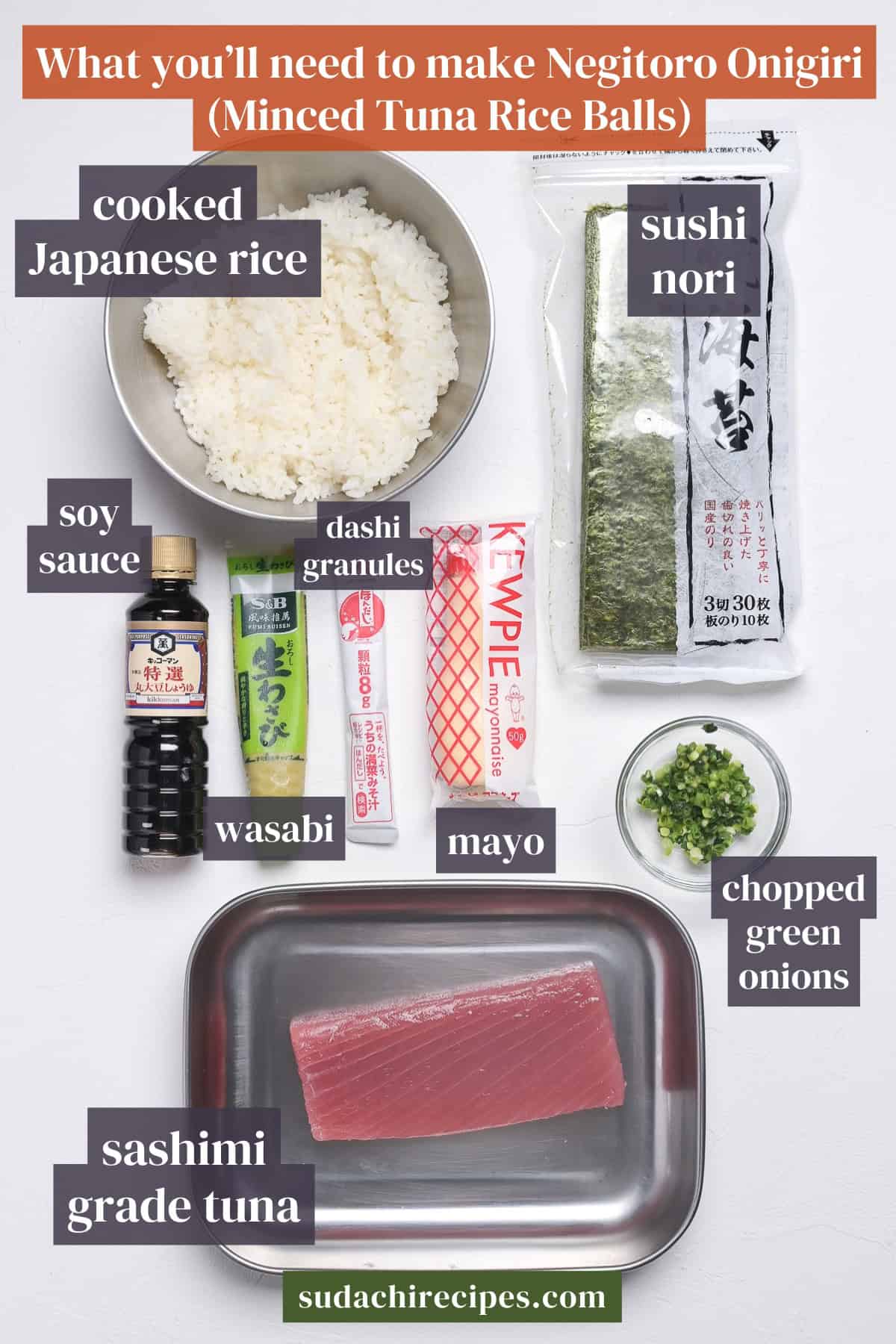
- Sashimi-grade lean tuna: Choose the cheapest block of lean tuna available, provided the label clearly says it is safe to eat raw. In US stores, look for yellowfin or bigeye. Both may be labeled ahi. You can also use sashimi-grade albacore, although its paler color and softer texture make a different filling.
- Japanese short-grain rice: Japanese short-grain is my choice. If you can’t get it, California-grown Calrose, a medium-grain rice, is the only substitute I’d use. I don’t recommend long-grain rice. Calrose can be shaped into rice balls, but the surface doesn’t hold together quite as well, allowing the filling to move around more. In a survey we conducted of Japanese people living abroad, one Ohio respondent reported buying Botan at Walmart. For a respondent in New York, a Japanese grocery store was the source of their Nishiki.
- Japanese mayonnaise: Along with the oil, this gives lean tuna its moist, silky texture. Egg yolks, rather than whole eggs, give Japanese mayonnaise a deeper, richer flavor.
Substitutions, Variations, and How to Customize
There are only a few substitutions I’d suggest for this recipe, with one list for ingredients you can’t find and a set of variations that give the filling a different flavor.
Substitutions:
- Sashimi-grade lean tuna → Opah (moonfish): If you’re not going to soup it up with mayonnaise and oil, I think opah makes much better negitoro than lean tuna. Its natural fat means it can need less mayonnaise and oil. Of course, buy it only when the label explicitly says it is safe to eat raw.
- Japanese short-grain rice → Korean short-grain rice: Can’t find Japanese rice? Korean short-grain comes closest in flavor and texture.
- Japanese mayonnaise → American mayonnaise: Whole eggs give American mayonnaise a paler color. It will still hold the lean tuna together, though you won’t get the flavor of Japanese mayonnaise.
- Dashi granules → A bit of MSG: A little MSG supplies the same direct lift of umami. I treat it as a seasoning like any other. Omitting both means losing that extra layer of flavor.
- Green onions → Chives: A scattering of finely chopped chives makes a good, milder topping. Avoid garlic chives, which are a different vegetable.
- Wasabi → Use less, or skip it: Use a smaller amount if you prefer, or leave it out altogether if you don’t like it.
Substitutions that I don’t recommend:
- Tuna steaks with no raw-eating label instead of a sashimi-grade block: The packaging doesn’t confirm that the fish is intended for eating raw, and the fish itself may not be what you expect. As a basic rule, never use fish without a clear label saying it is safe to eat raw.
- Canned tuna instead of sashimi-grade tuna: Add mayonnaise to canned tuna and you’ve made tuna mayo, a different kind of onigiri.
Missing a different Japanese pantry item? There are more swaps in my guide to Japanese ingredient substitutes.
Variations:
- Salmon negitoro: Use the same chopping method with sashimi-grade salmon labeled for eating raw, then mix in mayonnaise to bind it. This filling is also sold in Japan as salmon negitoro. Salmon’s own richness and fat mean mayonnaise is essentially all it needs, so you can leave out the oil.
- Old-school chop-only negitoro: Fatty tuna meat from near the bone needs only chopping to become the filling. If you can find it, you can make negitoro without either mayonnaise or oil.
How to Customize:
- Toro-taku with pickled daikon: Chopped takuan, Japanese pickled daikon radish, gives the filling a crisp crunch when mixed through.
- Shiso: Before shaping, place a single shiso leaf beneath the filling. This Japanese herb, also sold as perilla, adds a fresh aroma.
- Toasted sesame oil: Using this instead of neutral oil brings a toasted, nutty flavor reminiscent of yukhoe, a Korean raw beef dish.
- A little heat: Red chili powder takes the filling toward spicy tuna. Choose either chili or wasabi, as their heat competes.
How to Make My Negitoro Onigiri
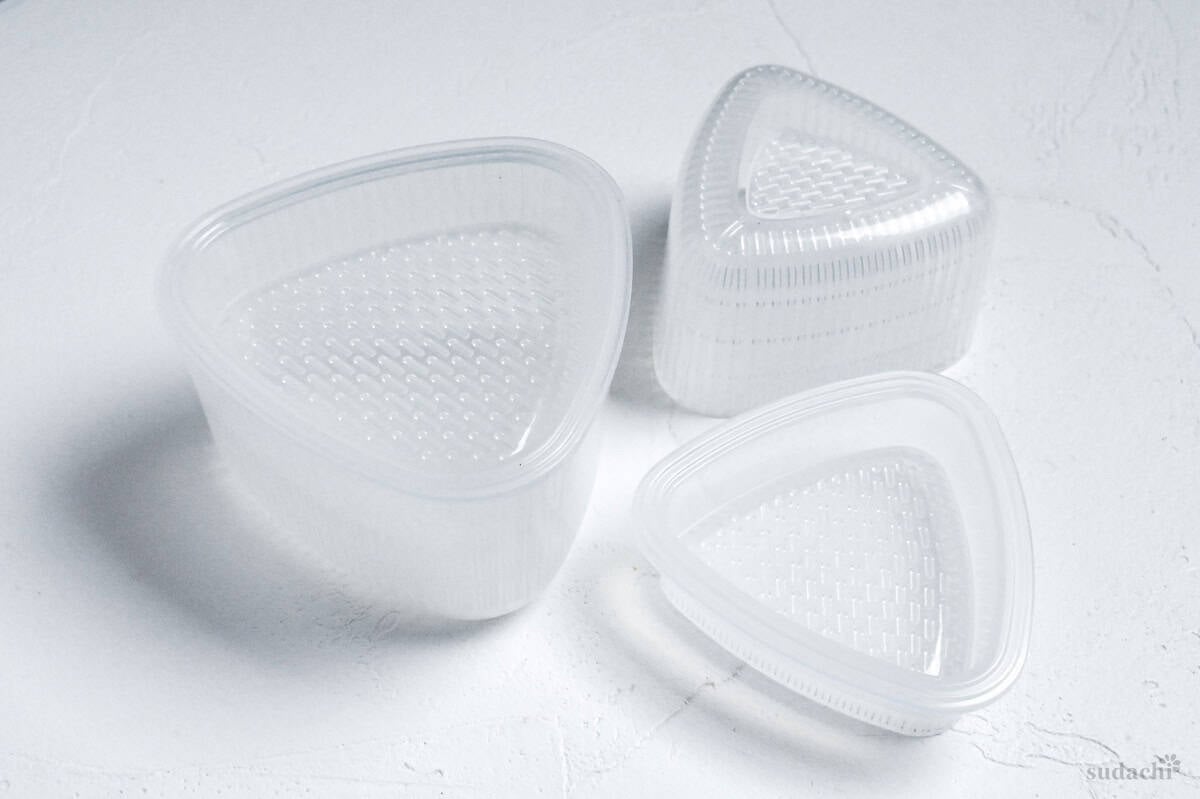
To develop this recipe, I used an onigiri mold.
i. Briefly rinse the tuna block in cold water, then dry it with paper towels.

ii. Coat it lightly and evenly with salt. Place it in a container tilted up at one end and refrigerate for 10 to 15 minutes, so the released liquid collects at the lower end. This is called “shiojime”.

iii. Wash away the salt with cold water and pat the block completely dry.

Shiojime is a salt cure used to prepare sashimi-grade fish. A light sprinkling of salt and a short rest draw out excess moisture, leaving the flesh firmer. Removing some of that water concentrates the flavor and reduces any fishy smell. Japanese fishmongers suggest this extra preparation to improve supermarket sashimi, but it’s optional.
i. Use a spoon to scrape the flesh from the tuna block.

ii. Roughly mince the scraped flesh with a knife.

iii. Put the tuna in a bowl and stir in the mayonnaise, oil and dashi granules until everything is evenly mixed.

Simply chopping lean tuna leaves it dry, with a texture that isn’t quite smooth and a dominant iron-like flavor. The result tastes one-dimensional. Mayonnaise, oil and dashi granules fix all of that.
i. Separate the cooked rice into 4 equal portions.
ii. For an onigiri mold, sprinkle a pinch of salt into the mold, then add half a portion of rice. Make a small hollow in the rice and add a spoonful of negitoro.

iii. To shape onigiri by hand, dampen your hands with water and spread a pinch of salt over your palms. Flatten a portion of rice across one palm, then put the filling in the center.
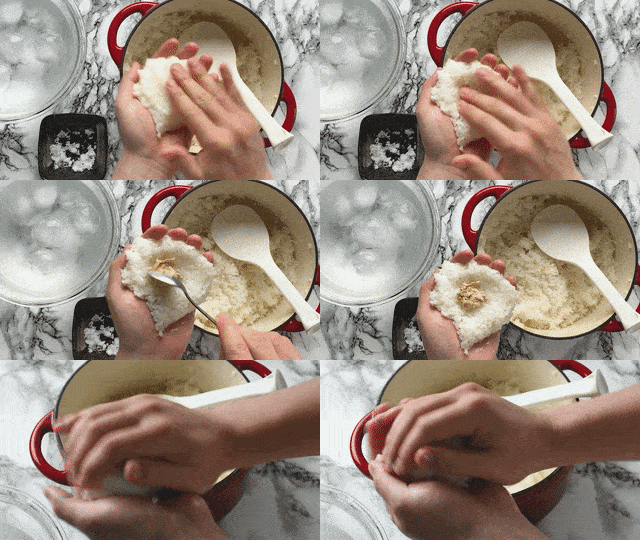
iv. Add a little wasabi and chopped green onion on top of the tuna, followed by one drop of soy sauce.


i. If using a mold, add the remaining half portion of rice over the filling and sprinkle with a pinch of salt. Press with the lid to form the rice ball.


ii. If shaping by hand, bring the rice up around the filling to cover it completely. Press between your palms to form a triangle with rounded corners.

iii. Wrap in nori and eat right away. Freshly wrapped nori has the crunch that best sets off the soft rice and creamy center.
If you follow the default recipe, it will make 4 rice balls.

Tips for the Best Negitoro Rice Balls
- Use a spoon to separate the flesh from the white sinew. A tough white strip sometimes runs along the back of lean tuna blocks. Raw, it is hard to chew through and can leave a stringy thread in your mouth. Scraping off just the flesh lets you leave that sinew on the block.
- Shape the rice while it still feels slightly warm. Fully cooled rice loses its stickiness and is harder to shape, but steaming rice begins cooking the tuna’s outer surface. Aim for a faint warmth against your palm.
- Serve freshly made and leave these out of the freezer. Some onigiri can be frozen in advance, depending on the filling, but these can’t. Freezing causes the mayonnaise to separate and leak into the rice. Previously thawed tuna shouldn’t be frozen again either.
Leave out the excess water and sinew, use rice with a little warmth left in it and eat straight away, and even the cheapest lean tuna filling stays as creamy at the first bite as it was in the bowl.
What to Serve With Negitoro Onigiri
- Hearty Tonjiru (Pork Miso Soup)
- Dashimaki Tamago (Rolled Omelette)
- Spinach Ohitashi
- Quick-Pickled Napa Cabbage (Hakusai no Asazuke)
Negitoro Troubleshooting
Excess moisture in the filling can turn the rice red and make the rice ball lose its shape. It usually comes from thawing liquid mixed in from the tray or moisture left on the tuna after drying. Before shaping any more, gently blot the remaining filling with paper towels. Add just one drop of soy sauce on top, and do not add any extra oil to the filling.
The tough sinew along the back of the tuna block has been chopped into the flesh. Spread the mixture in a thin layer on a plate and remove the white strands with chopsticks. Then carry on shaping the rice balls.
Moisture from a watery filling travels through the rice and into the nori, softening it. Nori also loses its crispness the longer it stays wrapped around rice. Remove the soggy piece and replace it with a fresh strip just before eating. For a batch of rice balls, wrap each one as you’re ready to eat it.

More Japanese Rice Recipes
- Flaked Salmon Onigiri
- Lawson-Style Devil’s Onigiri
- Kombu Tsukudani Rice Balls
- Okaka Bonito Flake Onigiri
You can make the salmon and kombu rice balls from Japanese convenience store shelves at home too, and they’re all in my Japanese Rice Recipes.
Did You Try This Recipe?
I would love to hear your thoughts!
💬 Leave a review and ⭐️ rating in the comments below. 📷 I also love to see your photos – submit them here!

Negitoro Onigiri (Minced Tuna Rice Ball)

Ingredients
- 60 g sashimi grade tuna block
- salt
- ½ tbsp Japanese mayonnaise
- ½ tsp cooking oil
- ⅛ tsp dashi granules
- 440 g cooked Japanese short-grain rice warm (not hot)
- wasabi
- finely chopped green onions
- Japanese soy sauce (koikuchi shoyu)
- 4 strips roasted seaweed for sushi (nori)
The ingredient brands and tools I trust are in my Japanese pantry guide and my cooking tools guide.
Can’t find certain Japanese ingredients? See my substitution guide here.
Instructions
- Optional step for improved texture & flavor: Shiojime. Wash and dry 60 g sashimi grade tuna block, then sprinkle with salt all over and place it in a container. Store the container in the fridge for 10-15 minutes with one side elevated to drain the excess moisture. Wash off the salt and pat the surface dry with kitchen paper.

- Use a spoon to scrape the tuna flesh.
- Chop with a knife until it becomes roughly mashed.
- Place the mashed tuna in a bowl and add ½ tbsp Japanese mayonnaise, ½ tsp cooking oil and ⅛ tsp dashi granules. Mix until evenly distributed.
- Measure out 440 g cooked Japanese short-grain rice and divide it into equal portions. If using a rice ball mold, sprinkle a pinch of salt into the mold and add half a portion (approx 55g / 2oz) of rice. Make a dent in the center and add a spoonful of mashed tuna.
- If shaping by hand, wet your hands and sprinkle them with a pinch of salt. Take a portion of rice (approx 110g / 4oz) and spread it flat on your palm, placing a spoonful of mashed tuna in the center.

- Top the tuna with a small blob of wasabi and a few finely chopped green onions. Add 1 drop of Japanese soy sauce (koikuchi shoyu).
- For the mold, add the other half of the rice on top and sprinkle with a pinch of salt. For hand-shaping, fold the rice over and then shape into a rounded triangle.
- Wrap with nori and serve right away. Enjoy!


Leave a rating and a comment