

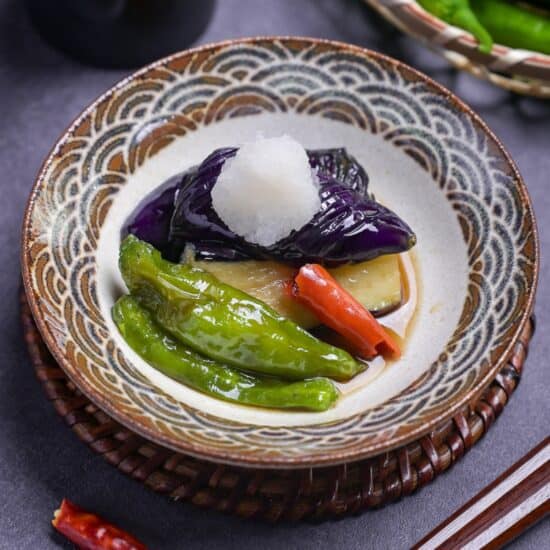


Fry the eggplant in oil. Pour boiling water over it to rinse that oil away. Then let it soak in dashi.
You are probably wondering why. For a long time I thought these were just fussy extra steps. Now I see it the other way around. Every one of these roundabout steps has a reason, and the reasons are too big to wave off. So I skip none of them, because agebitashi made without skipping a step is one of the best side dishes I know.
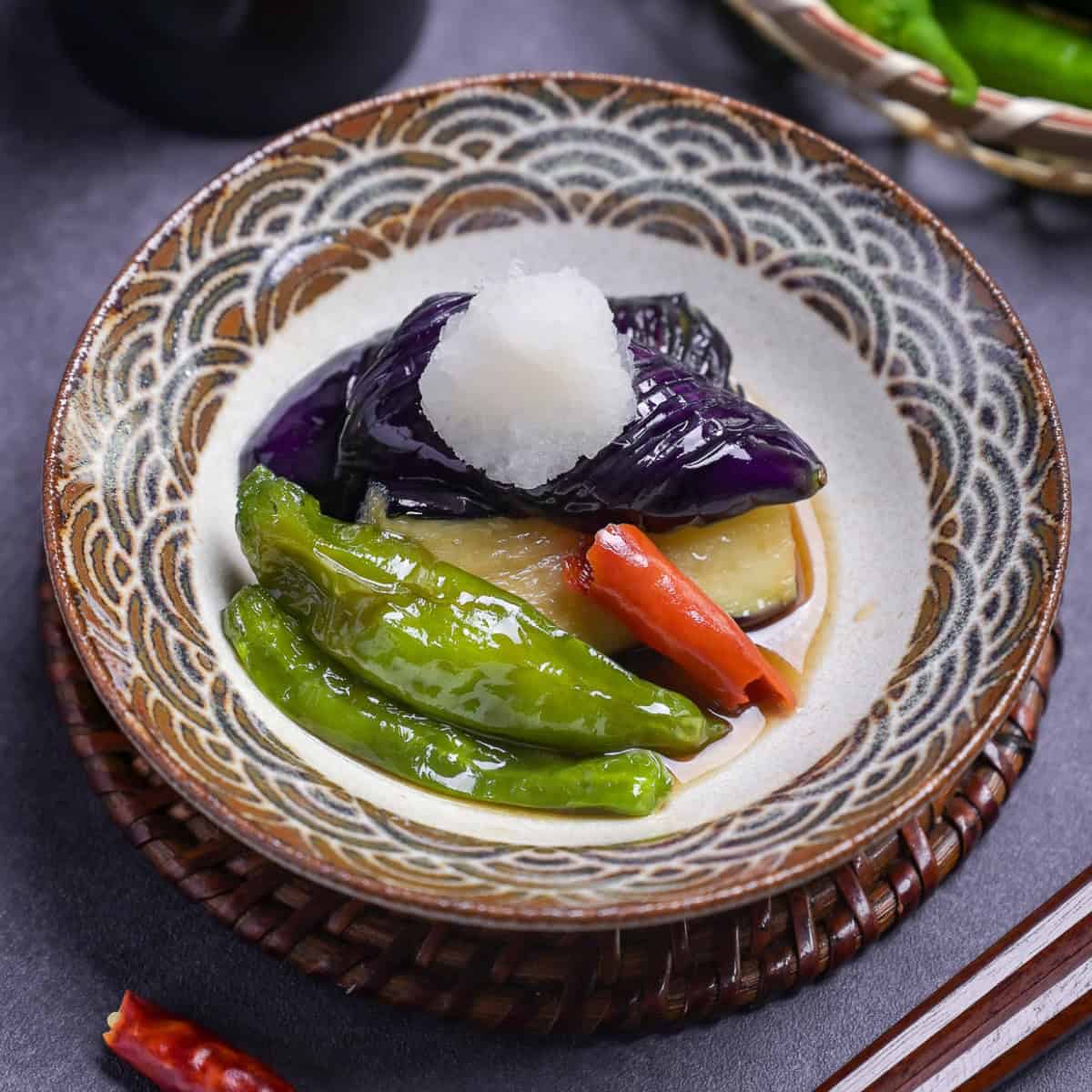
Nasu no Agebitashi
Recipe Snapshot
- What is it? Nasu no agebitashi is eggplant fried without batter and chilled in a dashi-rich soy sauce broth. Japanese cooks make it ahead all summer and autumn, and izakaya serve it too.
- Flavor profile: The eggplant flesh gives way instantly, its oil flooding out with the dashi before the soy sauce and mirin land. The skin alone holds firm and breaks up that softness.
- Why this recipe works: The broth cools before frying, so hot eggplant pulls it in. Just a pour of boiling water strips surface oil and leaves the oil inside. Only a sponge does both.
- How to make it: Boil and cool the broth, fry the scored eggplant, pour boiling water over it, and chill it in the broth. Light and cold, that broth lays your dashi bare.
- What to expect: This agebitashi takes 45 minutes (10 prep, 5 frying, 30 chilling). Ready once chilled, deeper in flavor but paler the next day. The one catch is oil temperature.
Summarize & Save this content on:
What Is Nasu no Agebitashi?
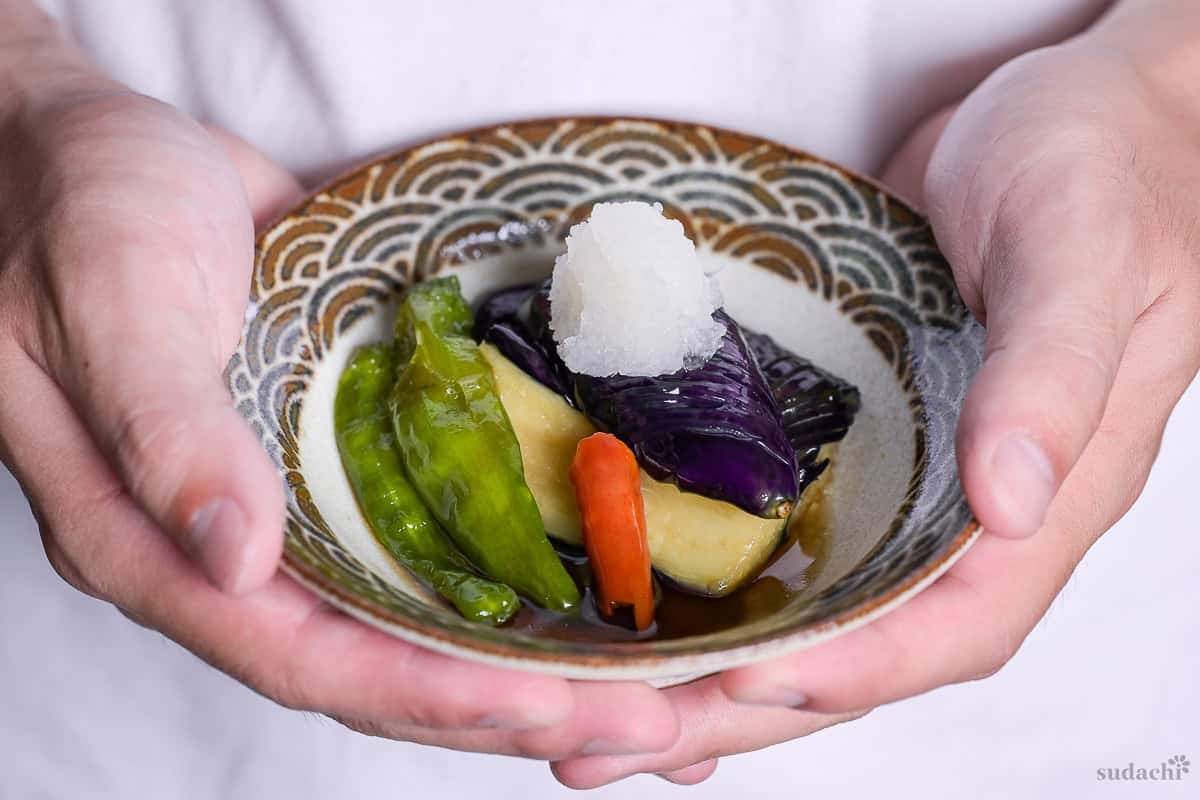
Nasu no agebitashi is a summer staple among Japanese home side dishes. The name says it. You fry, then you soak, and nothing gets simmered. The eggplant is fried with no batter, then chilled in a broth of dashi, soy sauce and mirin. The flesh turns meltingly soft while the skin keeps a little bite.
Agebitashi is also the name of the technique, so it is not limited to eggplant, which is just the best-known version. Agedashi nasu sounds close and is a different dish. It is coated in potato starch, fried, and served at once under hot broth.
Soaked dishes are old. The word hitashimono shows up in written records in 1517, for vegetables that are prepped and then steeped in a seasoned liquid to take on flavor, and agebitashi belongs to that family with plain deep-frying (suage) added on top. No primary source can say who made it first or when. What can be said is that once cooking oil became an everyday thing in home kitchens in the modern era, the easy match of eggplant and oil settled into this old culture of soaked dishes, and no particular feudal domain or restaurant can claim it as its own creation.
I make the broth first, before anything goes into the oil. The dish is served cold, so I give the broth its cooling time up front, which means what meets in the pot is hot eggplant and broth that has already cooled. I also pour boiling water over the fried eggplant, and I never skip that. In a recipe this simple, doing each step with care is what pays off.
Eggplant Agebitashi Ingredients
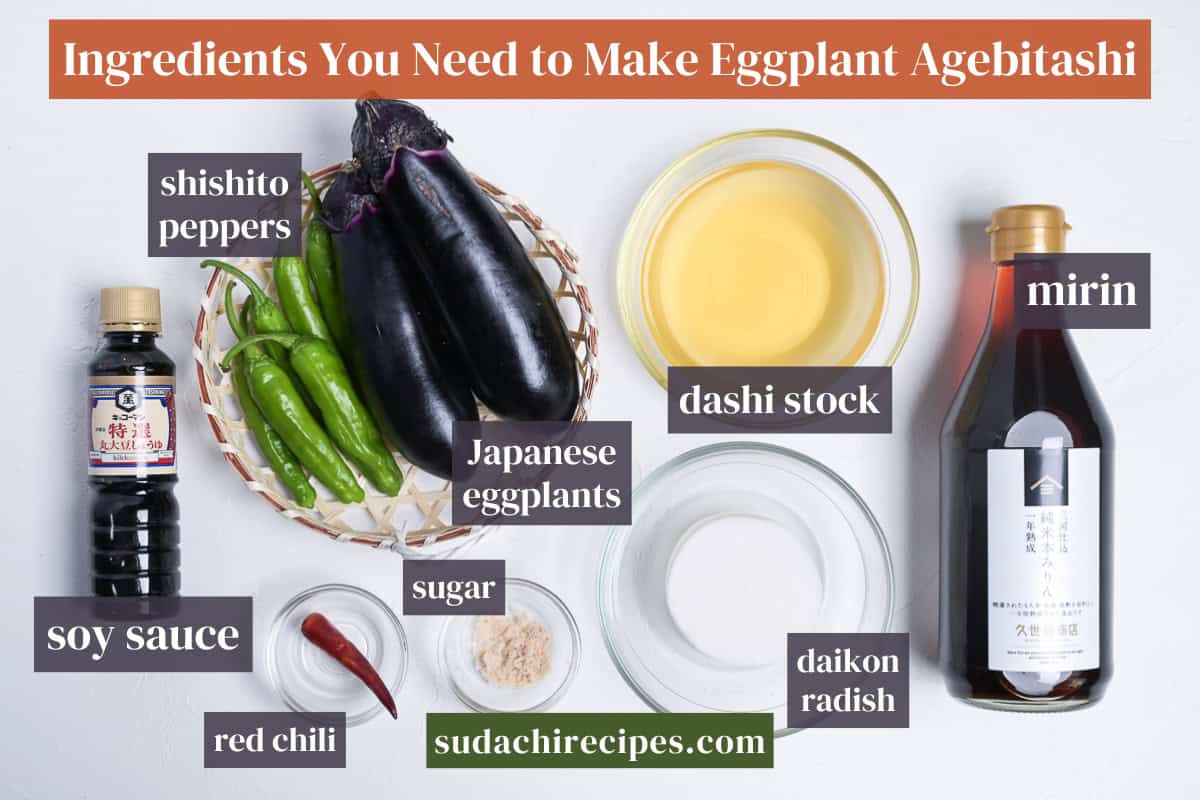
- Japanese eggplant: Look for long, slim eggplants with thin skin and few seeds. At an Asian grocer they usually sit under a Japanese eggplant or Chinese eggplant label. Pick each one up and choose the ones that feel heavy for their size, with glossy skin and sharp little spines on the stem cap. My next pick after those would be Italian eggplant. Avoid globe eggplant for this recipe.
- Dashi: The broth is lightly seasoned and served cold, and the fried eggplant drinks in nothing else, so the dashi has nowhere to hide. The best, as ever, is dashi you make yourself from katsuobushi and kombu. Next come my homemade dashi packs or store-bought dashi packets. Dashi granules are fine, but remember they are the last resort.
- Frying oil: Use a neutral oil with a high smoke point. The oil seasons nothing here. It is a tool that carries the heat and lays a thin film on the cut faces, and that film keeps the purple from bleeding into the broth. Skip a fragrant oil like toasted sesame oil.
Substitutions & Variations
These are the swaps for cooking this with what you can actually find, plus other ways to use the same broth.
Substitutions:
- Japanese eggplant → Chinese eggplant: The closest swap. The skin is nearly as thin and the seeds nearly as few, so the cut and the frying time can stay as they are.
- Japanese eggplant → Italian eggplant: My second pick. It runs a size thicker, so cut the pieces smaller than usual, and only if you end up with a harsh-tasting one, run it quickly through salted water and wipe it dry.
- Dashi → kombu and shiitake dashi: The plant-based route, with no katsuobushi. It tastes gentler, and it still stands up well against oil-soaked eggplant. My vegan dashi recipe walks you through making it.
- Standard Japanese soy sauce → tamari: For when you want to avoid wheat. It tastes close to soy sauce and runs a little stronger, so taste as you add it. Coconut aminos will not give you the same flavor, though.
- Shishito peppers → skip them: They are optional to begin with. Leave them out if you have none, or if you really want something there, bell pepper works.
Variations:
- Summer vegetable agebitashi: Shishito peppers, bell peppers, kabocha squash, and zucchini fry in the same pot and soak together in the same broth. They cook at different speeds, so slice the kabocha thin and fry it first, then give the shishito a short turn at the end. They keep more bite than eggplant and take in less of the broth.
- Shallow-fried version: Pour a shallow layer of oil into a frying pan and roll the pieces around as they cook. You lose some richness and the softening might come out uneven, but the broth still soaks in the same way. For a weeknight make-ahead batch, that is all you need.
- No-fry version: Roast it in the oven or microwave it with a coat of oil. It does go soft, but you miss the fried aroma and the oil film that holds the purple in the skin. Technically I cannot call it agebitashi, but it’s an option if you avoid deep frying.
- Chicken or tofu in the same soak: Fry chicken thigh or thick fried tofu (atsuage) the same way and put it into the same broth. It is a modern make-ahead take rather than a classic dish, and on its own it makes a main.
For more swaps across the Japanese pantry, see my substitution guide here.
How to Make My Nasu Agebitashi
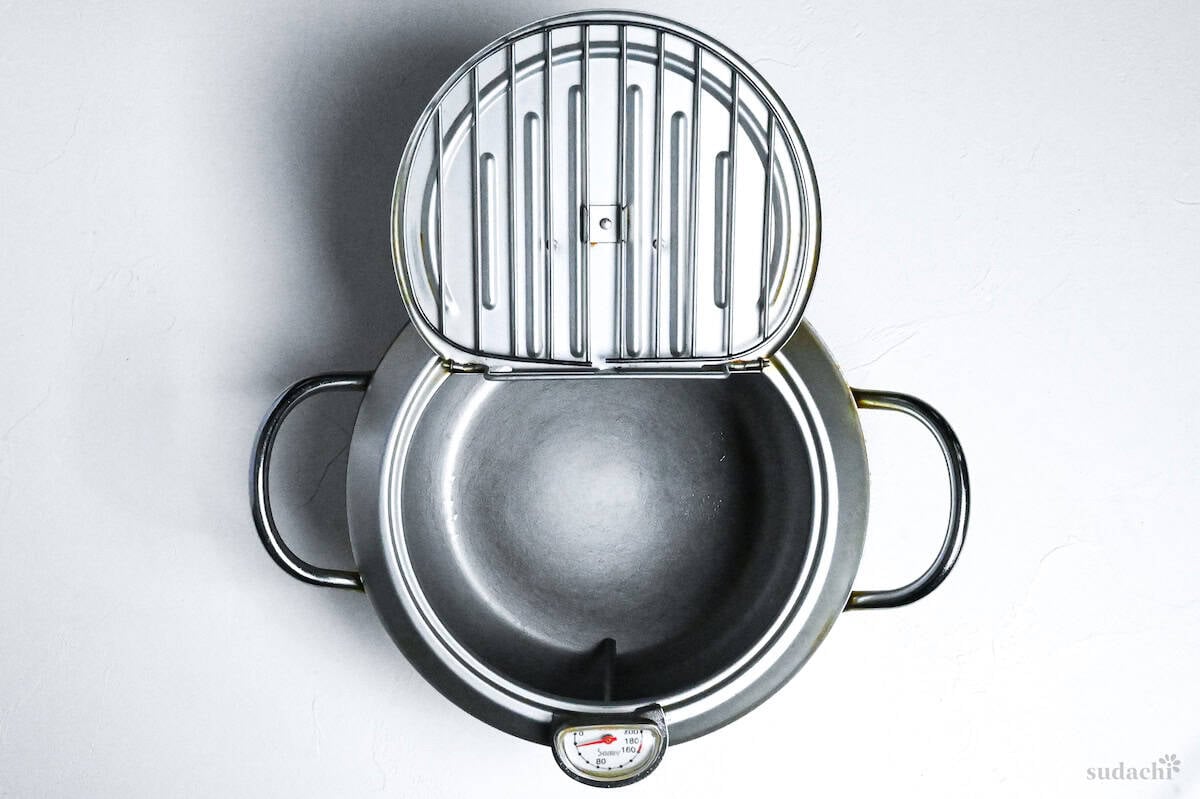
To develop this recipe, I used a tempura pot with a built-in thermometer.
i. Combine the dashi, soy sauce, mirin, sugar, and dried red chili in a small pan over medium heat.
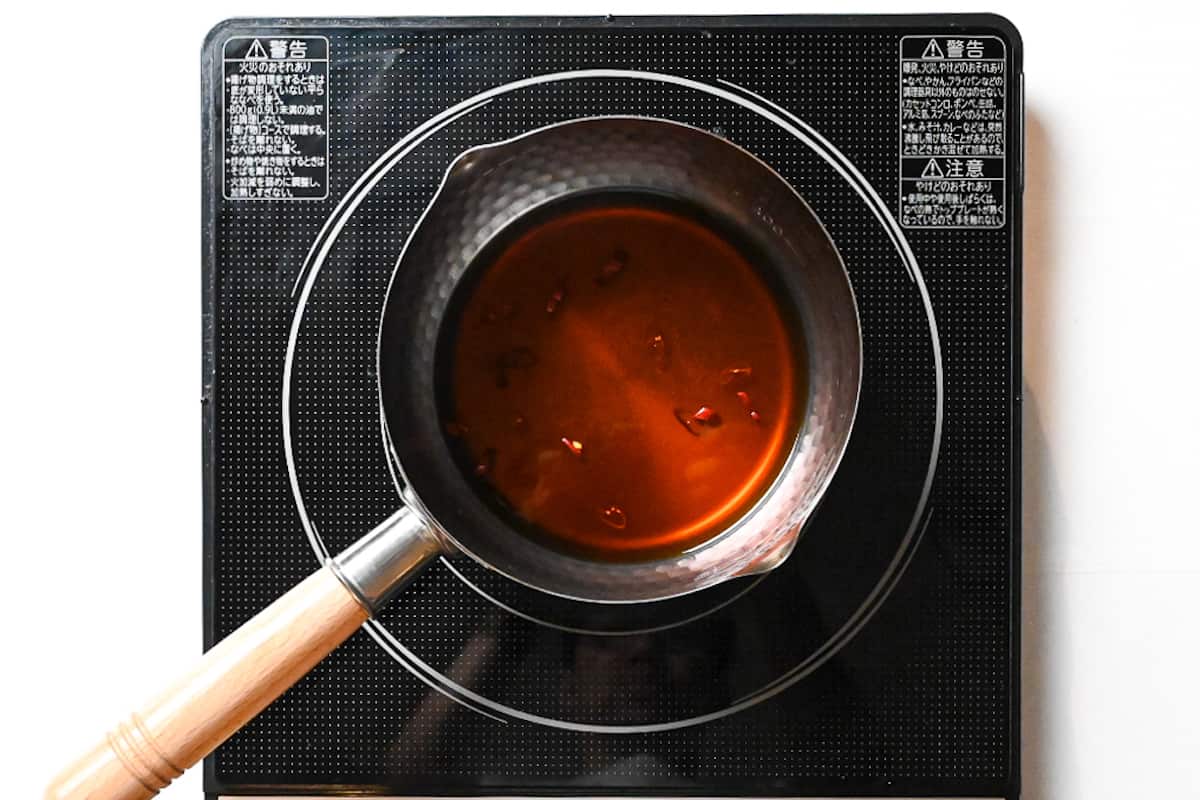
ii. Once it boils, let it bubble for 1 minute. That burns off the alcohol in the mirin and dissolves the sugar.
iii. Take it off the heat and leave it to cool. It gets made before any frying so the cooling time is already running.

i. Wash the eggplants, trim off the stems, make shallow diagonal cuts across the skin side, about 3-5mm apart.
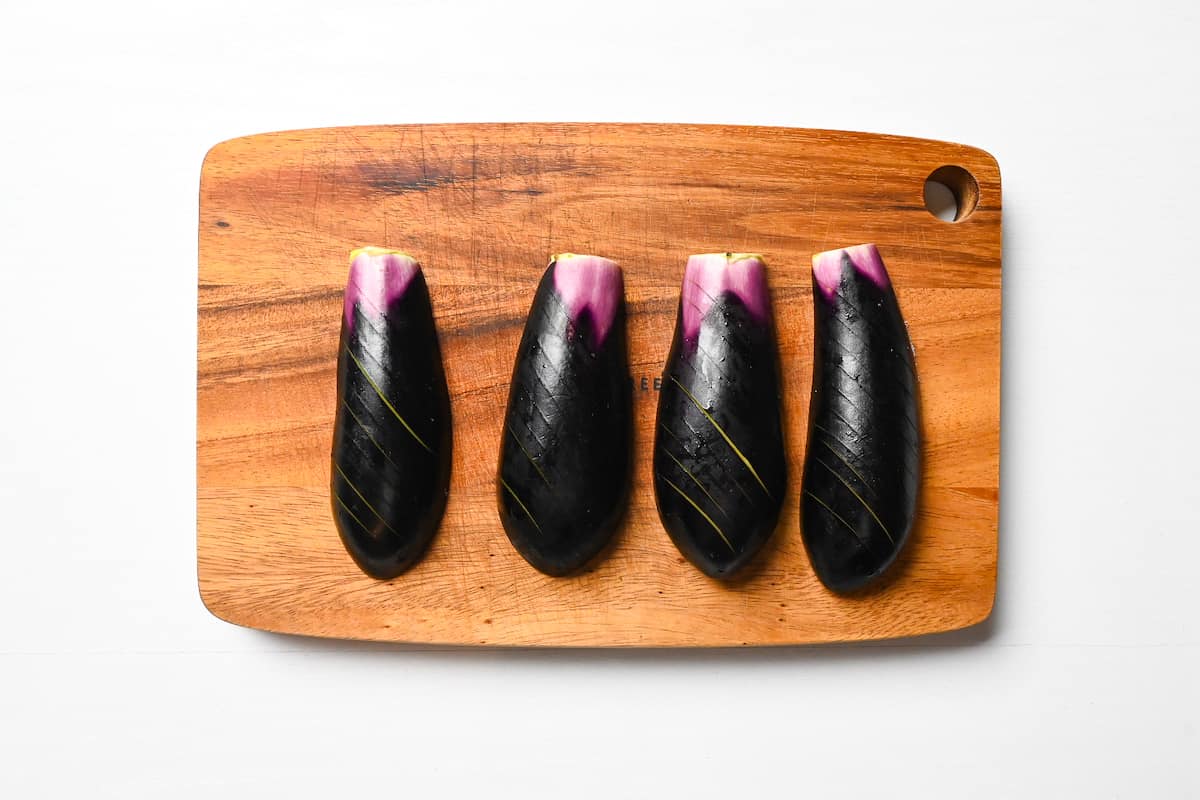
ii. And halve them lengthwise.
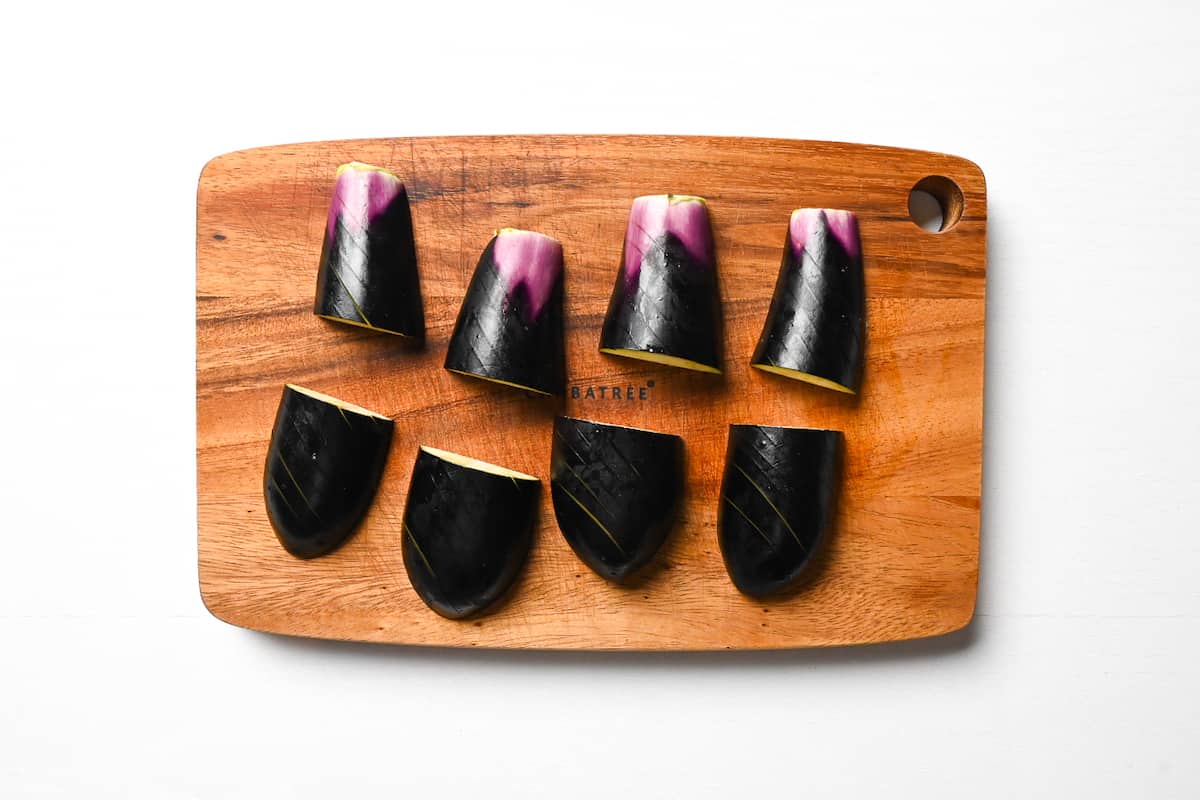
Cut small ones in half crosswise and longer ones into thirds or quarters. Leave each piece a little bigger than a bite, since it shrinks in the oil.
Tip: Cut only once the oil has started to heat. If you leave cut eggplant out in the open air for too long, they start to discolor.
iii. Cut off the shishito’s stems too.
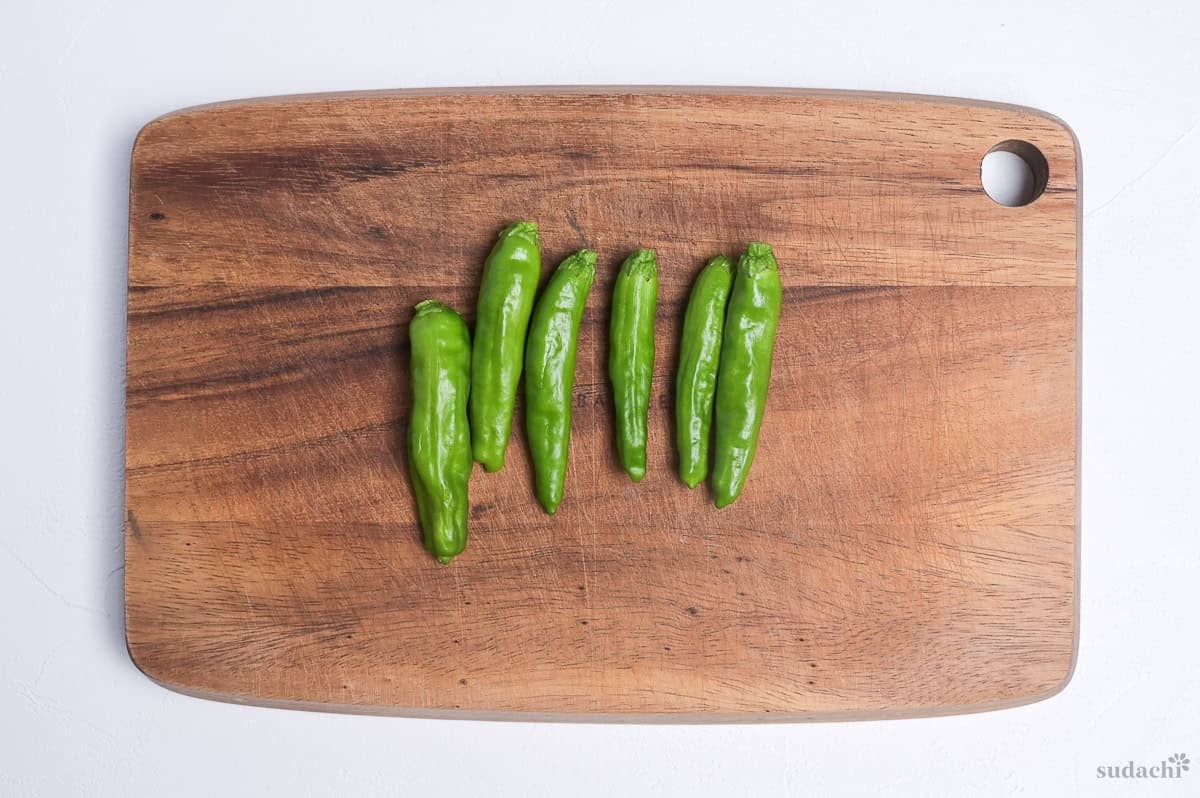
Scoring, called kakushi-bocho (隠し包丁) in Japanese, is the prep step of making shallow cuts so heat and flavor get in more easily, and it turns up often on daikon and eggplant. On eggplant the cuts go into the skin side, because the skin is tougher than the flesh and lets heat and broth through slowly, so the cuts give them a way in. With them in place the broth gets in from the skin side too, and you can cut each piece with chopsticks when you eat. It is not just a decorative pattern, it has a real purpose. Go through the skin to about halfway into the flesh. Cut deeper, or in a tight crosshatch, and the corners of the cuts scorch first in the hot oil.
i. Heat the oil to 170°C (338°F). It is at medium frying heat when cooking chopstick tips touching the bottom of the pot sends up fine, straight bubbles.
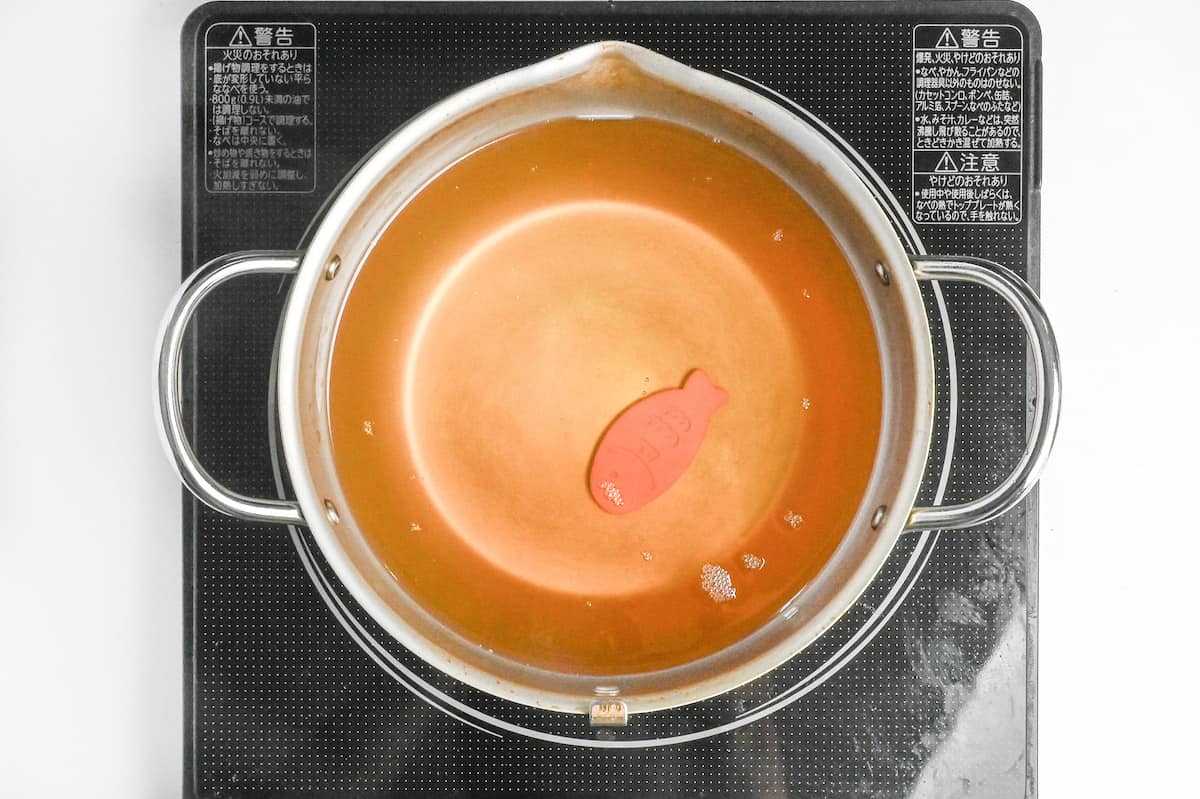
ii. Fry the eggplant skin side down for 1 minute, then 1 minute on the other side. Shishito peppers get 1 minute total. In Japanese, this is called “suage”.
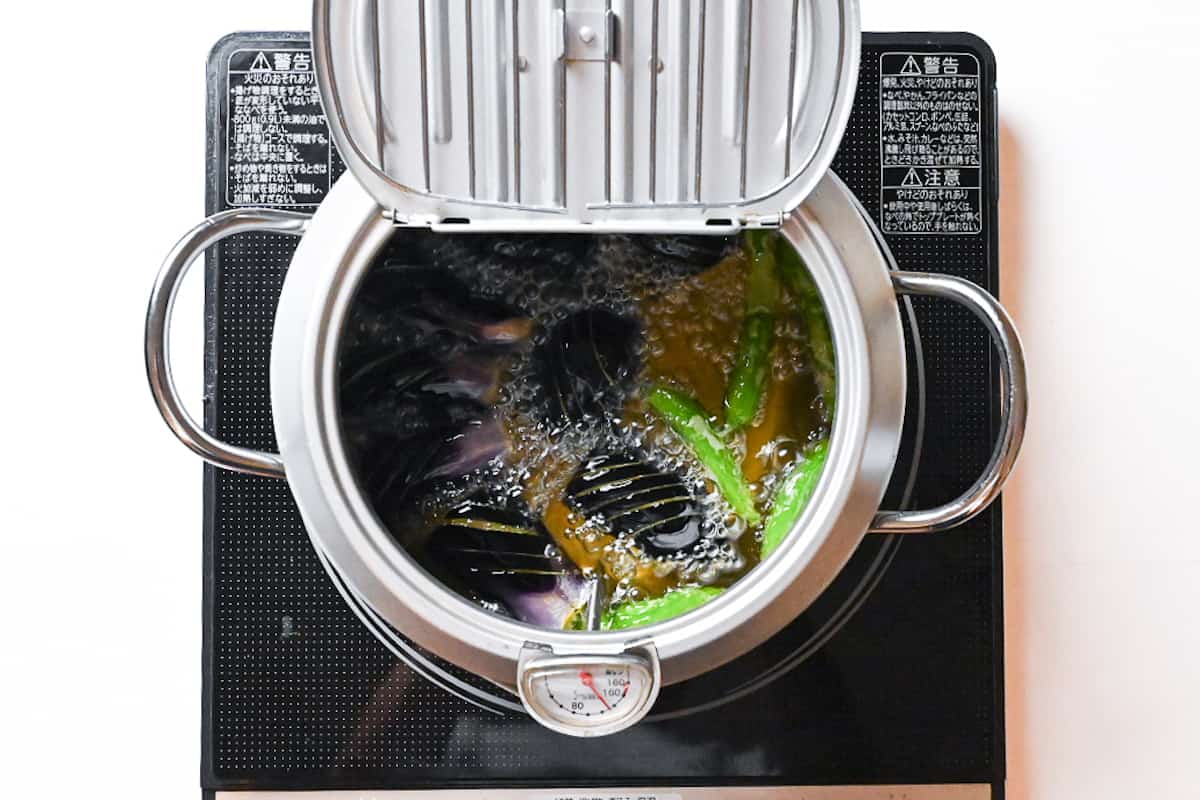
No need to crisp it through. Cell-wall pectin breaks down at 80°C to 85°C (176°F to 185°F), so heat reaching that far turns the flesh silky. Judge by feel instead of color, and lift a piece out once a chopstick pinch leaves a mark.
Eggplant flesh is a sponge of air pockets, and as heat widens the gaps between cells, oil moves in. Fry low and slow and it keeps coming in with no way out. A short hot fry will set the surface first, which prevents too much oil seeping in.
Suage (素揚げ) is frying an ingredient just as it is, with no coating at all, so there is no tempura batter, no panko, or starch like karaage. The coating stays off because the pieces go into a broth next. A coating would drink up the broth and fall apart, and it would hold on to extra oil as well, so in a dish you eat soaked it only gets in the way. Suage does not come out crisp. The surface tightens for a moment, but what you are after is melting flesh and skin with a little bite, and you want both in the same mouthful.
i. Move the pieces to a colander set in the sink or over a heatproof bowl.
ii. Pour freshly boiled water over them from above. This is a quick rinse we call “abura-nuki”. Do not let them sit in water.
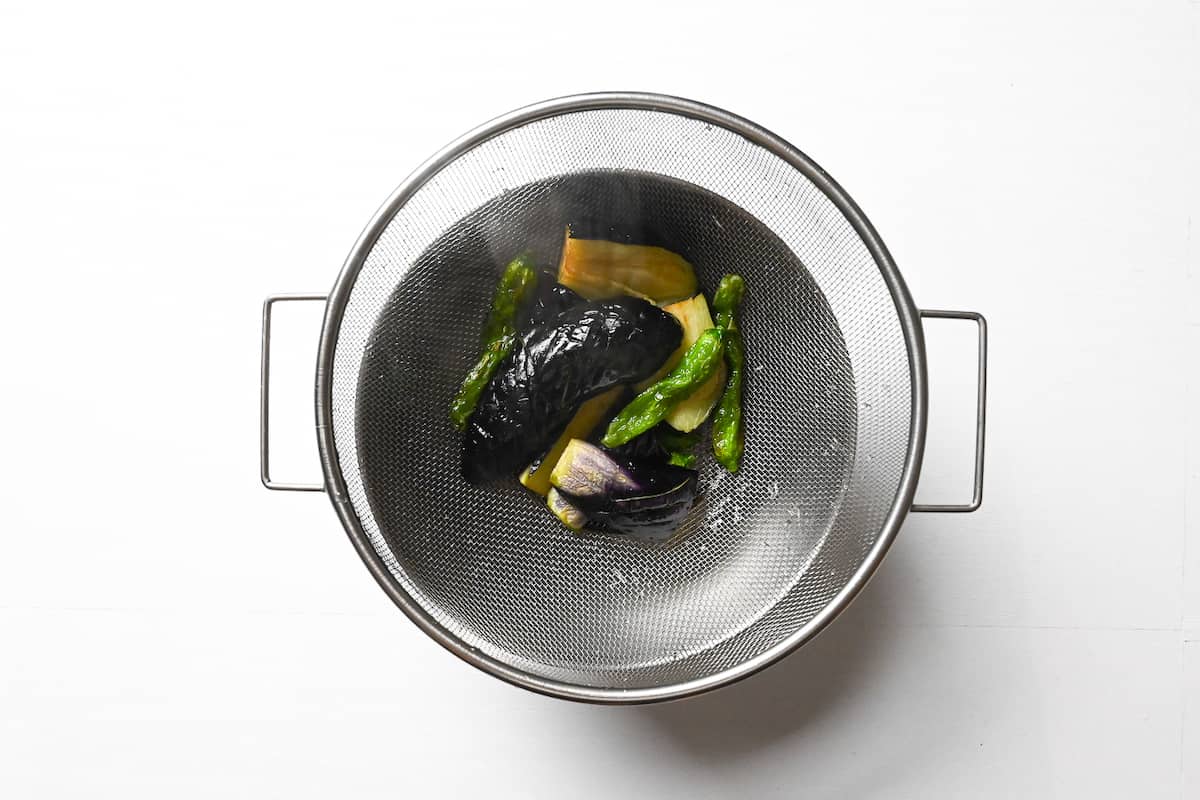
This takes off only the surface oil. The oil held inside the flesh stays, and that is the oil that spills out alongside the dashi when you bite in.
Nasunin, the pigment in purple skin, dissolves in water. Boil it, leave it sitting in water, or simmer it in broth, and the color moves into the liquid. Frying lays a thin film over the skin and cut faces, so less surface meets the water. You fry for that film. A crisp coating has nothing to do with it.
Abura-nuki (油抜き) is the prep step of taking the surface oil off fried foods or aburaage, the thin fried tofu pouches. Japanese kitchens treat it as a single verb, and it gets done by pouring hot water over, dipping for a few seconds, or pressing with paper towels. What matters is that pouring and soaking do different jobs. Leave the pieces sitting in hot water and the umami and the purple pigment leave along with the oil, while a pour takes off only the surface shine. The broth tells you whether it worked. If no film of oil spreads across its surface after the eggplant goes in, you got it right.
i. While the eggplant is still hot, sink it into the cooled broth.
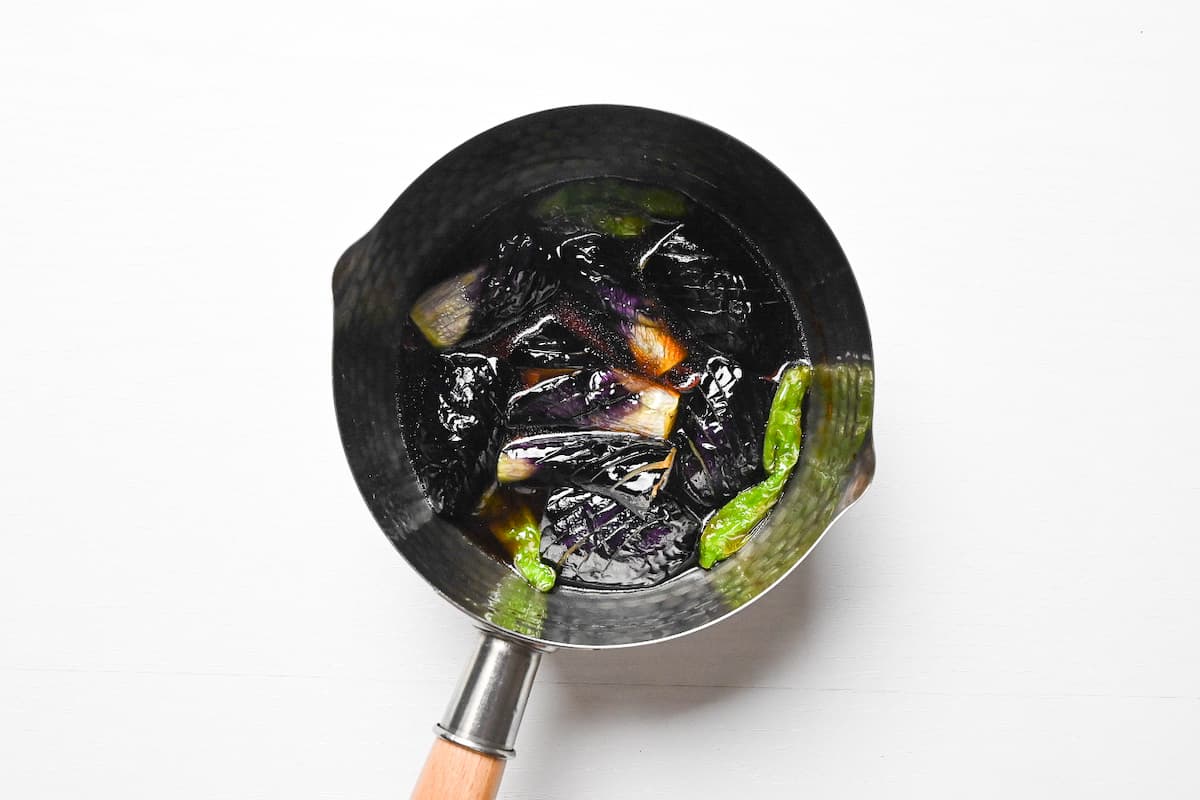
ii. Put drop lid (otoshibuta) on and soak for at least 30 minutes. If you want to use it as a make-ahead dish, transfer the content to lidded container and store it in the fridge.
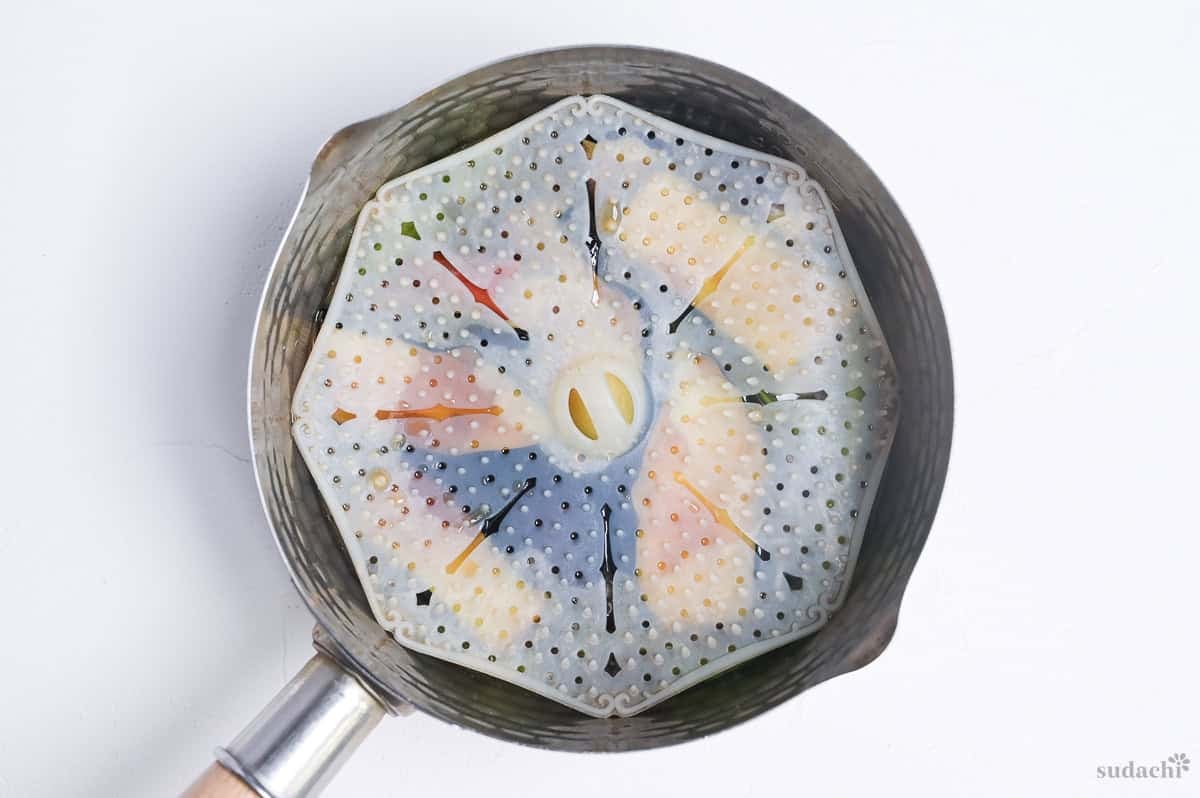
Sink freshly fried, hot eggplant into cooled broth and the broth travels right into the flesh. Let the eggplant cool first and pour the broth over, and the flavor only sits on the surface.
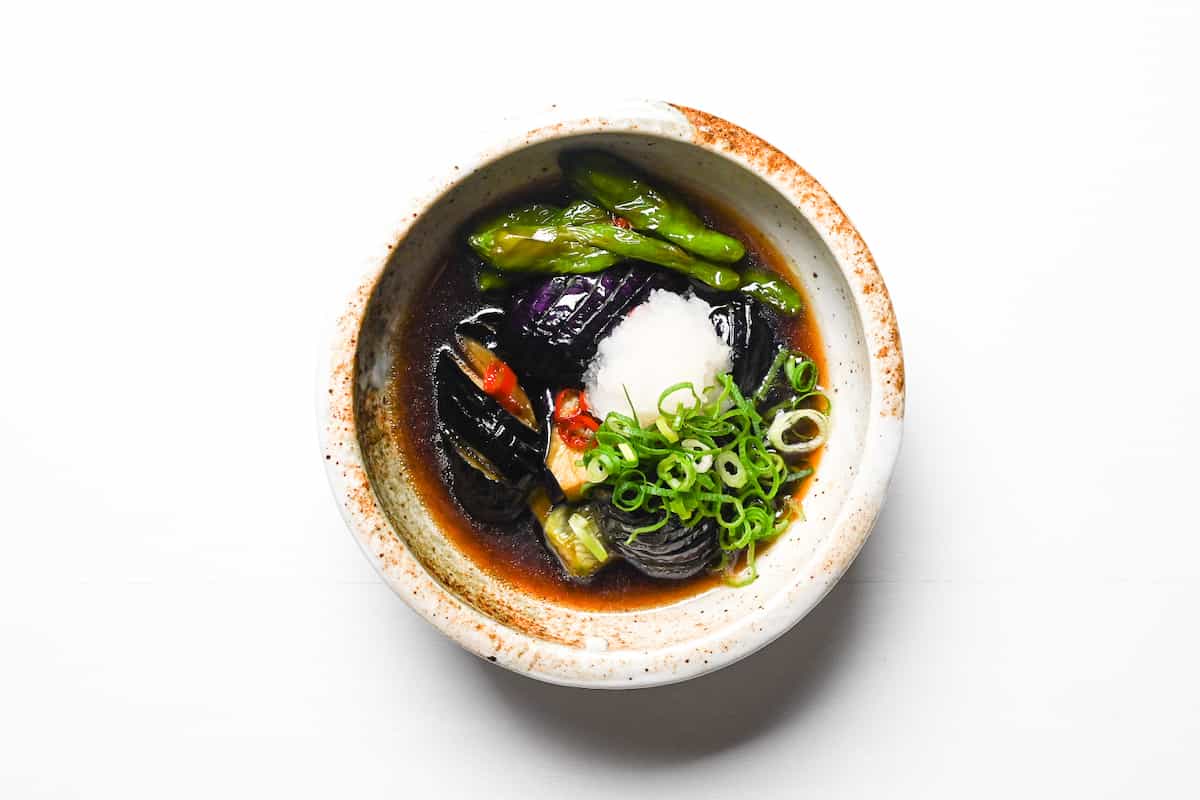
i. Dish it up, either together in a large bowl or in individual bowls.
ii. Squeeze the grated daikon lightly, pile it on top, and scatter over chopped green onions. Serve it cold, no reheating needed.

Tips for the Best Agebitashi
- When deep frying, only fill half the pot. The more pieces go in at once, the further the oil temperature falls. Fine bubbles rise around the eggplant the moment it goes in, and when those bubbles settle, the heat has dropped, so wait for them to come back before the next batch.
- Spread the fried eggplant in a single layer in the colander. Stacked pieces steam under the weight and heat of the ones on top, and the skin changes color first where the pieces touch. For larger batches, rinse in batches or use multiple colanders. Move the rinsed pieces straight to the broth as you go.
- Add the grated daikon and green onions right before serving. If you chill them in the broth, the green onion scent drifts into the liquid and fades, while the daikon lets out water and thins the broth. Store them separately and add as toppings right before you serve.
At the pot you are guarding the oil temperature, at the colander the color of the skin, and at the bowl the scent of the garnishes and the strength of the broth, each one by how you handle that moment.
Storage & Meal Prep
Fridge: Covered and submerged, it keeps 3 days. Turn any exposed pieces midway. Day 1 has the brightest purple, day 2 the deepest flavor. Toss anything sour-smelling, slimy, or moldy.
Freezer: Not suitable. The cells have already collapsed, so thawed eggplant weeps water that separates from the broth.
Meal prep: Made to wait, so cook it the night before and just plate and garnish. Serve cold or at room temperature.
What to Serve With Eggplant Agebitashi
- Steamed Japanese Rice (Gohan)
- Classic Miso Soup
- Salt-Grilled Mackerel (Saba no Shioyaki)
- Chilled Somen with Chicken and Citrus
Nasu no Agebitashi Troubleshooting
Either too many pieces went in at once and fried while the oil was running cool, or the boiling water pour after frying got skipped. If the eggplant is not in the broth yet, spread it in a colander and pour just-boiled water over it, and that still fixes it. Even after soaking, you can lift the pieces out, pour boiling water over them, skim the oil floating on the broth, and put them back. The oil sets white as it chills, so it skims most easily straight from the fridge.
Either the cut eggplant sat in water, or it went into the broth and then over the heat. Both pull the purple out into the liquid. Cut faces also turn brown if the eggplant waits after cutting. The color will not come back, but the flavor is intact, so grated daikon, chopped green onions and shiso leaves if you have them still pull the plate together. Next time, cut the eggplant after the oil has heated up and put each piece straight in, skin side down.
The scores were too shallow, the eggplant had cooled before it went into the broth, or pieces sat above the surface and never got turned. Lift them out now, score the skin again, and return them to the broth. Lay a paper towel over the top so every piece stays under, then leave it in the fridge for half a day and the broth reaches the center.
More Japanese Eggplant Recipes
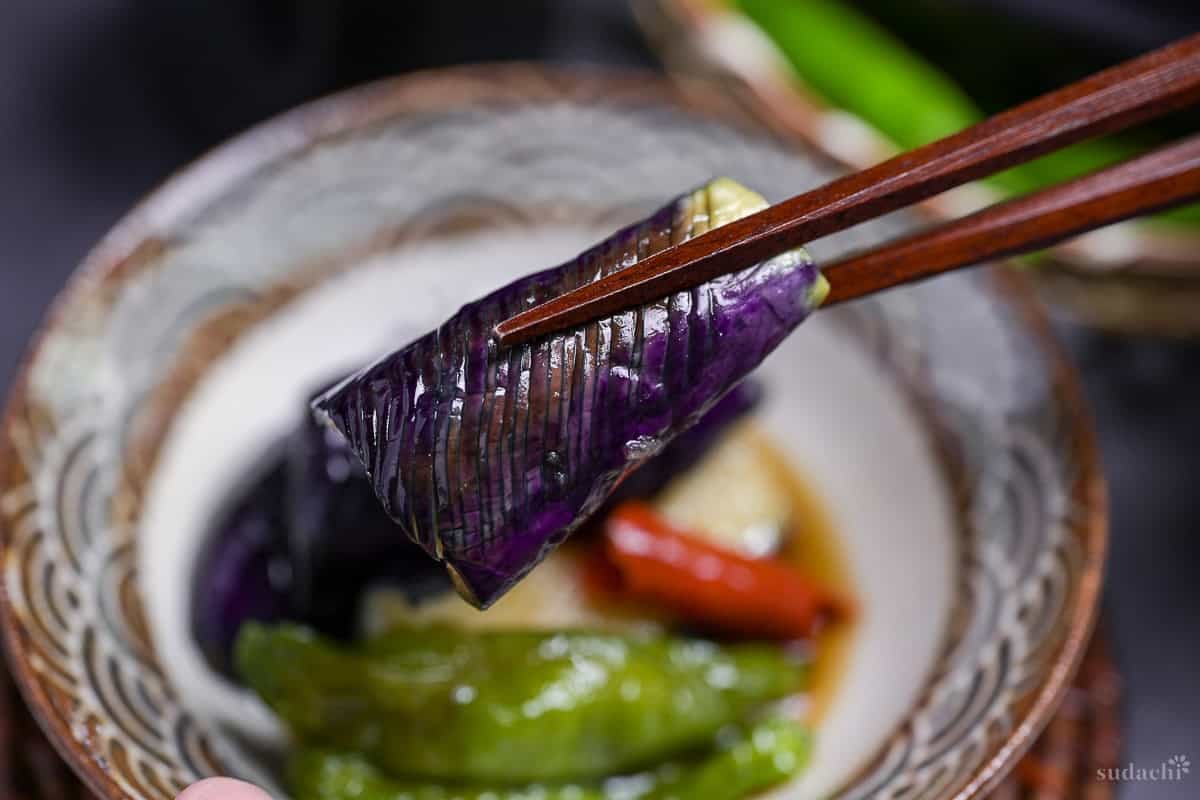
Grilled or stir-fried, the same eggplant turns into a different dish entirely, and I keep those together in my collection of Easy Japanese Eggplant Recipes.
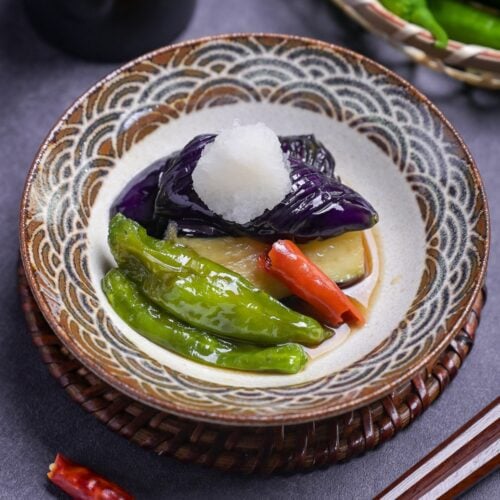
Nasu no Agebitashi (Japanese Fried Eggplant in Dashi)

Ingredients
Broth
- 100 ml dashi stock use shiitake and kombu dashi for plant-based diets
- 1 tbsp Japanese soy sauce (koikuchi shoyu)
- 1 tbsp mirin
- ¼ tsp sugar
- 1 dried red chili pepper deseeded
Vegetables
- 2 eggplants long and slim like Japanese/Chinese/Italian eggplant
- 6 shishito peppers optional
- cooking oil for deep frying, a neutral high-smoke-point oil
To Serve
- 1 tbsp grated daikon radish (daikon oroshi)
- finely chopped green onions optional garnish
The ingredient brands and tools I trust are in my Japanese pantry guide and my cooking tools guide.
Can’t find certain Japanese ingredients? See my substitution guide here.
Instructions
- Add 100 ml dashi stock, 1 tbsp Japanese soy sauce (koikuchi shoyu), 1 tbsp mirin, ¼ tsp sugar, and 1 dried red chili pepper to a small saucepan. Place on the stove over medium heat and bring it to a boil. Boil for 1 minute, then remove it from the heat and leave to cool.

- Wash 2 eggplants and cut off the stems. Cut in half lengthways and make shallow, diagonal slices across the skin side. (Each incision should be about ½ cm apart.)
- If you have small eggplants, cut them in half horizontally. If you have longer eggplants, cut them into thirds or quarters.
- Heat your oil to 170 °C (338 °F) and add the eggplant with the skin side facing down, fry for 1 min on each side. Fry 6 shishito peppers for 1 minute.
- Remove the eggplant and shishito peppers from the oil and place them in colander sitting over a large heat proof bowl. Pour boiling water over the to wash off the excess oil. Make sure they are not sitting in the hot water.
- Place the eggplant and shishito peppers in the agebitashi broth and rest on the counter top. Once cool, cover and chill in the refrigerator for at least 30 minutes.
- Divide between serving bowls and serve with 1 tbsp grated daikon radish (daikon oroshi) and finely chopped green onions. Enjoy!

In our family we grate the daikon, squeeze water out of it, and mix it into the sauce for a minute before finishing cooking the sauce.
Hi Jan,
That sounds fantastic! Such a tasty mizore-style twist! Thank you for sharing your family’s method!
Yuto
I have just made it yesterday and left to chill for 1 day in the fridge. It turned out delicious! Thank you, Yuto, for this amazing recipe.
I have tried with kombu+shiitake dashi this time, but I will definitely experiment with different dashi in the future.
I am not so sure if my green peppers were similar to shishito kind, but they also turned out very good. I have chosen not spicy peppers with thin walls.
Hi Anita,
Thank you so much for making it, and for taking the photo and sharing it. It came out really well! Thin-walled and not spicy is exactly the right call for a shishito stand-in. Thank you for writing down what you used, too. I’m in Japan, so I’ve got no way of knowing what green peppers actually turn up in shops where you are, and that detail is going to help the next reader who can’t find shishito. 🙂
Yuto