

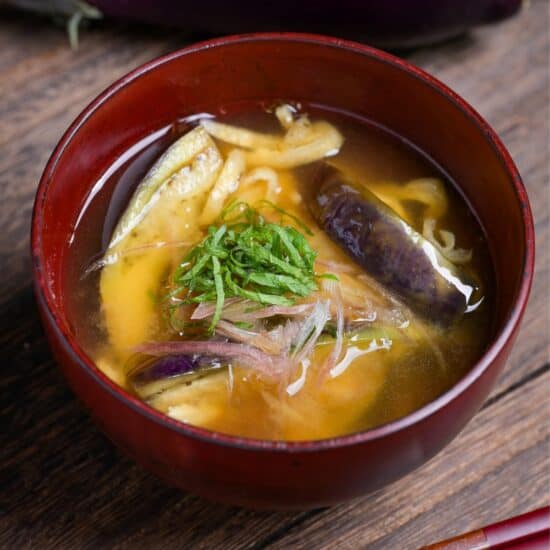


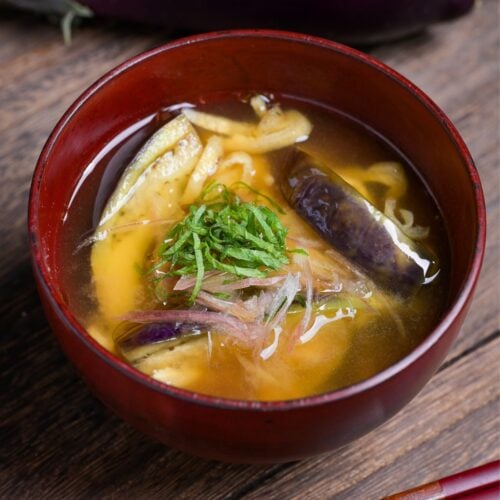
Elegant, makes sense, and designed to get the absolute best out of eggplant. That was the concept behind this miso soup recipe, and the finished product delivers exactly that.
It might be the best miso soup variation I’ve ever made. I might even prefer it over my tonjiru or chicken miso soup. One sip and you will understand why.
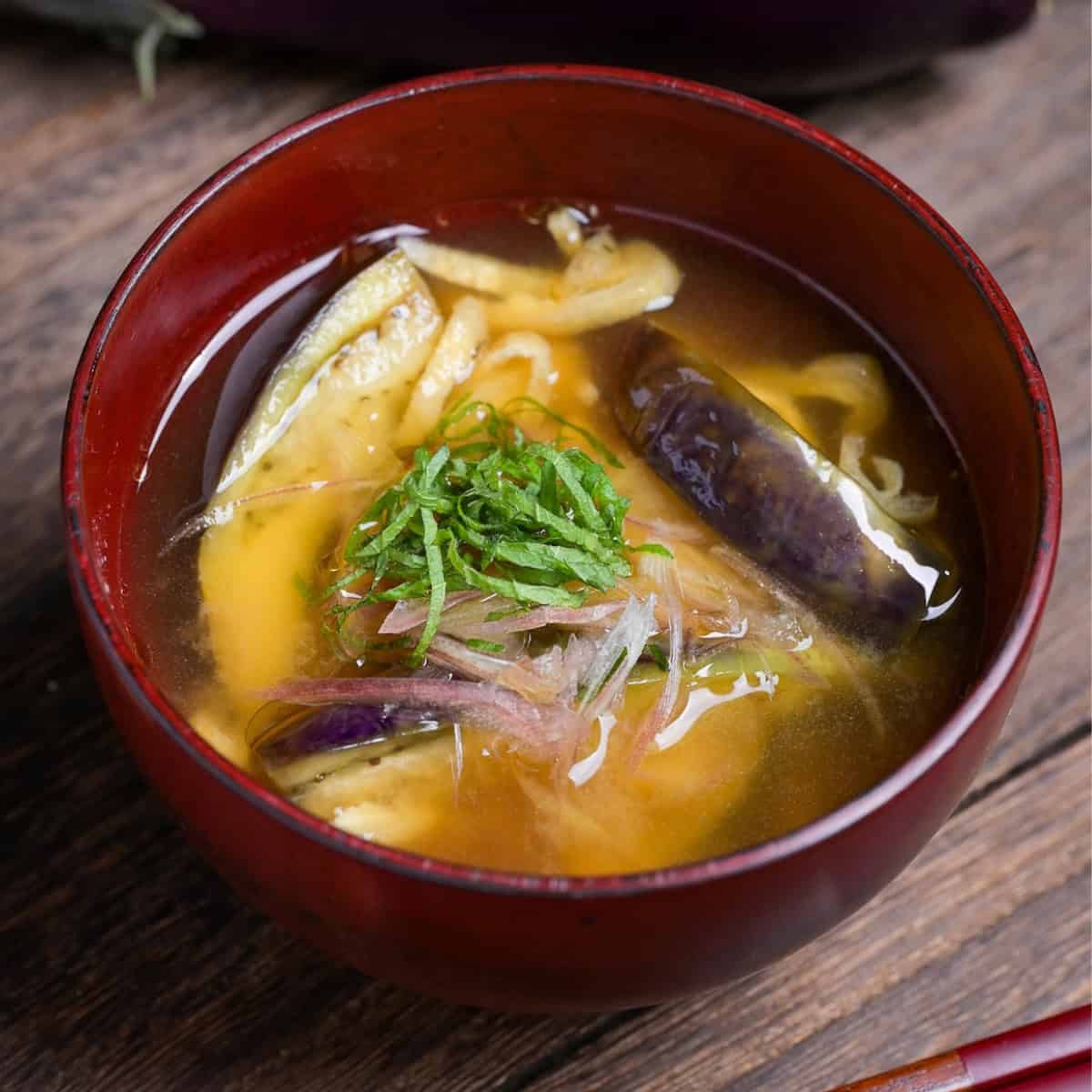
Eggplant Miso Soup
Recipe Snapshot
- What is it? A Japanese home-cooking staple: sliced eggplant sauteed in, then simmered briefly in a dashi-miso broth with aburaage, finished with myoga and shiso.
- Flavor profile: Savory, umami-forward from dashi-miso synergy, with subtle eggplant sweetness and a nutty sesame oil depth/aroma.
- Why you will love this recipe: The saute locks in the eggplant’s purple color and adds a richness most might skip entirely. You get silky, vibrant nasu instead of the gray, mushy result from boiling raw eggplant in broth.
- Must-haves: Japanese or Chinese eggplant (preferably), quality miso paste, and toasted sesame oil.
- Skill level: Easy!
Summarize & Save this content on:
What is Nasu no Misoshiru?
Eggplant miso soup, or nasu no misoshiru (なすの味噌汁), is a Japanese soup made by combining sliced eggplant with dashi stock and dissolved miso paste. In this version, the eggplant is sauteed in oil before entering the broth, a technique that preserves the skin’s purple color and adds a layer of nutty richness you don’t get from simply boiling raw eggplant.
In Japan, eggplant is the defining summer miso soup ingredient, with its popularity peaking from July through October. While it doesn’t crack the year-round top 10, nasu miso soup carries a seasonal significance that reflects the Japanese practice of eating with the seasons.
In my recipe, I pair the eggplant with aburaage for textural contrast and finish with myoga and shiso for a bright, aromatic lift. It’s a more layered bowl than a standard tofu miso soup, with that signature toro-toro (melt-in-your-mouth) eggplant texture that no other miso soup ingredient can replicate.
Eggplant Miso Soup Ingredients
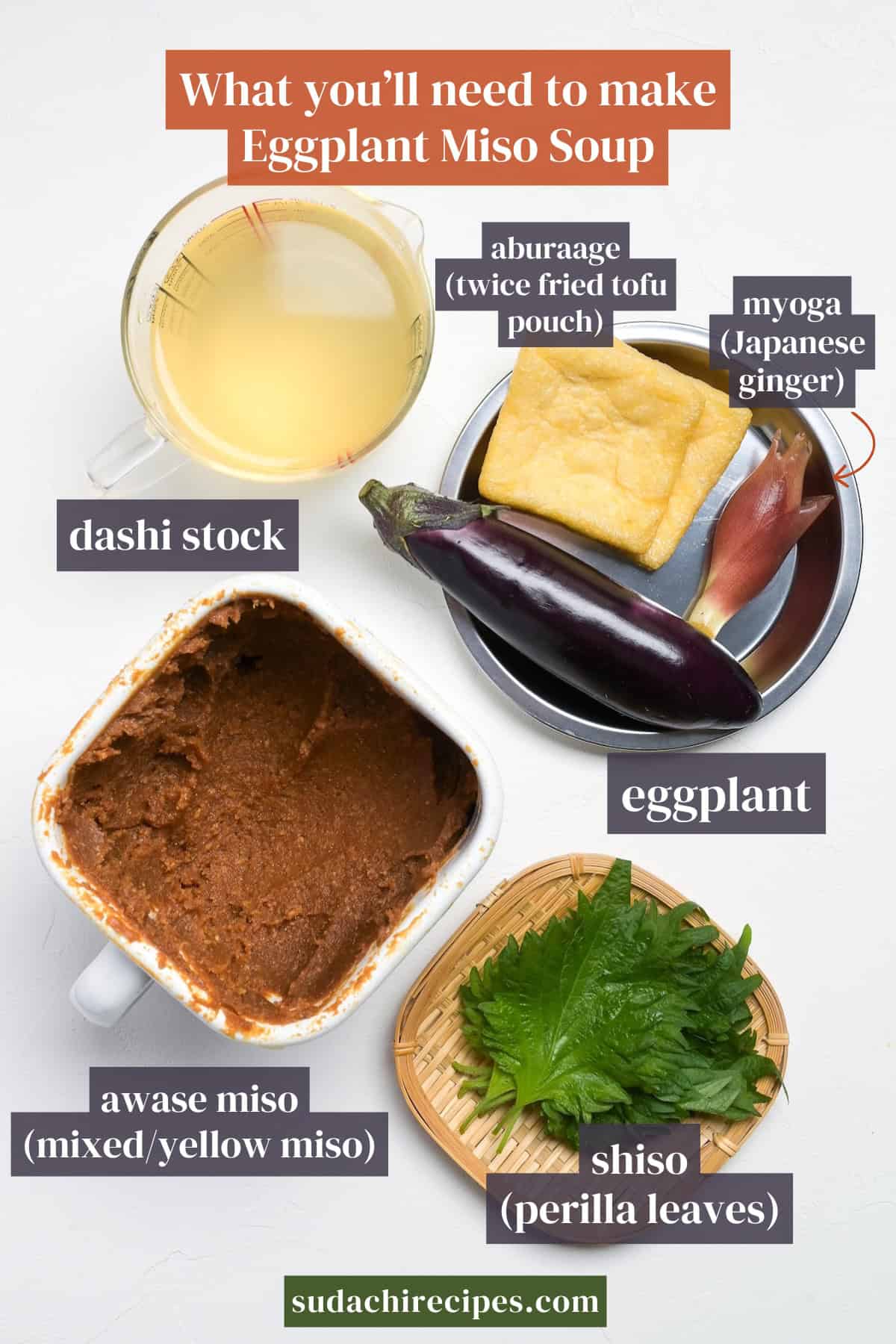
- Eggplant: Any purple-skinned eggplant works here, but Japanese eggplant is the best choice for this recipe. It has thinner skin, fewer seeds, and its flesh turns silky-soft when cooked, giving you that signature toro-toro texture. Chinese eggplant is a solid backup, slightly firmer but very similar.
- Aburaage: These thin sheets of deep-fried tofu add a chewy texture contrast against the soft eggplant, plus the rich oil they release during cooking gets absorbed by the eggplant, building depth.
- Dashi stock: Use your preferred method. Homemade awase dashi (katsuobushi + kombu) gives the cleanest, most layered result. I also strongly recommend homemade dashi packets, which are incredibly convenient. Store-bought dashi packets are a solid next choice. Dashi granules work too, but keep in mind that they contain added salt and flavor enhancers, so the taste won’t be as clean.
- Miso paste: I use awase miso (a blend of red and white, sometimes labeled “yellow” or “blended” outside Japan), but you can use whatever miso you prefer. The key thing to know is that salt content varies dramatically between types and brands, so always taste as you add. Start with less than you think you need, then adjust. There is no universal measurement for miso.
Substitution Ideas
- Japanese eggplant → Chinese eggplant is the closest substitute. Slightly firmer, but cooks beautifully in miso soup with no adjustments needed. Globe (American) eggplant works in a pinch, but you will need to peel the thick skin, salt the pieces for 15-20 minutes to draw out moisture, and cut them smaller. The texture won’t be as silky.
- Myoga → Grated fresh ginger + sliced green onions is the best combined substitute. The ginger brings a similar brightness, and the green onions add the freshness.
- Make it vegan by using kombu + dried shiitake dashi and confirming your miso paste is vegan (pure rice miso made from soybeans, rice, salt, and koji is inherently vegan). Check out my vegan dashi recipe for the instructions.
- Make it gluten-free by using rice miso, which is naturally gluten-free. Avoid barley (mugi) miso. Brands like Hikari Organic and Marukome Organic have certified GF options.
- Add tofu for more protein. Tofu cubes alongside the eggplant and aburaage make it a more substantial bowl.
Have trouble finding Japanese ingredients? Check out my ultimate guide to Japanese ingredient substitutes!
How to Make My Eggplant Miso Soup
Before you start (Mise en place):
- Cut the eggplant in half crosswise, then slice each half into 4 sticks lengthwise (or 8 thinner sticks if you prefer). The goal is even thickness so every piece cooks at the same rate.
- Julienne the myoga and soak briefly in cold water to mellow its bite.
- Slice the shiso into thin ribbons and set aside.
- Slice the aburaage into thin strips.
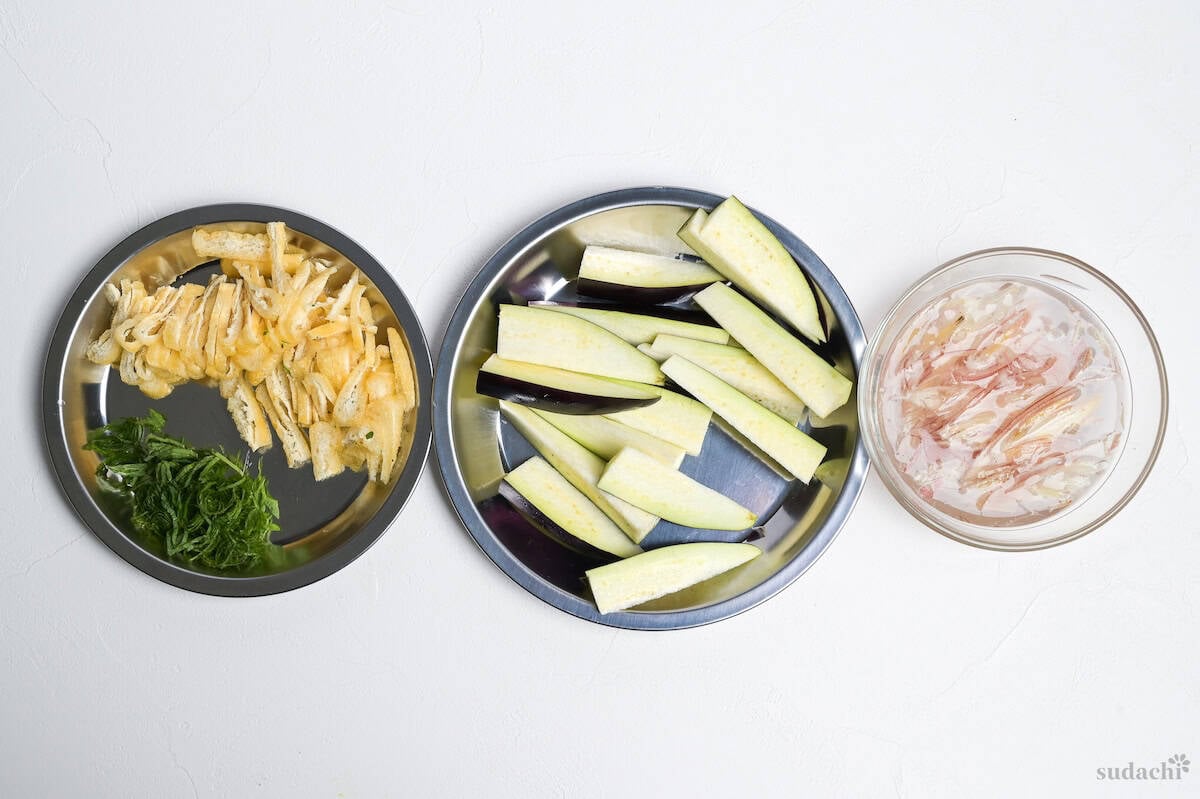
If you are sauteing in oil (which this recipe does), you can skip the soak entirely. The oil mellows any astringency, and cooking immediately after cutting prevents the flesh from browning. If you are making a variation where raw eggplant goes directly into the broth, a brief 5-minute soak in water helps preserve the color.
i. Add neutral cooking oil, the sticks of eggplant, and the sliced aburaage to a cold frying pan, then turn the heat to medium. Starting in a cold pan lets you coat every piece evenly before the oil gets hot.
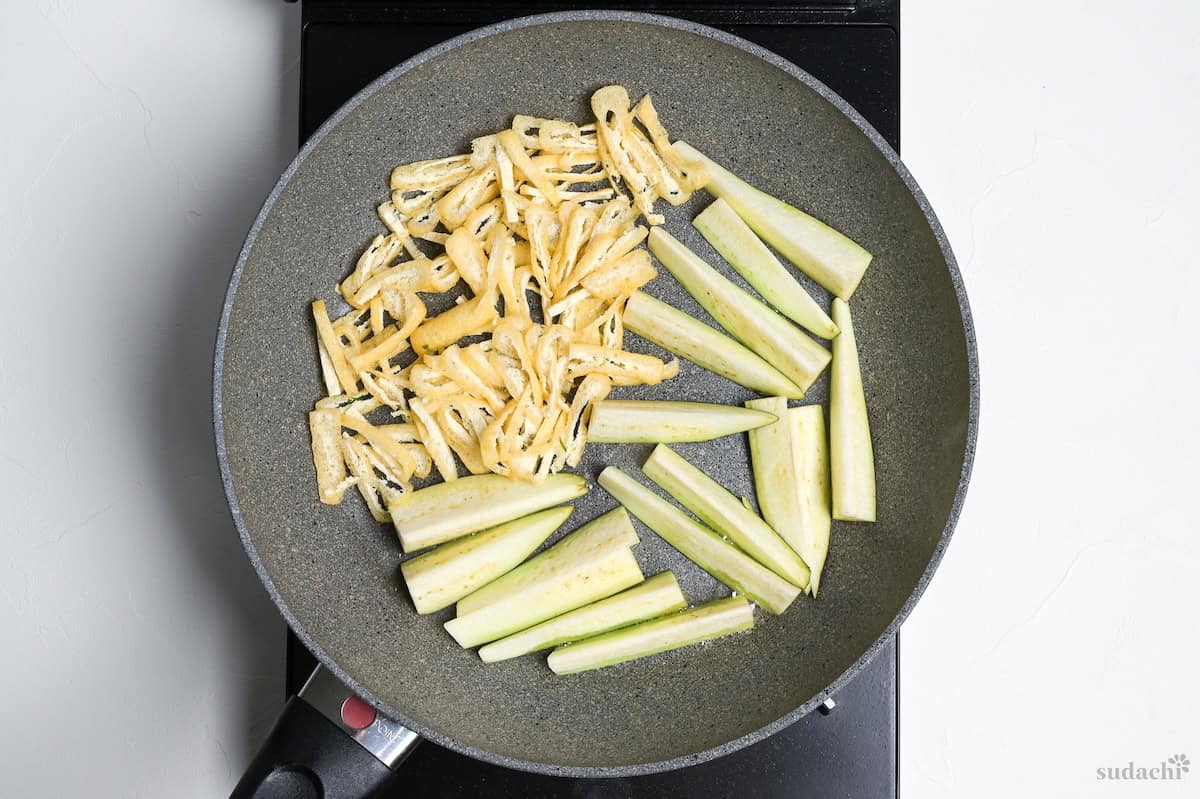
Research on eggplant anthocyanins shows that these pigments degrade significantly faster in liquid environments than in solid matrices. In a 2020 food science study, the half-life of eggplant anthocyanins was nearly three times longer in a solid-state system than in a liquid one under steaming conditions. By coating the skin in oil before the eggplant enters the broth, you effectively reduce the contact between the water-soluble pigment and the liquid, slowing color loss.
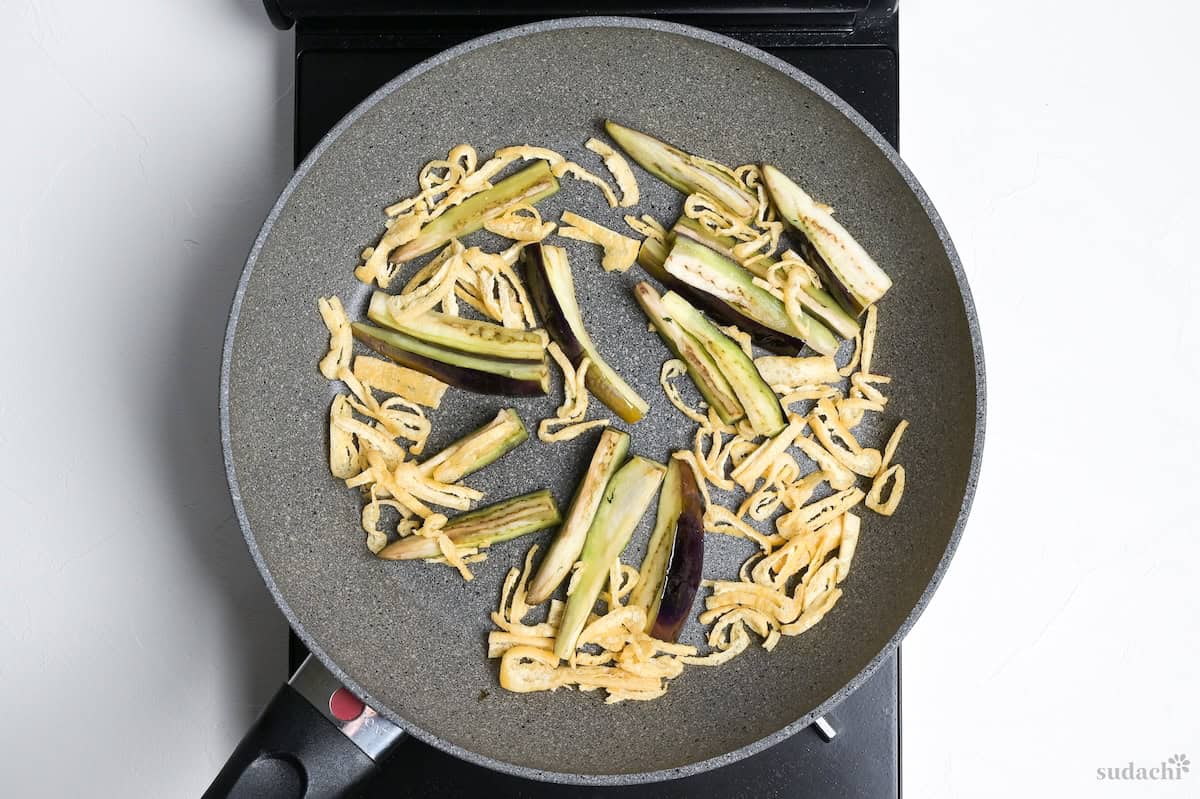
ii. Place the eggplant pieces skin-side down and press gently with chopsticks to make sure the oil contacts the entire skin surface. When the skin turns glossy and the flesh looks slightly translucent (about 1-2 minutes), flip and briefly cook the cut sides.
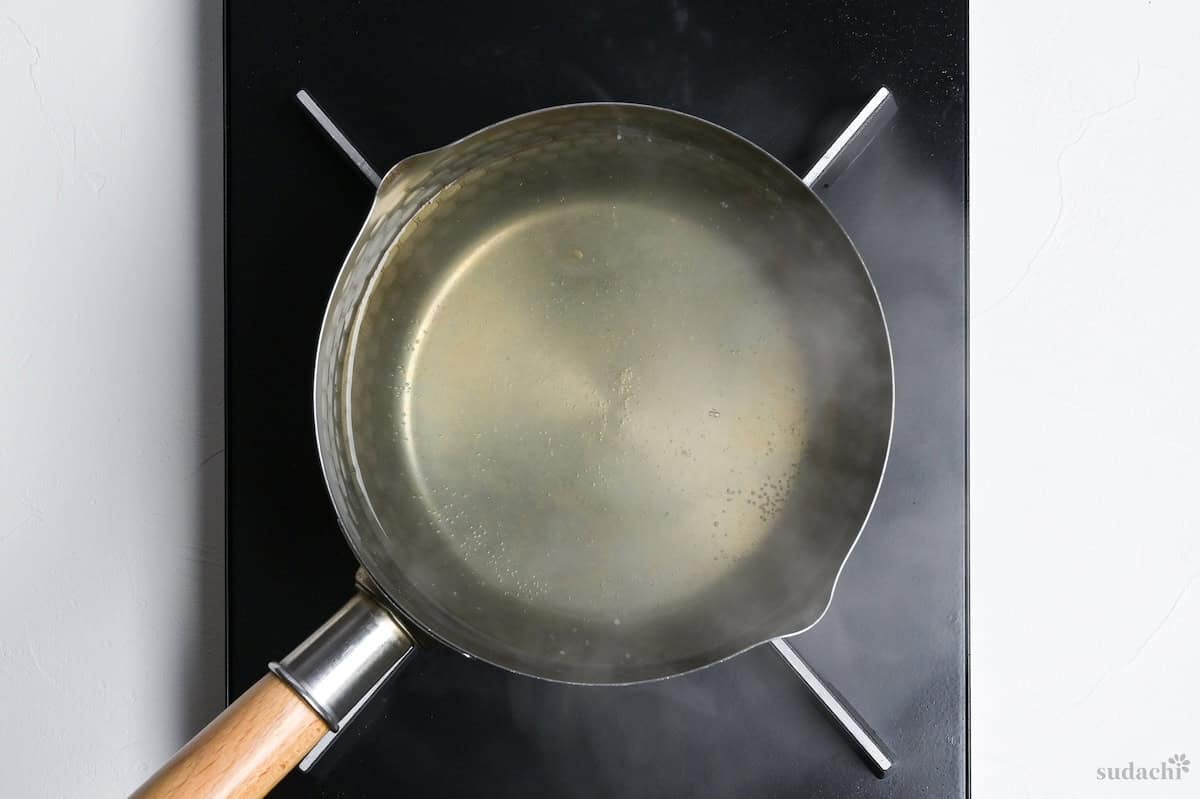
i. Pour dashi stock into a pot and bring it to an almost boil over medium-high heat.
i. Once the dashi reaches an almost boil, add the sauteed eggplant and aburaage to the pot. Cook for just 1-2 minutes. The eggplant is already partially cooked from the saute, so it only needs a brief simmer to finish.
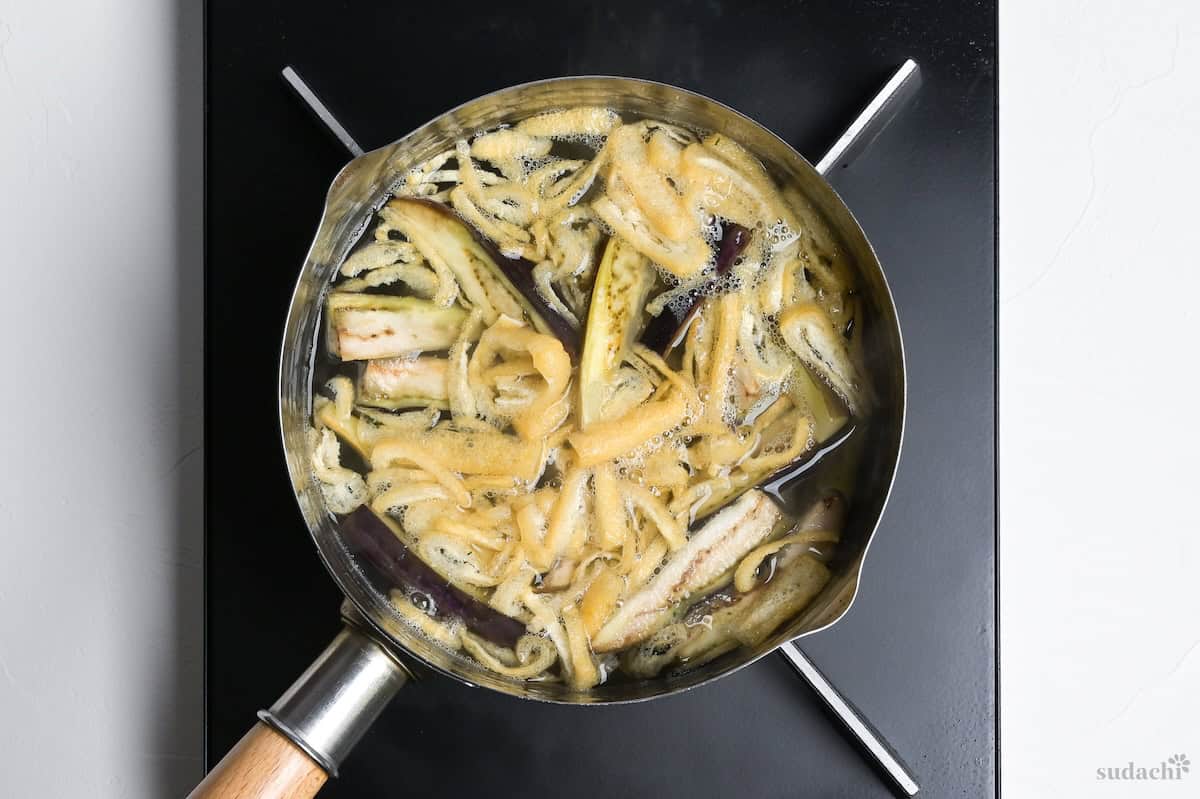
Because the eggplant is already partially cooked from the sauté, it only needs 1-2 minutes in the broth to finish. A shorter time in the liquid means less opportunity for purple pigments (nasunin) to dissolve into the soup.
ii. Turn the heat off. Scoop miso into a ladle or miso strainer, lower it into the broth, and whisk thoroughly inside the strainer to thin it out. Then, remove the strainer and stir it gently into the broth to distribute.

iii. Taste the soup. If it needs more salt, add extra miso a small amount at a time. Miso paste varies wildly in salt content between brands and types, so there is no fixed measurement. Only trust your palate.
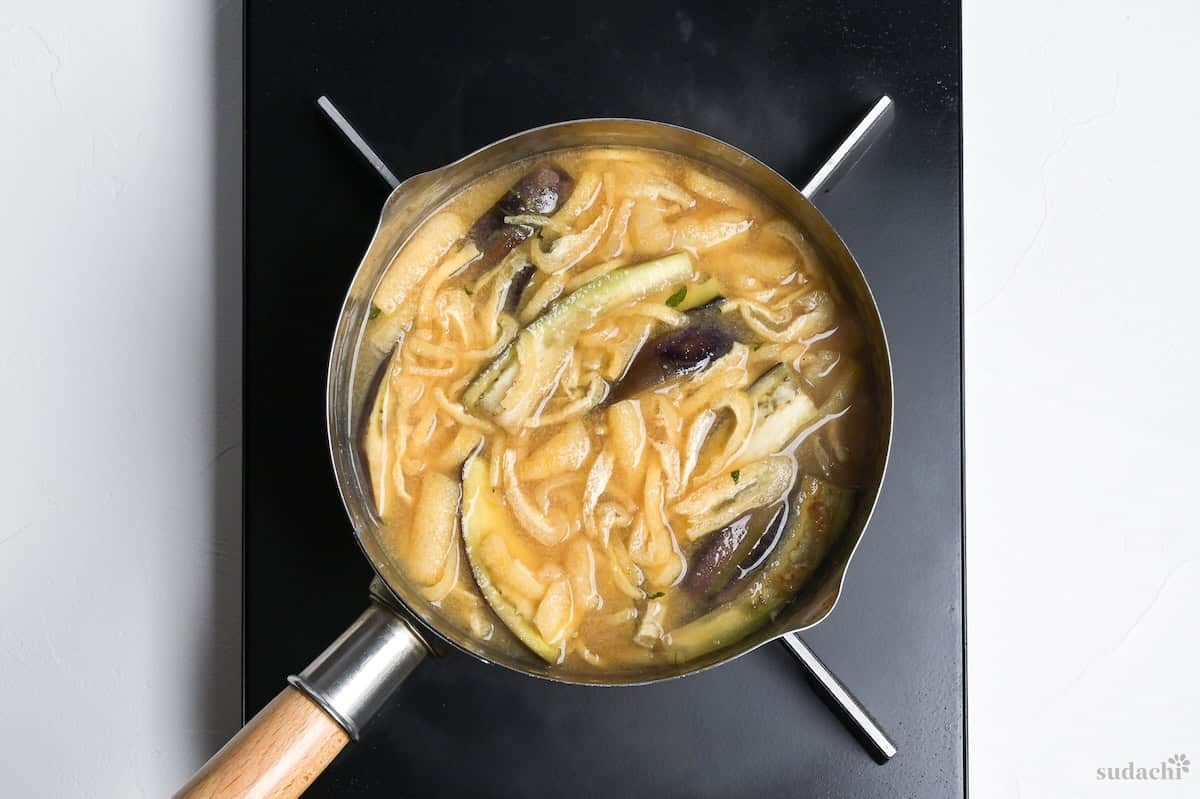
i. Ladle the eggplant pieces into bowls first, then pour the broth over them. Drizzle a small amount of toasted sesame oil into each bowl for aroma, then top with the julienned myoga and shiso ribbons. If you don’t have myoga or shiso, finely chopped green onions work well.
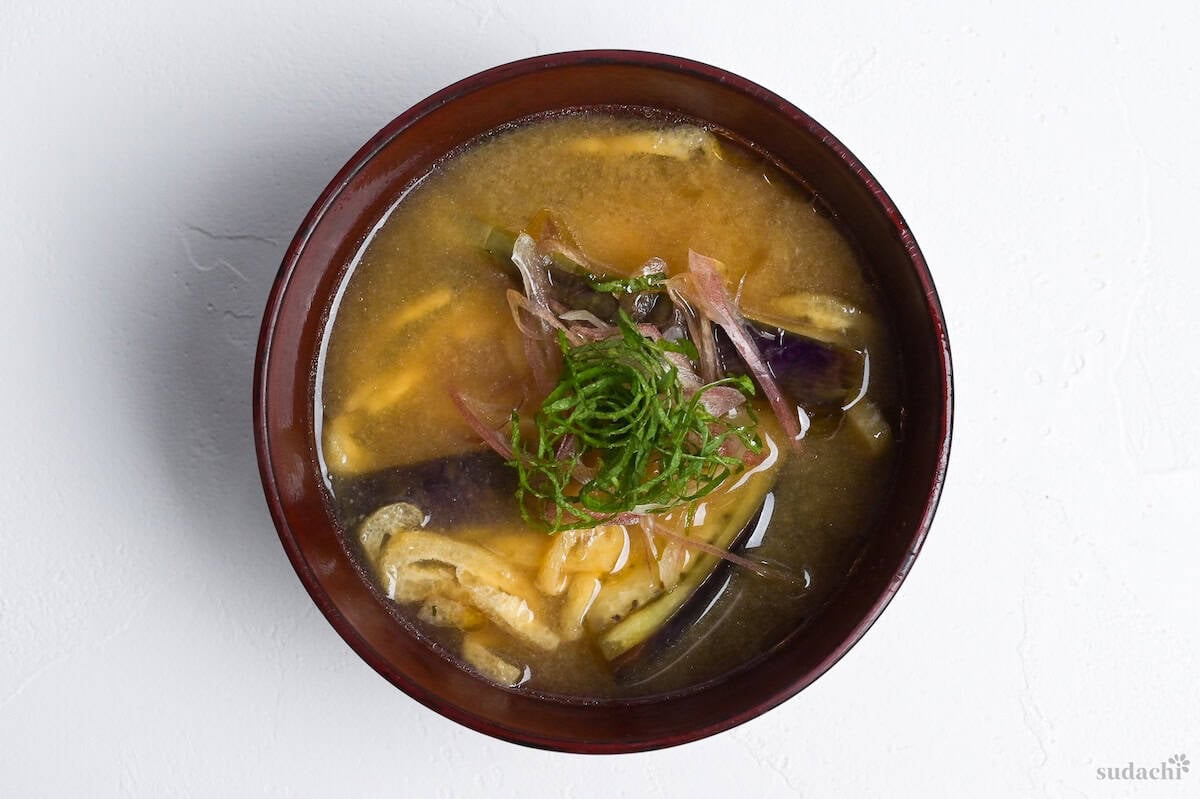
The soup is at its absolute best the moment you’ve finished cooking it. If you need to reheat leftovers, warm gently below a boil and stir in a small spoonful of fresh miso (oi-miso) right before serving to restore the fragrance.

Essential Tips & Tricks
- Saute the eggplant in oil before adding it to the soup. This single step preserves the purple color by creating an oil barrier that prevents nasunin from dissolving into the broth.
- Add the eggplant to hot dashi and cook briefly. High temperature reduces the rate at which color pigments leach into the liquid. For oil-sauteed eggplant, 1-2 minutes is enough (it is already partially cooked).
- Cut the eggplant right before cooking. Polyphenol oxidase in the flesh oxidizes on contact with air, turning the cut surfaces brown and darkening your soup. If you must cut ahead, soak briefly in water or 1% salt water for no more than 5 minutes.
- When reheating leftovers, stir in a small spoonful of fresh miso (oi-miso) right before serving. This technique restores the aroma that degrades over time.
With these simple tips in mind, you’re set for success every time you make eggplant miso soup.
Storage & Meal Prep
Fridge: Store in a sealed container for up to 2 days in summer, 3 days in cooler months. Cool the soup completely before refrigerating.
Freezer: Not recommended.
Meal Prep: Dashi can be made 2-3 days ahead and refrigerated. Eggplant should be cut right before cooking (it oxidizes quickly once exposed to air). You can saute the eggplant and aburaage in advance and refrigerate briefly, then add to hot dashi at serving time. Miso dissolution and garnish cutting must happen right before serving for the best aroma and freshness.
Reheating: Warm gently on low heat, never bringing it to a boil. Stir in a small spoonful of fresh miso (oi-miso) just before serving to restore the lost fragrance. Add a splash of fresh dashi if the flavor has weakened, and top with fresh garnishes.
What to Serve With This Recipe
- Salt-Grilled Mackerel (Saba no Shioyaki)
- Juicy Ginger Pork (Shogayaki)
- Fluffy Dashimaki Tamago
- Chilled Tofu (Hiyayakko)
Nasu no Misoshiru FAQ
The purple pigment in eggplant skin (nasunin) is water-soluble. When raw eggplant sits in hot broth, the color leaches out and darkens the liquid. Sauteing in oil before adding to the soup creates a barrier that keeps the color locked in. Adding to fully boiling dashi also helps.
Awase miso (a blend of red and white) is my go-to, but any miso works. White miso makes a sweeter, lighter soup. Red miso is bolder and saltier. Hatcho (bean) miso is a traditional pairing with eggplant in the Nagoya region. The most important thing is to taste as you add, because salt content varies dramatically between brands and types.
Yes. Use kombu and dried shiitake dashi instead of katsuobushi-based dashi, and confirm your miso paste is vegan.
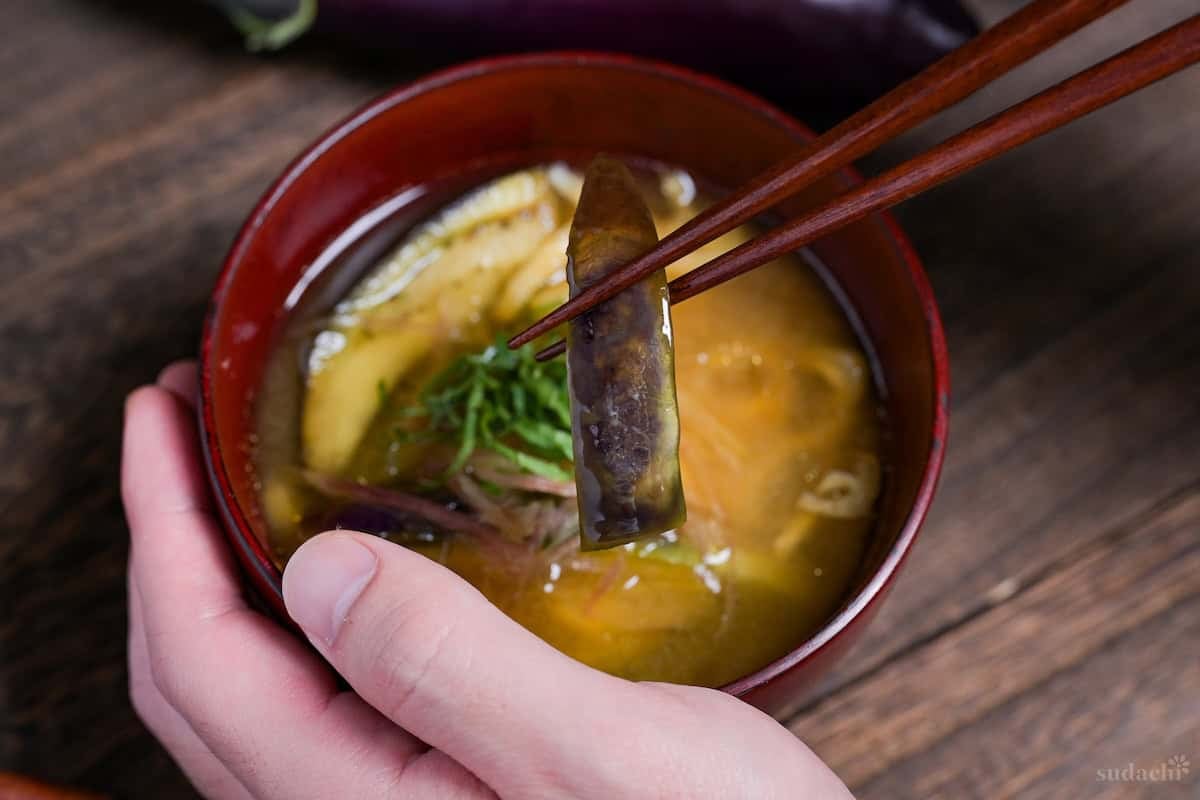
More Miso Soup Recipes
And if you want to see more ideas, check out my miso soup recipes roundup!
Did You Try This Recipe?
I would love to hear your thoughts!
💬 Leave a review and ⭐️ rating in the comments below. 📷 I also love to see your photos – submit them here!
Eggplant Miso Soup (Nasu no Misoshiru)
Ingredients
- 100 g eggplant Japanese or Chinese recommended, cut into sticks
- 1 tbsp cooking oil for sauteing
- 2 sheets fried tofu pouch (aburaage) sliced into thin strips
- 500 ml dashi stock
- 2 tbsp yellow miso paste (awase) or any miso, adjust to taste
Finishing
- toasted sesame oil drizzle, for aroma
Garnish (optional)
- 1 Japanese ginger (myoga) julienned or chopped green onions
- 4 shiso leaves cut into thin ribbons
My recommended brands of ingredients and seasonings can be found in my Japanese pantry guide.
Can’t find certain Japanese ingredients? See my substitution guide here.
Instructions
- Pour 1 tbsp cooking oil into a cold frying pan, then add 100 g eggplant and 2 sheets fried tofu pouch (aburaage). Mix gently until everything has a thin, even layer of oil.

- Turn the eggplant pieces so that they are skin-side down, and set the heat to medium. Gently press them down so that the skin makes full contact with the pan. Fry for 1-2 minutes, or until the skin looks glossy and flesh slightly translucent, then remove from the heat.
- Pour 500 ml dashi stock into a saucepan and heat on medium-high until almost boiling. Transfer the eggplant and aburaage to the both, and simmer for 1-2 minutes.
- Turn off the heat, place a miso strainer into the broth and add 2 tbsp yellow miso paste (awase). Whisk to loosen, then lift out the strainer and gently mix to disperse. Taste test and add more miso if needed.
- Ladle the eggplant and aburaage into serving bowls, then pour the soup over the top. Add a drizzle of toasted sesame oil, then garnish with julienned Japanese ginger, and shredded shiso leaves. Enjoy!

Leave a rating and a comment