



Featured Comment
This ramen recipe was so good! It was easy to make, too. The miso got it close to tasting like my favorite local restaurant ramen. I’ll definitely be making it this way from now on.
★★★★★
– Misty
I am Japanese, and I still think of miso ramen as a bowl you go out for. Then I finished this recipe, stood in my own kitchen, and thought, wait, that was it?
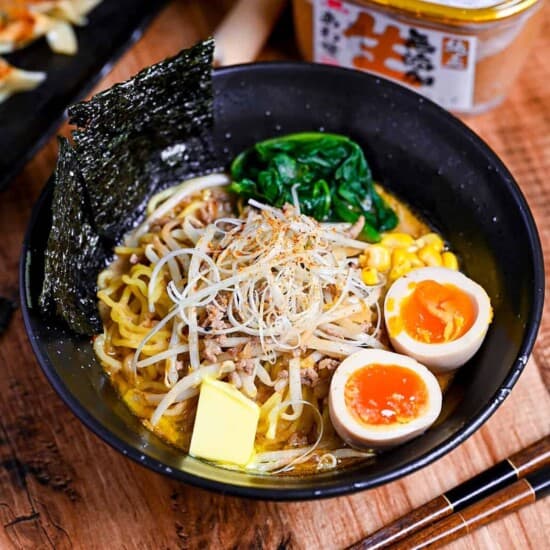
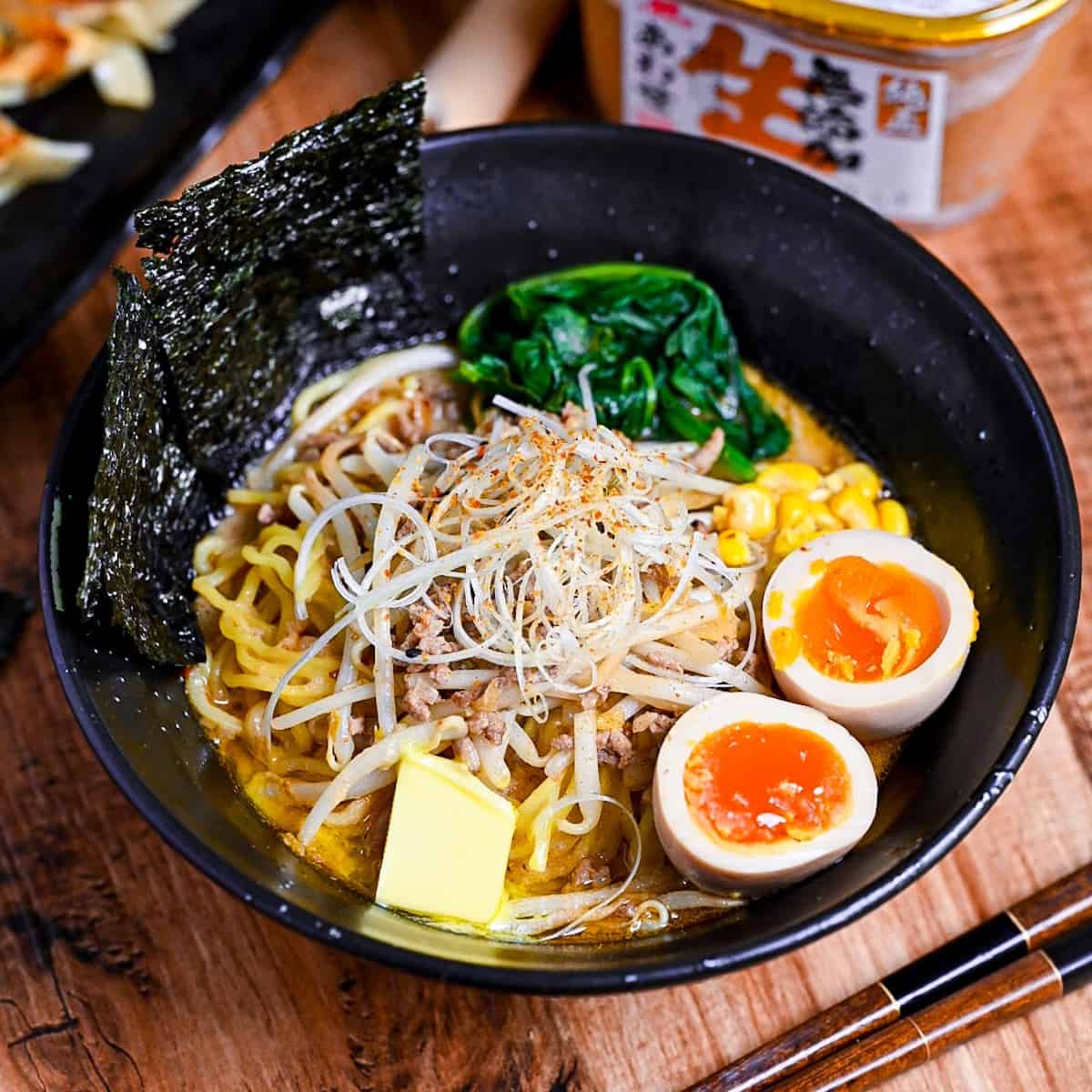
Peanut butter, ground sesame, seasoned pork, 15 minutes. I am not putting this next to the shops who tend their broth for days. But the bowl it makes at home genuinely shocked me. Meet my miso ramen.
Easy miso ramen
Recipe Snapshot
- What is it? A hot pork-and-aromatics soup that takes both its name and its flavor from fermented miso added at the finish, the youngest of the classic ramen styles.
- Flavor profile: Rich, savory, and quietly nutty.
- Why you will love this recipe: Speed and ease, and the fact that the bowl tastes far better than the clock says it should. It comes together in about 15 minutes using a trick Japanese home cooks have trusted for years, and even the toppings stay casual.
- Must-haves: Unsalted, unsweetened smooth peanut butter for the broth, and blended yellow miso (awase).
- Skill level: Easy. About 15 minutes start to finish, and the only real technique is loosening the peanut butter into a smooth paste before the broth comes together.
What Is Miso Ramen?
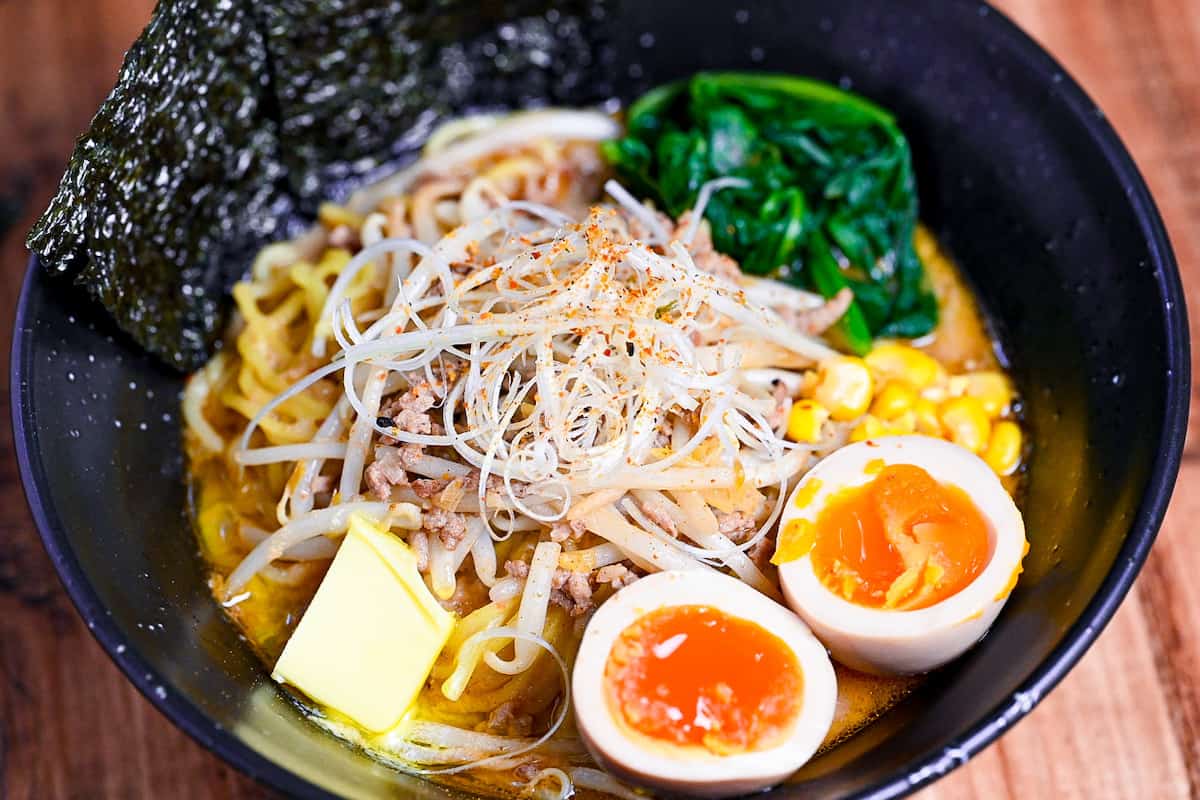
Miso ramen (味噌ラーメン) is the style of Japanese ramen that gets its identity from miso, stirred in as a concentrated seasoning at the very end. Let me clear up the biggest misunderstanding right away. This is not miso soup with noodles in it. The bowl stands on a savory pork base, and the miso rides on top of it.
It is also the youngest of the big ramen styles, born in Sapporo in the 1950s at a small diner called Aji no Sanpei, and it never forgot its birthplace. This is winter food, engineered for Hokkaido cold. The bowl comes to the table steaming hot, and the fat on the surface works like a lid, holding that heat in until the last sip.
Easy Miso Ramen Ingredients
What You’ll Need for the MISO RAMEN Broth
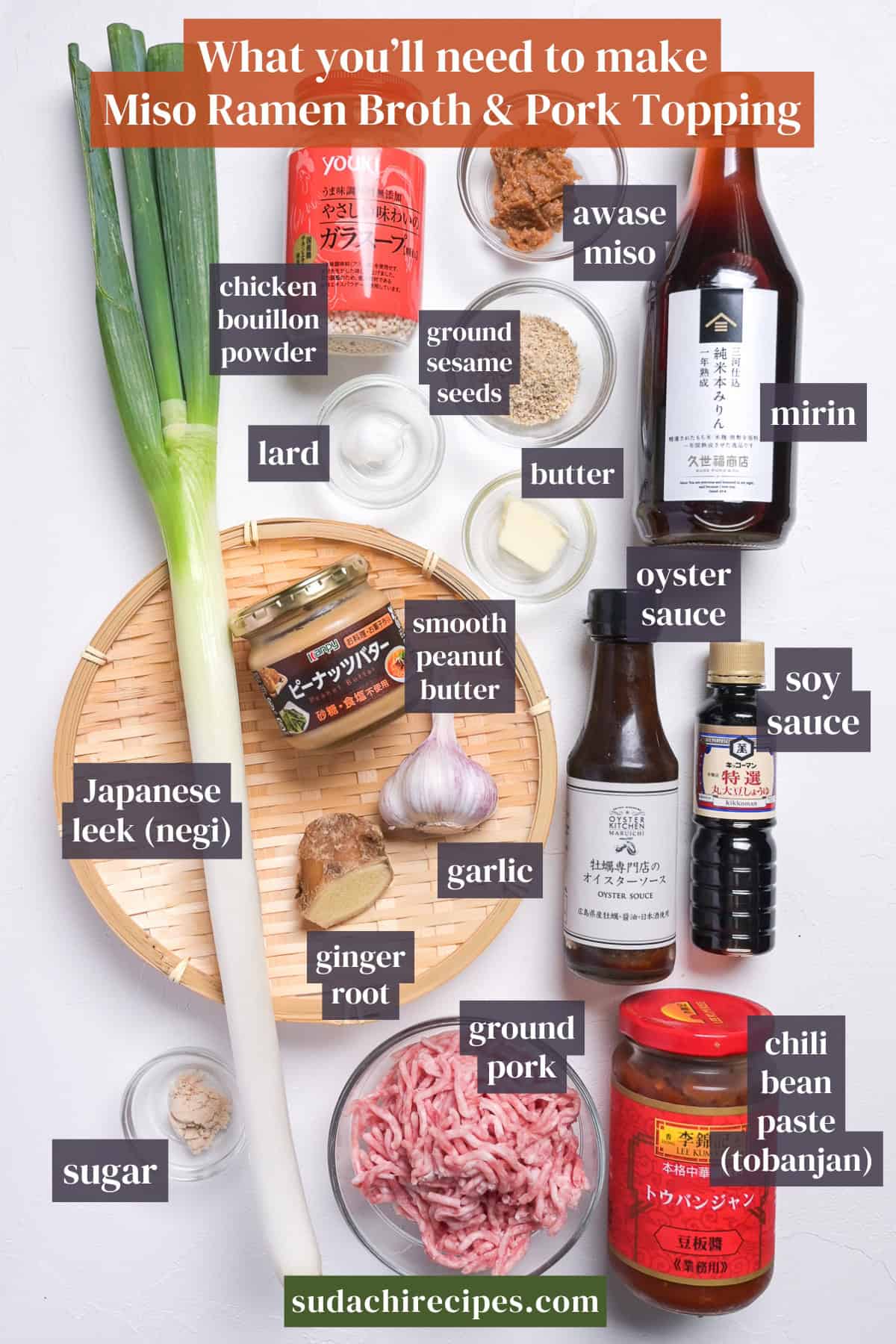
- Smooth peanut butter: The broth’s secret engine. It has to be unsalted and unsweetened, no exceptions. I tested it against sesame paste side by side more times than I can count, and peanut butter made the stronger, creamier soup every time.
- Chinese-style chicken bouillon powder: 1 modest spoonful carries the whole meat backbone of this broth, so brand strength matters here. Check your label before you pour. My brand’s standard ratio is 1 tsp per 200 ml to make bouillon. If your brand is more concentrated, use a touch less and taste.
- Yellow miso paste (awase): The seasoning that names the dish, stirred in at the very end, off the heat. Go for blended yellow miso. All-white miso cannot carry this bowl, and there is a whole section on choosing below, so keep scrolling before you shop.
What You’ll Need for the Toppings
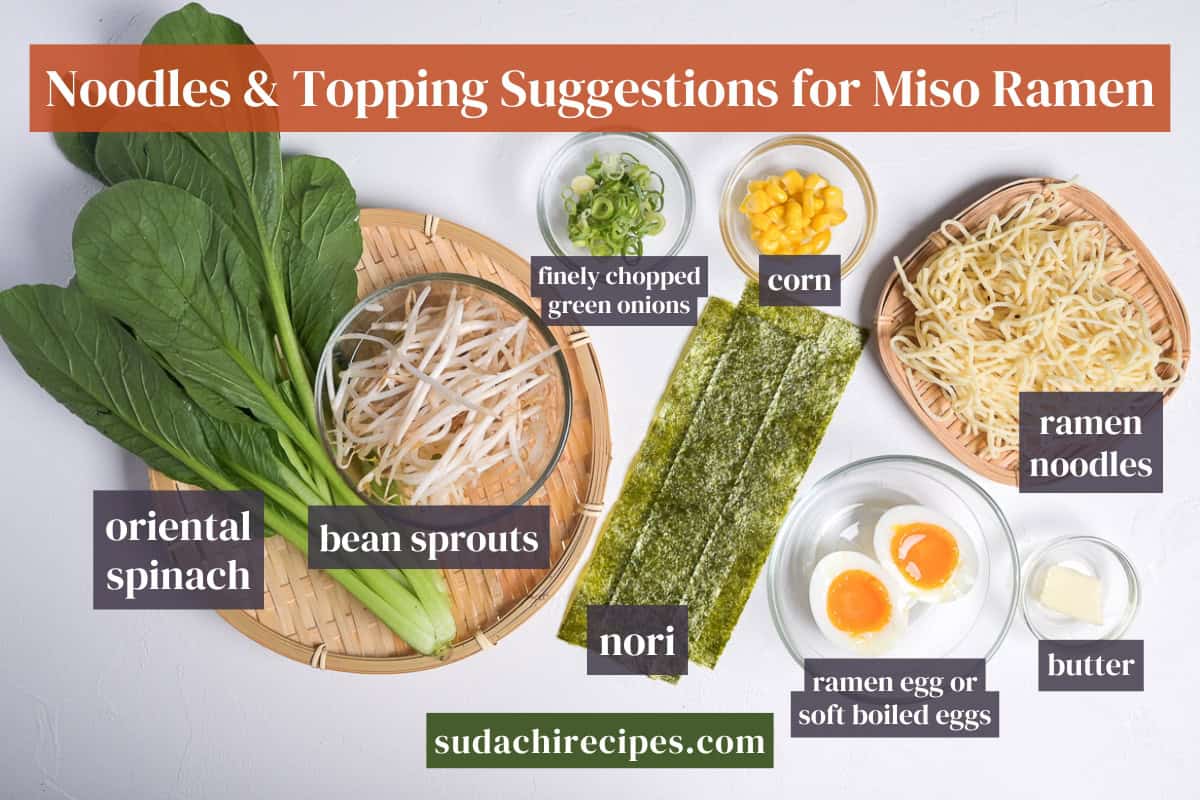
The Best Noodles for Miso Ramen
Choosing the right noodles can move your miso ramen from good to memorable. Traditional Sapporo-style ramen runs on medium-thick, wavy noodles, and that choice is not an accident. Here is how the common types stack up against a rich miso broth.
| Noodle Type | Approx. thickness (mm) | Soup Grip |
|---|---|---|
| Ultra-thin (極細麺) | 1.0-1.2 | Low, slips off quickly |
| Thin (細麺) | 1.2-1.5 | Medium-low |
| Medium (中細麺) | 1.5-1.7 | Medium |
| Medium-thick (中太麺) | 1.7-2.2 | High, ideal grip |
| Thick (太麺) | 2.2 and up | Very high |
The wave is not decoration. It controls how much soup each bite picks up, so every lift carries the right amount of flavor instead of drowning your palate, and the medium-thick cut keeps its chew alive in hot broth. Traditional Sapporo noodles are also egg noodles, and the eggs are where the extra richness and that yellow color come from.

Whatever you buy, pull the noodles about 30 seconds before the package time. The hot broth finishes the job. And if you want to make the real thing from scratch, I have a wavy egg noodle recipe built specifically for miso ramen.
Choosing the Right Miso Paste
The short answer first. Buy blended yellow miso (awase), and you are done shopping. It is sold at most Asian markets, often labeled just “yellow miso” in English, and it lands this bowl right in the sweet spot. The type of miso paste you pick shapes the whole personality of the soup, so here is how the common varieties compare.
| Miso Type | Color | Flavor Profile |
|---|---|---|
| Red Miso | Dark reddish-brown | Salty, robust, complex umami |
| White Miso | Light beige or yellow | Sweet, mild, delicate |
| Mixed/Blended (Yellow) | Medium brown | Balanced sweet-savory |
| Barley Miso | Light to medium | Slightly sweet, nutty |
| Bean Miso | Very dark | Intense, harsh |
Why blended? The extremes fail in opposite directions. All red turns the bowl salty and aggressively fermented, and all white turns it simple and sweet. Blended yellow splits the difference, which is exactly what this broth wants.
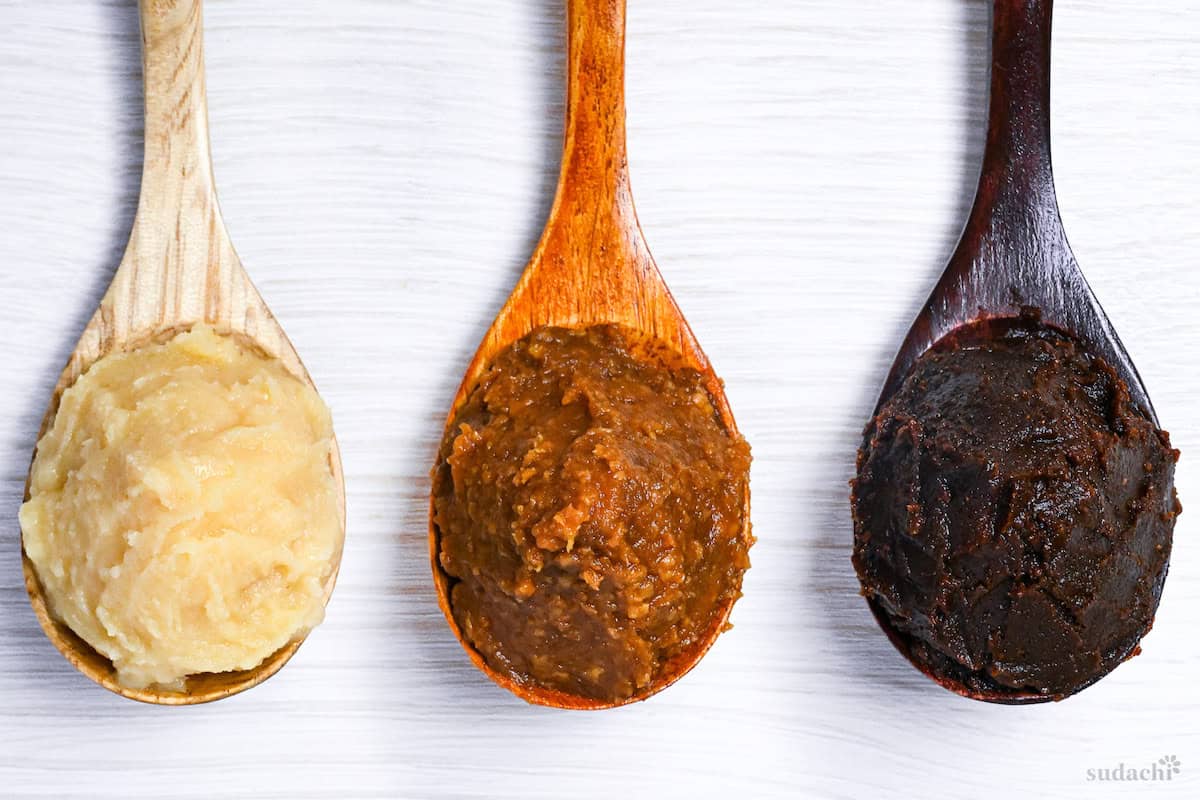
Once the yellow base is in your fridge, there is room to play. My favorite upgrade is a small spoonful of extra red miso stirred in, which deepens the color and gives the umami another gear.
- Easiest option: Pre-blended “yellow miso” (awase miso)
- My blend: Yellow miso plus a small amount of red miso
- Avoid: 100% extreme varieties like sweet saikyo miso or intense hatcho miso
Substitution Ideas
- Smooth peanut butter → Tahini or Japanese sesame paste (neri-goma): Swap it measure for measure. Peanut butter is still my first pick, but the sesame version only loses a touch of creaminess and the bowl works just as well.
- Chinese-style chicken bouillon powder → Western-style chicken bouillon powder: It works if it truly has to, but the flavor drops a step, since Western bouillon often carries herbs and spices that pull the broth in a different direction. Use powder or granules, never a cube, and taste as you go.
- Japanese leek (naganegi) → Leek, onion, or shallot: Any of these can melt into the butter and lard with no drama. What does not work here is thin scallions.
- Lard → More butter: All butter still makes a lovely bowl, so do not cancel dinner over it. But lard genuinely earns its spot, for the pork flavor and for the higher smoke point that lets the aromatics fry without the dairy solids burning first.
- Chili bean sauce (toban djan) → Gochujang: Normally I would not point you here, because gochujang is sweeter and pulls the flavor in a different direction. At the tiny amount this recipe uses, though, it passes.
- Oriental spinach → Regular spinach or bok choy: Oriental spinach is the Japanese-style bunched spinach sold at Asian grocers. Since the greens get blanched rather than served raw, regular spinach slides right in, and bok choy works too.
- Ramen noodles → Store-bought fresh, dried, or the spaghetti hack: Fresh noodles from an Asian grocer come first, a quality dried noodle comes second, and my spaghetti ramen hack covers the nights when the pantry is all you have. Just skip instant noodles, they are engineered for their own soup packet, not for a broth you made from scratch.
Have trouble finding Japanese ingredients? Check out my ultimate guide to Japanese ingredient substitutes!
How to Make My Miso Ramen
If you prefer to watch the process in action, check out my YouTube video of this miso ramen recipe!

i. Bring a small pot of water to a rolling boil and add a pinch of salt. Drop in the bean sprouts, then lower the spinach in stem-first, leaves hanging over the edge of the pot.

ii. After 30 seconds, push the leaves under and give everything another 30 seconds.
iii. Straight into the ice water. That cold plunge locks in the green color and stops the cooking on the spot. Leave them there for later.

i. Add the ground sesame seeds, peanut butter, and chicken bouillon powder to the heatproof bowl. Pour in just a splash of the freshly boiled water.


ii. Whisk until it loosens into a smooth paste. Only then pour in the rest of the water, mix well, and park it by the stove.


A splash of hot water first loosens the peanut butter into a smooth paste, and a smooth paste accepts the rest of the water without breaking. 30 seconds of whisking here buys you a soup that stays silky to the last sip.
i. Set a wok or wide skillet over medium heat and drop in the butter and lard. Once they melt and shimmer, turn the heat down to medium low.

ii. In go the grated garlic, grated ginger, and the white part of the naganegi.

iii. Stir them gently until the edges pick up a little color.

Slow, gentle frying mellows the raw pungency of the garlic and negi and builds a sweeter, rounder aroma. Garlic is also the first thing in this pan to burn, and a single scorched clove will follow the broth all the way to the table.
iv. Raise the heat back to medium and crumble in the ground pork. Fry until no pink remains and the edges start to catch and brown, about 3 minutes.

v. Splash in the soy sauce, mirin (sweet rice seasoning), oyster sauce, sugar, and chili bean sauce.

vi. Keep stir-frying until the pan looks almost dry and every crumb of pork is glossy and coated.

i. Pour the nutty broth into the wok and mix, scraping the browned bits off the bottom as you go. That gives our broth even more depth!

ii. Keep the heat on medium high just until small bubbles skitter across the surface, then cut the flame.
i. Place the awase miso in a small strainer or ladle, dip it into the hot broth, and whisk until every streak of it disappears.

Miso’s delicate aromas start to vanish above about 80°C (176°F). By mixing it in off the heat, you keep the full essence in your bowl instead of steaming it off into the kitchen.
i. Boil the ramen noodles according to the package, but pull them out 30 seconds early. The hot broth finishes the chew right in the bowl.

ii. Drain hard and shake the colander like you mean it. Wet noodles will water down any good soup.

i. Divide the noodles between serving bowls and ladle the miso broth with all its savory pork over the top.

ii. Squeeze the spinach firmly, shake the bean sprouts, and arrange them on the noodles. Any water still clinging to the greens is broth dilution waiting to happen, so be a little ruthless.
iii. Scatter the sweet corn and green onions, tuck in a sheet of nori, and lay the ramen eggs on top.

iv. Last, drop in a small pat of butter and watch it melt into a glossy layer that keeps the soup steamy. Eat while it is still dangerous.
v. This last move is fully optional, and I will be honest, I usually eat it exactly as it lands. If you want more aroma, a tiny drizzle of toasted sesame oil or chili oil does it. If the richness runs ahead of you, a small splash of black or rice vinegar resets your palate. Small moves only. The bowl is already loud. Enjoy!
- Chashu: tender soy-braised pork slices for extra protein
- Menma: crunchy fermented bamboo shoots with a salty-savory bite
- Raw diced onion: a fresh, sharp crunch against the richness
- Grated ginger: a warming zing for a mid-bowl refresh

Essential Tips & Tricks
- Pull the noodles 30 seconds early, every time. A bowl of hot broth is a second stove, and carryover heat keeps cooking the noodles from the moment the soup goes over them.
- Taste while the miso goes in, not after the bowls are built. Miso and bouillon brands vary widely in salt, so treat the written amounts as a starting point. Whisk in most of the miso, taste the broth, and let the last spoonful earn its place. Adjusting in the pan takes seconds, and it is the whole difference between seasoned and salty.
- Once the miso is in, keep the soup off a rolling boil. Miso’s aroma is at its best when it never boils again, which is exactly why it goes in after the flame is off. That said, do not hover over the pot in fear. Miso ramen is a bold soup that takes a brief slip better than most, so aim for gentle heat and relax.
- Squeeze the blanched greens drier than feels necessary. Spinach and bean sprouts hold far more water than they look like they do, and every hidden drop drains into the broth you just balanced.
With these simple tips in mind, you’re set for success every time you make miso ramen.
Storage & Meal Prep
Fridge: My honest answer is that I rarely store this soup and I do not really recommend it, because a fresh batch takes 15 minutes. If leftovers happen anyway, keep the soup in a sealed container away from the noodles and finish it within 2 days.
Freezer: Not recommended.
Meal prep: There is nothing here worth prepping ahead except for ramen toppings. This recipe is faster than most reheats, so making it fresh is the meal prep.
Reheating: Warm leftover soup gently over low heat and stop before it reaches a boil, since a hard boil burns off the miso’s aroma. Cook the noodles fresh for every serving, stored noodles only turn soft and lose their bite.
What to Serve With This Recipe
Miso Ramen Troubleshooting
The peanut butter went into hot liquid without being loosened first, and once the fat splits out, no amount of whisking in the wok reliably brings it back together. The honest fix is prevention. Whisk the peanut butter, ground sesame, and bouillon powder with a splash of hot water into a smooth paste before it ever meets the pan. Those 30 seconds are the insurance policy for this entire soup.
They almost certainly cooked for the full package time, and the hot broth then kept cooking them in the bowl. Carryover heat is real with ramen noodles, so pull them 30 seconds before the package says and drain them hard. If the bowl is already in front of you, there is only one fix, and it is eating faster.
Either your bouillon powder runs more concentrated than mine, or the full measure of miso went in without a taste check along the way. The only real fix at this point is hot water, added a splash at a time until the broth lands where you want it. Next time, taste as you dissolve the miso and hold some back.
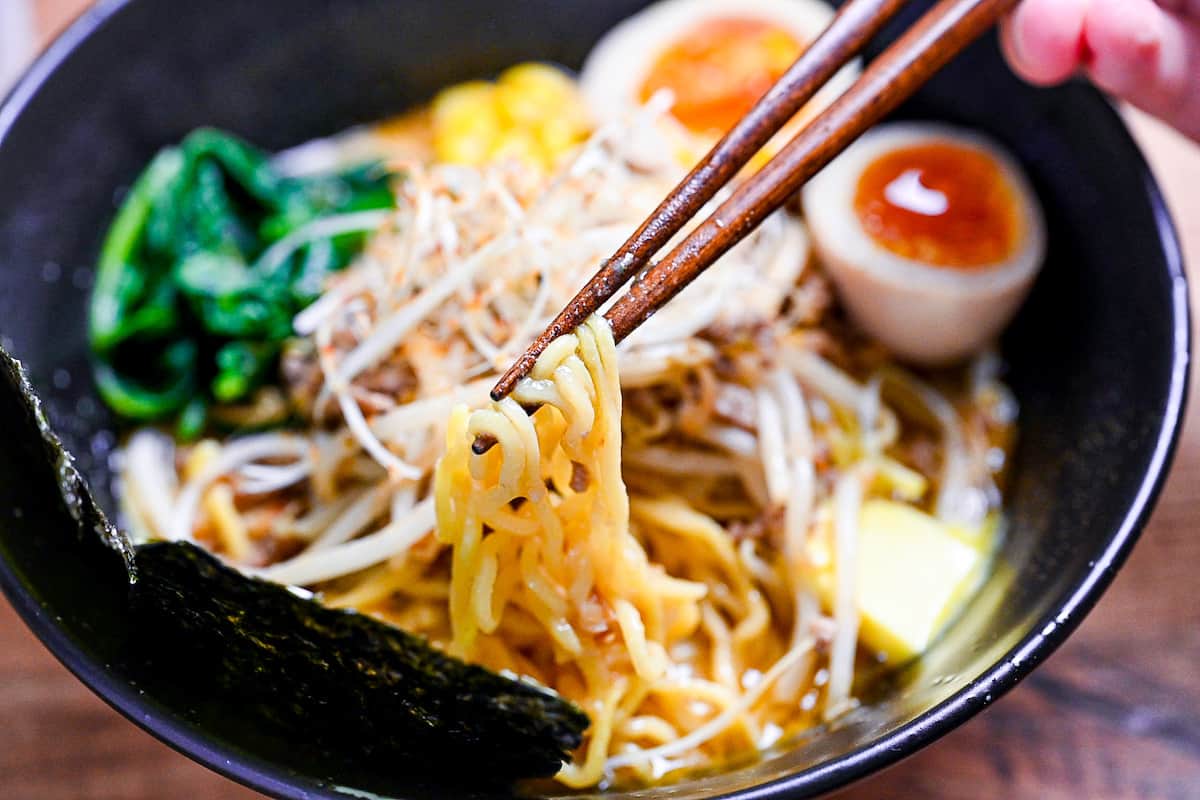
Ramen Toppings to Upgrade Your Bowl
Once the broth is second nature, the toppings are where the bowl becomes yours. My full ramen toppings collection has the complete lineup with a recipe for each one.
Did You Try This Recipe?
I would love to hear your thoughts!
💬 Leave a review and ⭐️ rating in the comments below. 📷 I also love to see your photos – submit them here!
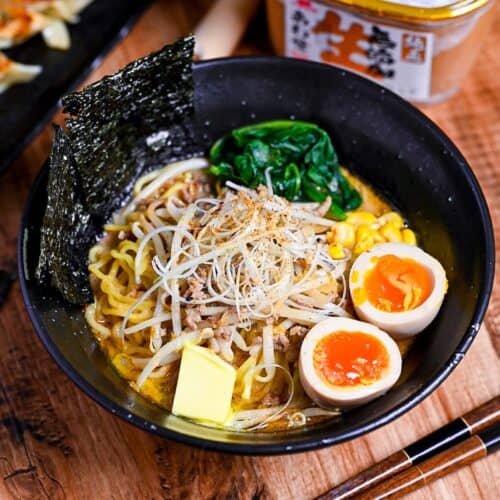
Sapporo-Style Miso Ramen with Ground Pork

Ingredients
Broth
- 1 tbsp ground sesame seeds toasted
- 1 tbsp smooth peanut butter unsalted and unsweetened, or sesame paste/tahini
- 1 tsp Chinese-style chicken bouillon powder
- 500 ml freshly boiled water
- 1 ½ tbsp yellow miso paste (awase) added at the end
Seasoned Pork
- 1 tsp butter
- 1 tsp lard or more butter
- 4 cloves grated garlic
- 1 tbsp grated ginger root
- 2 tbsp Japanese leek (naganegi) white part, finely diced, leek/onion/shallot also work
- 150 g ground pork
- 1 tsp Japanese soy sauce (koikuchi shoyu)
- 1 tsp mirin
- 1 tsp oyster sauce
- ½ tsp sugar
- ½ tsp chili bean sauce (toban djan) or gochujang
Toppings & Noodles
- 30 g Oriental spinach or regular spinach/bok choy
- 100 g bean sprouts
- 2 portions ramen noodles
- canned sweet corn
- finely chopped green onions
- butter
- ramen eggs or soft boiled eggs
- roasted seaweed for sushi (nori)
The ingredient brands and tools I trust are in my Japanese pantry guide and my cooking tools guide.
Can’t find certain Japanese ingredients? See my substitution guide here.
Instructions
- Prepare a bowl of ice water and set it by the stove. Bring a pot of water to a rolling boil and sprinkle in a pinch of salt. Add 100 g bean sprouts and the thick stem part of 30 g Oriental spinach to the pot and boil for 30 seconds.

- Submerge the leaves of the spinach and boil for another 30 seconds before transferring them to the ice water bath. Set aside for later.
- Add 1 tbsp ground sesame seeds, 1 tbsp smooth peanut butter, and 1 tsp Chinese-style chicken bouillon powder to a heatproof bowl or jug. Measure out 500 ml freshly boiled water and add a splash to the bowl.
- Whisk until smooth, then gradually add the rest of the water while mixing and set it by the stove for later.
- Heat a large wok over medium and add 1 tsp butter and 1 tsp lard. Once melted, reduce the heat to medium low and add 4 cloves grated garlic, 1 tbsp grated ginger root and 2 tbsp Japanese leek (naganegi). Mix occasionally to prevent burning and fry until fragrant.
- Increase the heat to medium and add 150 g ground pork, fry until cooked through and slightly browning around the edges. Then add 1 tsp Japanese soy sauce (koikuchi shoyu), 1 tsp mirin, 1 tsp oyster sauce, ½ tsp sugar and ½ tsp chili bean sauce (toban djan). Stir fry until the pork is evenly coated and thoroughly browned.
- Pour the bowl of broth from earlier into the wok and mix well, scraping the edges of the pan as you go. Bring to a boil then turn off the heat. Place 1 ½ tbsp yellow miso paste (awase) in a miso strainer, dip it in the broth and whisk thoroughly to incorporate it into the broth.
- Boil 2 portions ramen noodles for 30 seconds less than the time stated on the packaging.
- Drain the noodles thoroughly and rinse with hot water to remove excess starch. Shake thoroughly, then divide them between serving bowls and pour the broth over the top.
- Squeeze the spinach thoroughly and shake the beansprouts to remove any excess water. Arrange them on top of the noodles and spoon the seasoned pork mince in the center. Add your favorite toppings, I used canned sweet corn, finely chopped green onions, ramen eggs, roasted seaweed for sushi (nori) and a small pat of butter. Enjoy!

Hi!
What kind of smooth peanut butter is it?
Can I buy the noodles online? I can’t find it here where I live. Thank you!
Hi Michele!
Thanks for your question! I personally used Skippy, but it’s fine to use other brands as long as it’s the smooth kind. Skippy is known for being a bit salty and having more of a “roasted” flavour so I recommend it!
You should be able to buy ramen noodles online (they have them on Amazon etc) but if you can’t get them, you could try out my “ramen noodles made with spaghetti hack” https://sudachirecipes.com/ramen-noodle-hack-recipe/
Hope that helps, happy cooking! 🙂
This ramen recipe was so good! It was easy to make, too. The miso got it close to tasting like my favorite local restaurant ramen. I’ll definitely be making it this way from now on.
Hi Misty,
Thank you for your comment! I’m happy to hear that you enjoyed this recipe! 🙂
Yuto
Hi Yuto,
Greetings from Brazil! We tried the recipe today, we loved it! The idea of making a broth with bones and other ingredients, spending much time and effort, it wasn’t very encouraging. Thanks for simplifying everything with a delicious result my mother approved it
Hi Saulo,
Thank you for trying this recipe! That truly means a lot. I’m so glad you all enjoyed it, and especially that your mom gave it the thumbs up! Thank you for taking the time to share this! 🙂
Yuto
Thank you for the incredible tasty food. I’ve been following your site for a while now and always have success with your recipes. Just had to comment. I’m going to try the pork miso ramen today.
Hi Nina,
Thank you so much for your kind words! I’m really happy to hear you’ve had success with my recipes. Your support means a lot to me. I hope you love the pork miso ramen – let me know how it turns out!
Yuto
I love the idea of using peanut butter in the soup! It was so easy and tasty!!!
I didn’t have Chinese chili bean paste so used Korean. Still turned out very well.
Hi Jas,
Thank you so much for trying this recipe and sharing your experience! I’m happy to hear that you enjoyed the peanut butter trick, and it’s great to know that Korean chili paste worked well as a substitute!
Yuto
Your recipes are awesome – they are always so so good and easy to make. Thank you for sharing then with us. Loving the idea of peanut butter in this dish. Looking forward to making it.
Hi Ja,
That really means a lot! I’m happy the recipes have been working well for you! Hope you enjoy this peanut butter twist when you try it
Yuto
Fabulous – we loved it!
Thank you so much, Rob! 🙂
thank for all the details and the information about miso, very useful for non Japanese who want to learn more about your cuisine
Hi Esther,
Thanks so much! I’m really glad the details on miso came through clearly and were useful to you. 🙂
Yuto
WOW! This was way better than most restaurant ramen we have here in the US. so many complex yet complimentary flavors. This will be a staple in our household now!
we did swap out some of the ingredients with things we had on hand! we used chicken instead of pork and sesame paste instead of powder. The sesame paste likely made the broth a tad thicker but the taste was incredible! This is definitely a recipe you can adapt slightly for things you have on-hand!
Always love all of Sudachi’s recipes!
Hi Jacque,
It’s been a long time! Hope you and your loved ones are doing great.
Thank you for sharing your feedback and lovely comment! I’m happy you enjoyed it and that it worked with your adjustments. 🙂
Yuto
he number of ramen stores around us is increasing daily, quality often questionable. But with your recipes and this one in particular, the best ramen is to be found Dwight here in my kitchen. We love it.
Hi Peti,
Thank you! Hearing that the whole house loves it is the part I’m happiest about. Really happy that’s where your best bowl is right now! 🙂
Yuto
My 10yo son had been asking me to make ramen for a long time, but the recipes I found always seemed overwhelming. This was a great recipe to ease myself into the world of cooking ramen at home! It was very easy and I appreciated the substitution suggestions. It’s easy, but definitely NOT a 15 min recipe!
Hi Gaby,
Thank you so much for writing this! I’m really glad the recipe helped you make ramen for your son after he’d been asking! It means a lot to me that it made ramen at home feel less overwhelming 🙂
Yuto