



Disclaimer: This post may contain Amazon affiliate links. Sudachi earns a small percentage from qualifying purchases at no extra cost to you. See disclaimer for more info.
What Is Rice Vinegar?
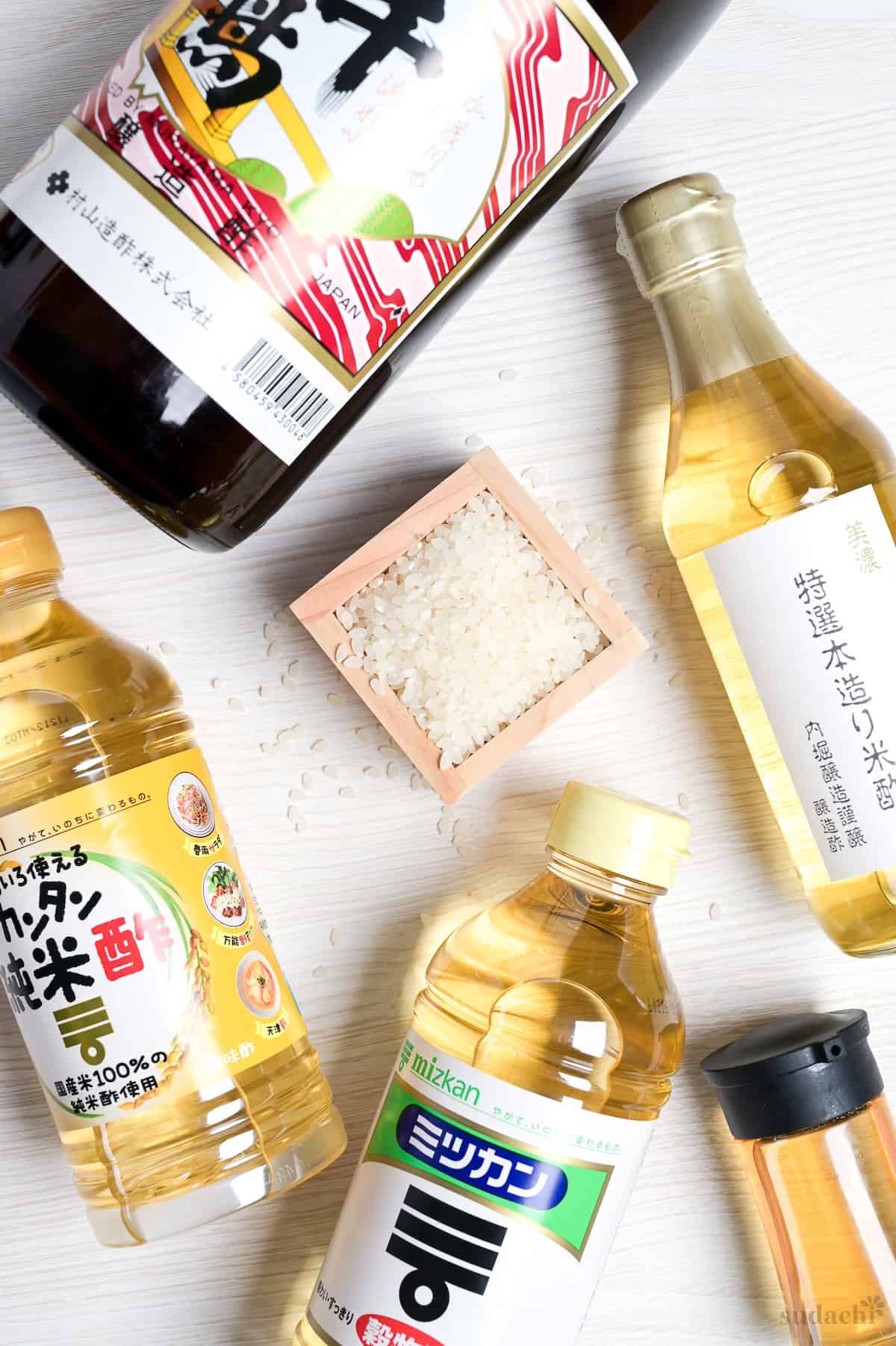
Rice vinegar, or komezu (米酢), is a mild vinegar made by fermenting rice. If you have ever tasted it side by side with Western white vinegar, the difference is immediately obvious. Rice vinegar is gentler, rounder, and carries a subtle sweetness that white vinegar does not have. Where distilled vinegar hits you with a sharp punch of acid, rice vinegar has layers: a clean sourness up front, followed by a faint sweetness and a lingering savory quality.
During fermentation, rice proteins are broken down into free amino acids, especially glutamic acid, the same compound responsible for the umami in kombu and parmesan. This is what separates rice vinegar from distilled vinegar at a chemical level.
A 2024 study published in Heliyon by researchers at Tokyo University of Agriculture confirmed that glutamic acid and aspartic acid are among the predominant free amino acids in rice vinegar, and that taste sensor analysis detected stronger umami in rice-based vinegars compared with modern acetic-fermented products.
How Rice Vinegar Is Made
The production process mirrors sake brewing before it diverges into vinegar territory. Steamed rice is inoculated with koji mold (Aspergillus oryzae) over 2 to 3 days. The koji’s enzymes convert starch into fermentable sugars while simultaneously breaking rice protein into amino acids. Water, yeast, koji, and more steamed rice are then combined into a moromi, where alcohol fermentation takes place, identical to sake production.
The resulting alcohol-rich liquid is then mixed with seed vinegar containing active acetic acid bacteria and held at around 40 degrees Celsius. The bacteria convert the alcohol into acetic acid over weeks or months, depending on the method used.
Rice Vinegar vs. Sushi Vinegar
This is the confusion that actually ruins dishes, and it happens all the time.
Plain (unseasoned) rice vinegar contains only rice (and sometimes added brewing alcohol). It has around 4.2 to 4.5% acidity, essentially zero calories, and no added flavoring. It is a blank canvas. You control the seasoning.
Sushi vinegar, also sold as “seasoned rice vinegar,” is a completely different product. It has sugar, salt, and sometimes corn syrup or MSG already mixed in. The acidity drops to around 1 to 4%, and it picks up roughly 30 calories per tablespoon from the added sugar. It is designed as a shortcut specifically for making sushi rice: pour it on, skip the measuring, done.

The problem shows up in 2 ways:
- Mistake 1: using sushi vinegar in a recipe that calls for plain rice vinegar. If a recipe for quick pickles, wafu dressing, or sunomono asks for “rice vinegar,” it means the unseasoned kind. Swap in sushi vinegar and you are adding sugar and salt that the recipe did not account for. Your pickles turn out sweet. Your dressing tastes off. Your sunomono loses its clean, sharp edge.
- Mistake 2: double-seasoning sushi rice. A recipe tells you to mix rice vinegar with sugar and salt, then fold it into cooked rice. You follow the recipe, but the bottle you grabbed is sushi vinegar, which already contains sugar and salt. You have just doubled the seasoning. The result is cloyingly sweet sushi rice that overpowers everything on top of it.
The reverse also happens. Someone uses plain rice vinegar for sushi rice without adding anything else and wonders why the rice tastes flat and underseasoned.
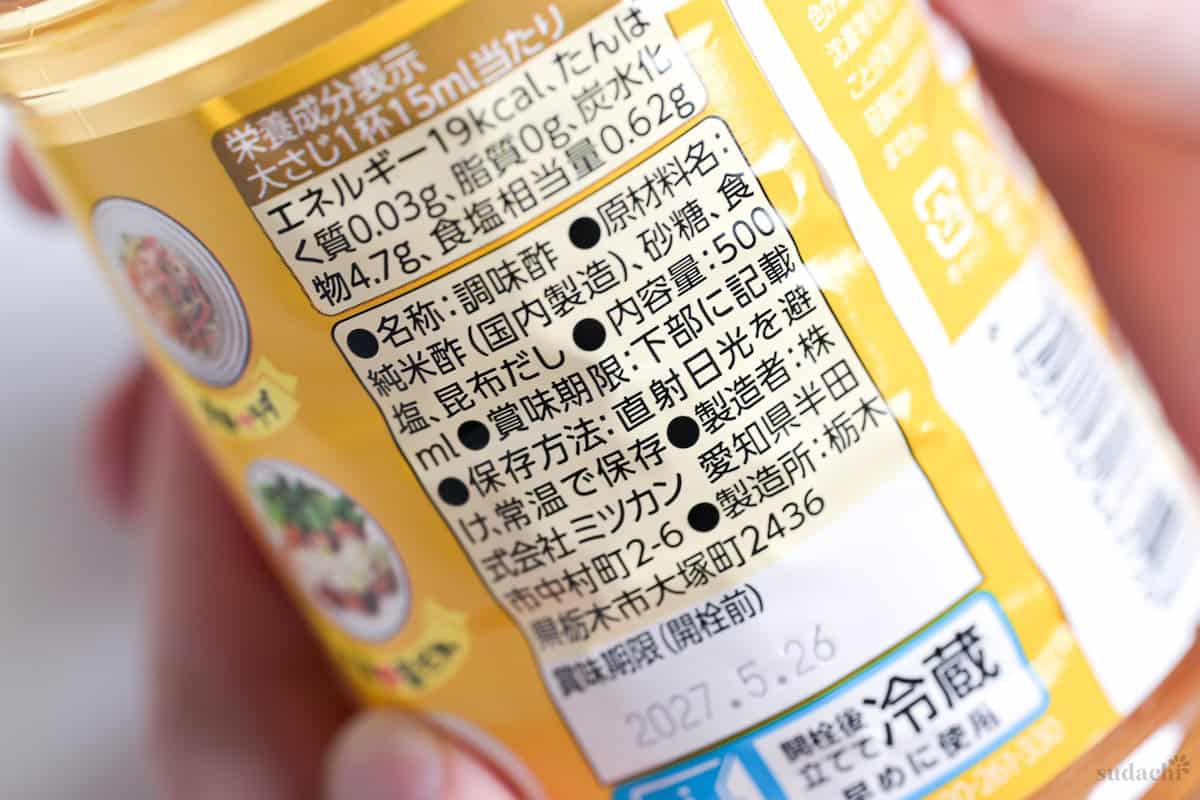
Flip the bottle and read the ingredient list. If it lists only rice or rice and alcohol, it is plain rice vinegar. If you see sugar, salt, or corn syrup, it is seasoned.
If you are buying only one bottle, choose plain (unseasoned) rice vinegar. It works for everything: sushi rice, dressings, pickles, marinades, simmered dishes. You can always add sugar and salt yourself, but you cannot remove them from a pre-seasoned product. Seasoned sushi vinegar has only one advantage: speed. But the advantage is only valid if you use it to make sushi rice.
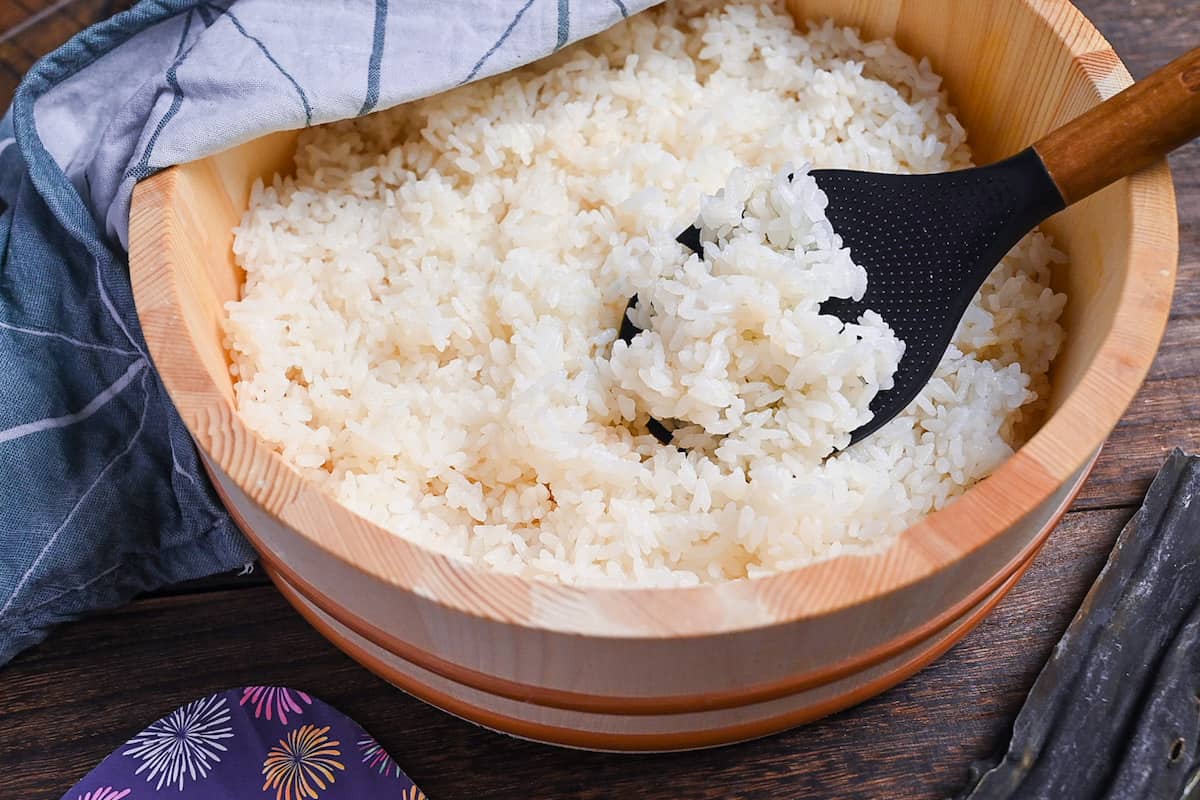
Just to be clear, none of my recipes use sushi vinegar.
Types of Japanese Vinegar: What the Labels Actually Mean
Japan has a precise classification system for vinegar under the Japanese Agricultural Standards (JAS), and understanding it will completely change how you shop. No English-language article explains this properly, which is a shame because it is the key to choosing quality products.
The JAS Hierarchy
All food vinegar in Japan falls into one of 2 categories. Brewed vinegar (醸造酢) is made through genuine fermentation and must contain absolutely no synthetic acetic acid. Synthetic vinegar (合成酢) is diluted glacial acetic acid with added flavoring, but today, synthetic vinegar has virtually disappeared from Japanese household kitchens.
Within brewed vinegar, the hierarchy gets specific:
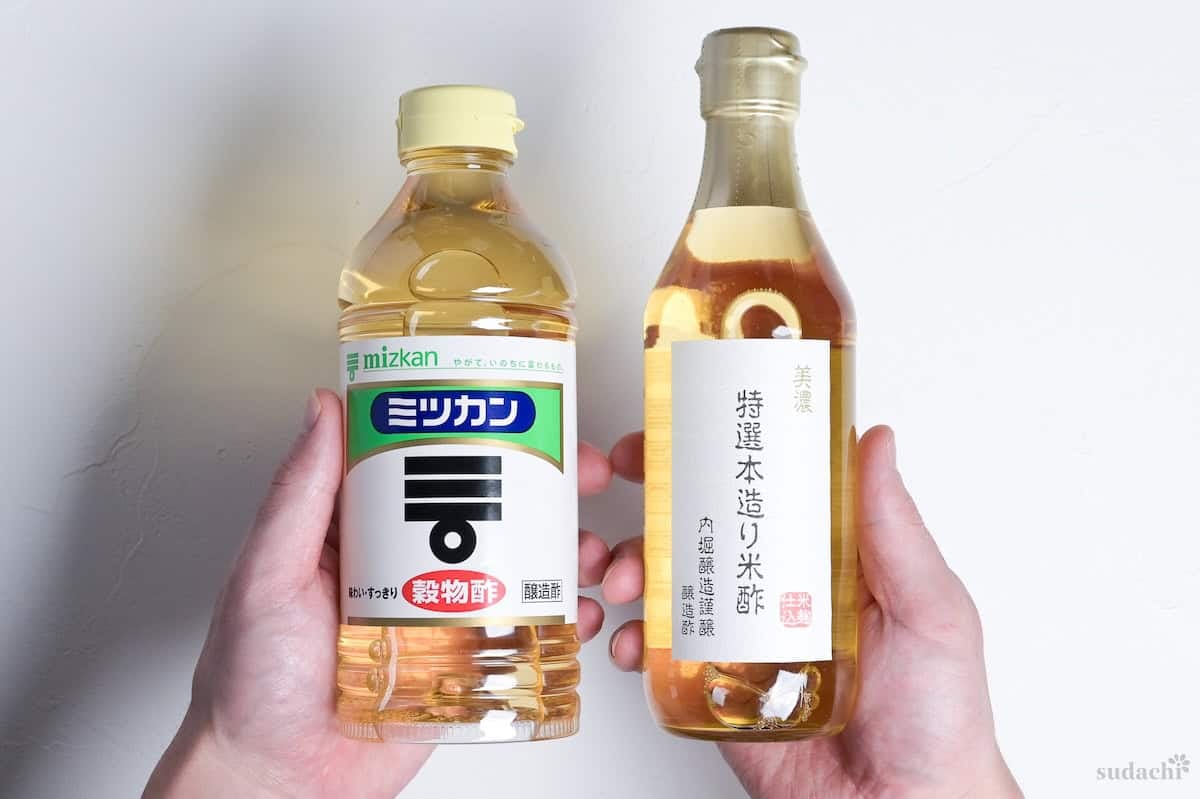
- Grain vinegar (穀物酢 / kokumotsu-su): requires at least 40 g of grain per liter. This is the workhorse vinegar in Japan. Made from blended grains. Clean, sharp, straightforward. Ideal for cooking with heat.
- Rice vinegar (米酢 / komezu): grain vinegar with at least 40 g of rice per liter. Milder, slightly sweet, with rice-derived umami.
- Pure rice vinegar (純米酢 / junmai-su): NOT a separate JAS category, but an industry term for rice vinegar made exclusively from rice without added alcohol.
The Gap Between Rice Vinegar and Pure Rice Vinegar
The JAS minimum for komezu is only 40 g of rice per liter. But to actually make vinegar from rice alone, without adding industrial alcohol, you need a minimum of roughly 120 g of rice per liter. That 80 g gap is bridged by adding cheap alcohol.
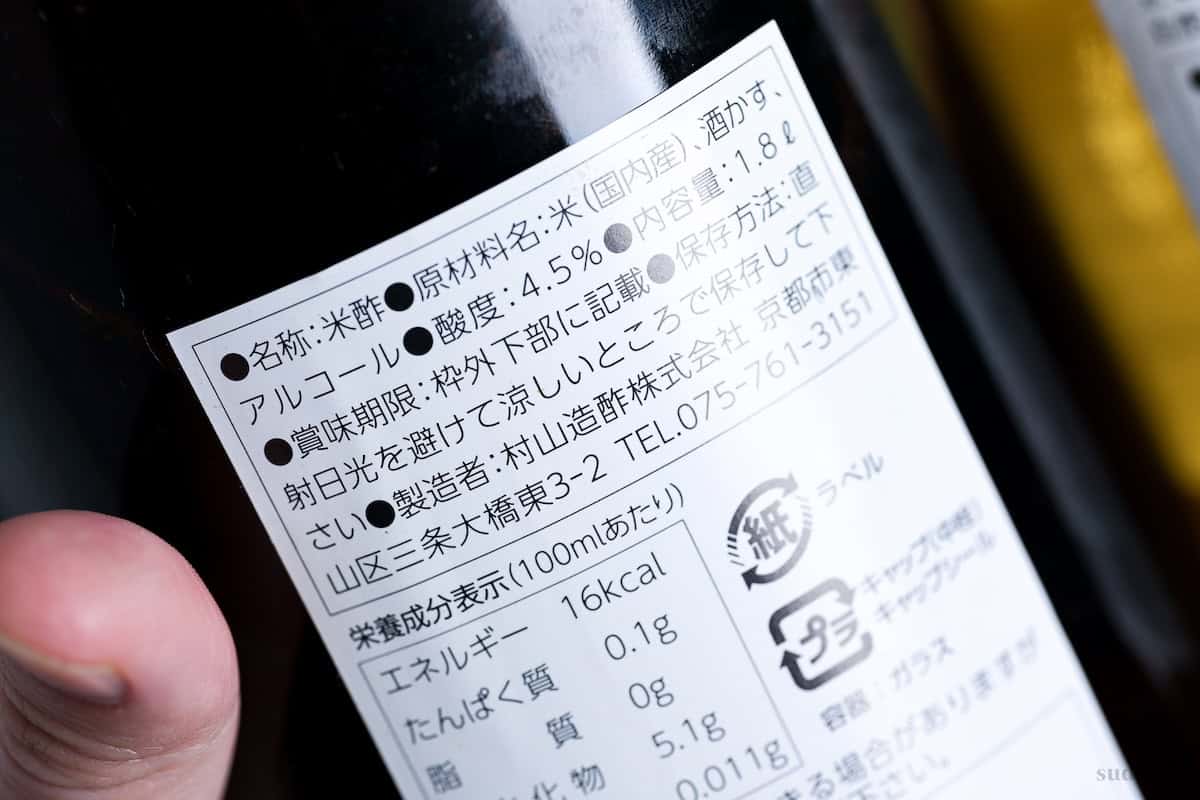
This means many products legally labeled “rice vinegar” contain substantial industrial alcohol alongside a relatively small amount of rice. When you pick up a Japanese vinegar bottle, check the ingredient list (原材料名). If it says only “米” (rice), you are holding pure rice vinegar. If it says “米, アルコール,” the rice content is supplemented with added alcohol.
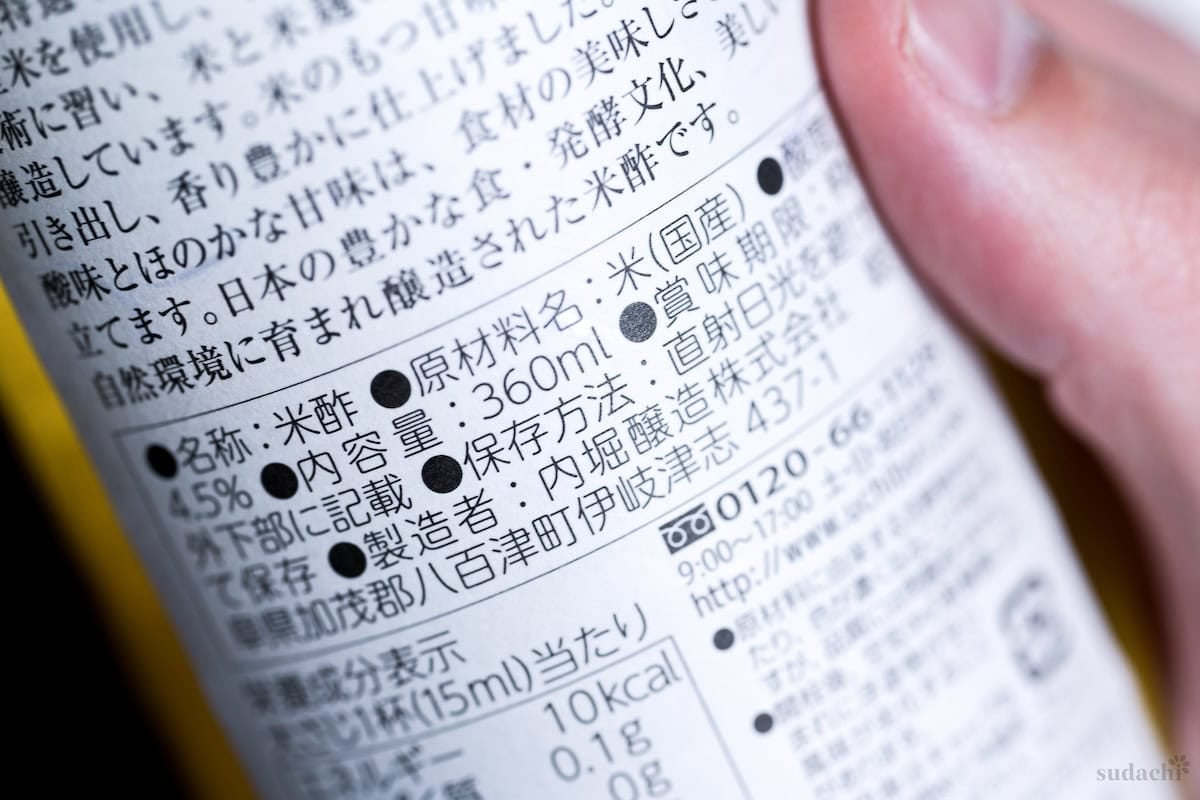
Premium producers go far beyond the JAS minimum. Iio Jozo uses 200 g of rice per liter for their standard Fuji-su, 5 times the legal minimum, and 320 g per liter for their Premium version.
Beyond Komezu: Japan’s Other Vinegars
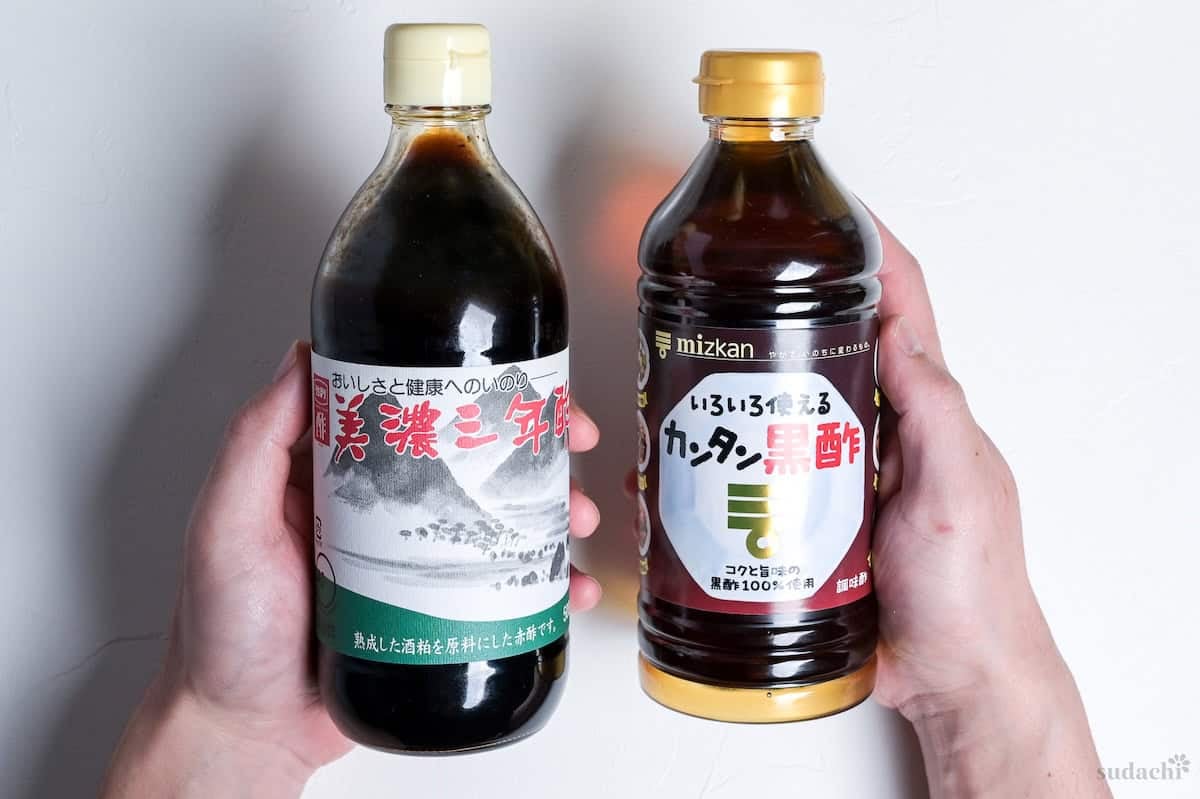
- Kurozu (黒酢), black vinegar is one of the world’s most extraordinary fermented products. Made in ceramic pots outdoors over a minimum of 1 year, it contains roughly 500 mg of amino acids per 100 mL, about 5 to 10 times that of regular rice vinegar.
- Akasu (赤酢), red vinegar made from aged sake lees, is the most historically consequential vinegar in Japanese culinary history. It is the vinegar that made Edomae sushi possible for ordinary people, and its near-disappearance after 1951 is the reason modern sushi rice tastes the way it does today.
- Genmai-su (玄米酢), brown rice vinegar, uses unpolished rice and retains the nutrient-rich bran layer. It has an amber color, a mildly nutty aroma, and is popular as a daily wellness supplement diluted in water.
Recommended Rice Vinegar Brands
Tier 1: Supermarket Staples
- Marukan Pure Rice Vinegar is probably the most widely available rice vinegar in US supermarkets. Founded in 1649 and now operating out of Paramount, California. Reliable and clean-tasting.
- Mizkan Rice Vinegar and Kikkoman Rice Vinegar are equally ubiquitous. Any of these 3 brands will serve you well for everyday cooking.

Tier 2: Worth the Upgrade (Asian Grocery Store)
- Mizkan Junmai-su (pure rice vinegar) is a meaningful step up. Made entirely from rice without added alcohol, it has noticeably richer umami.
- Uchibori rice vinegar, from Japan’s second-largest vinegar company, is another excellent choice.
Tier 3: The Gold Standard (Specialty)
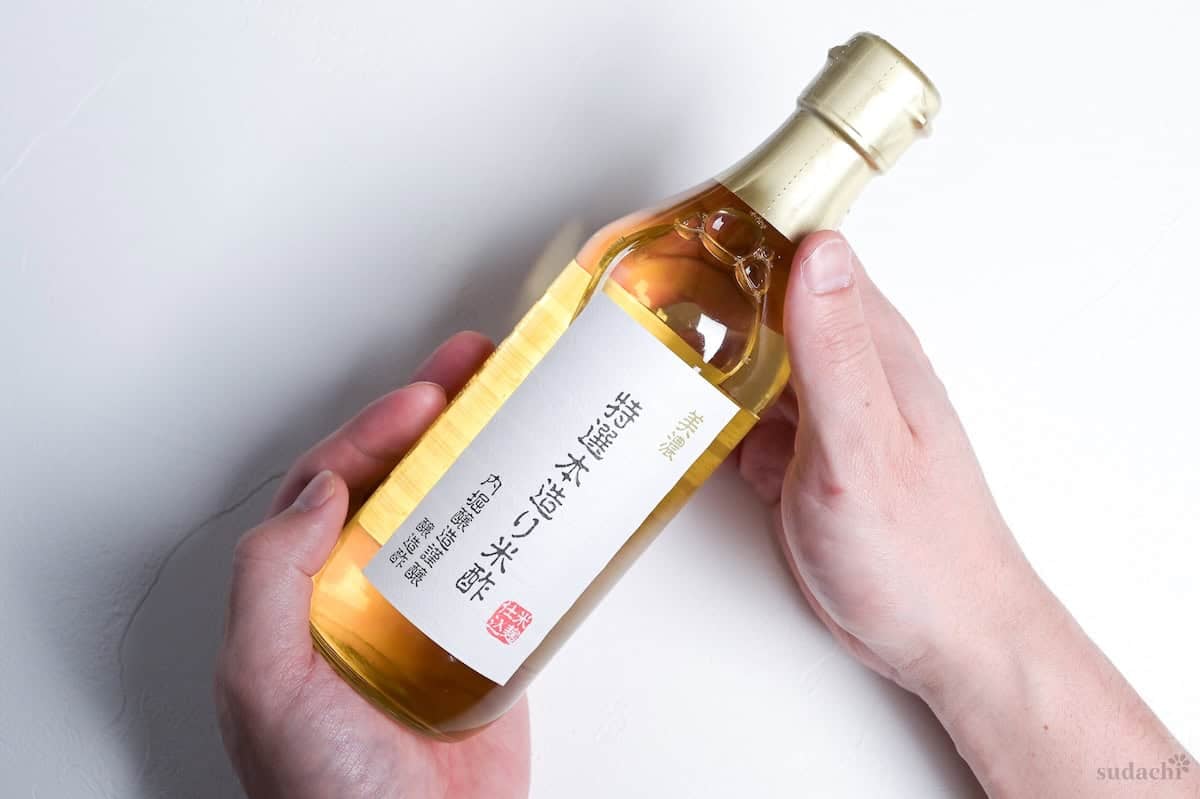
- Iio Jozo Fuji-su uses 200 g of rice per liter (5 times the JAS minimum) with pesticide-free rice and static fermentation. Their Fuji-su Premium at 320 g of rice per liter is extraordinary.
How to Read Japanese Vinegar Labels
- Look for 純米酢 (junmai-su) for the richest flavor
- Check the ingredient list: “米” only = pure rice. “米, アルコール” = rice + added alcohol
- Acidity (酸度): standard is 4.2 to 4.5%
Rice Vinegar Substitutes
- Apple cider vinegar: Best overall substitute. 1:1 ratio.
- White wine vinegar: Mix 2/3 white wine vinegar + 1/3 water, then add a touch of sugar.
- Champagne vinegar: Closest match in delicacy. 1:1.
- Distilled white vinegar: Mix 4/5 white vinegar + 1/5 water, then add sugar to taste. Not recommended for raw preparations.
- Lemon/lime juice: Different acid type entirely. Works contextually but fundamentally different.
- Mirin + white vinegar (equal parts): Particularly close approximation for cooked dishes.
For authentic sushi rice or sunomono, there is no adequate substitute. The amino acid profile from rice fermentation is absent from all alternatives.
How to Store Rice Vinegar
Unopened: 2 years best-by (quality, not safety). Vinegar is self-preserving.
Opened plain: 6 months at room temperature, up to 1 year refrigerated.
Opened seasoned: Refrigerate immediately.
3 enemies: light, heat, air. Store in dark bottle, cap tightly, keep upright.
White jellyfish-like material in older bottles = cellulose from acetic acid bacteria. Completely harmless. Brown sediment = Maillard reaction, also harmless.
Most rice vinegars are 4.0 to 4.3% acidity, below the USDA 5% minimum for safe water-bath canning. Always check the label.
Rice Vinegar FAQ
Yes. Identical products with different names.
Pure rice vinegar, yes. Check grain vinegar ingredient lists.

Leave a rating and a comment