

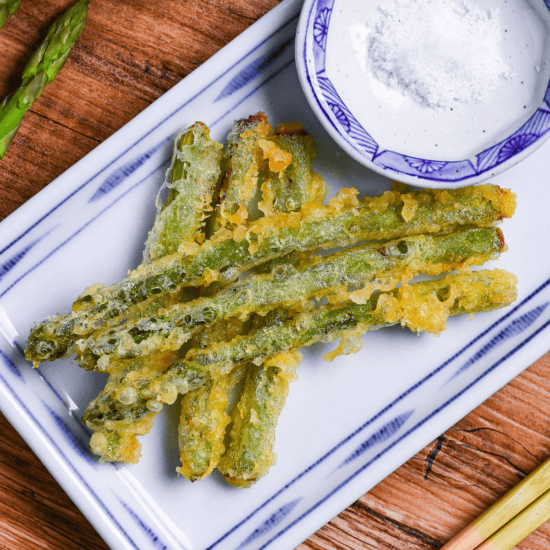


When you snap a spear open with chopsticks, hot juice bursts from the center. The crisp shell cracks with a dry sound, and yet the asparagus inside is still steaming, still full of its own bright moisture.
That is why it tastes sweet with nothing but salt. What fried in the oil was the batter, while the spear steamed inside its own jacket. Eat them the moment they land on the plate.
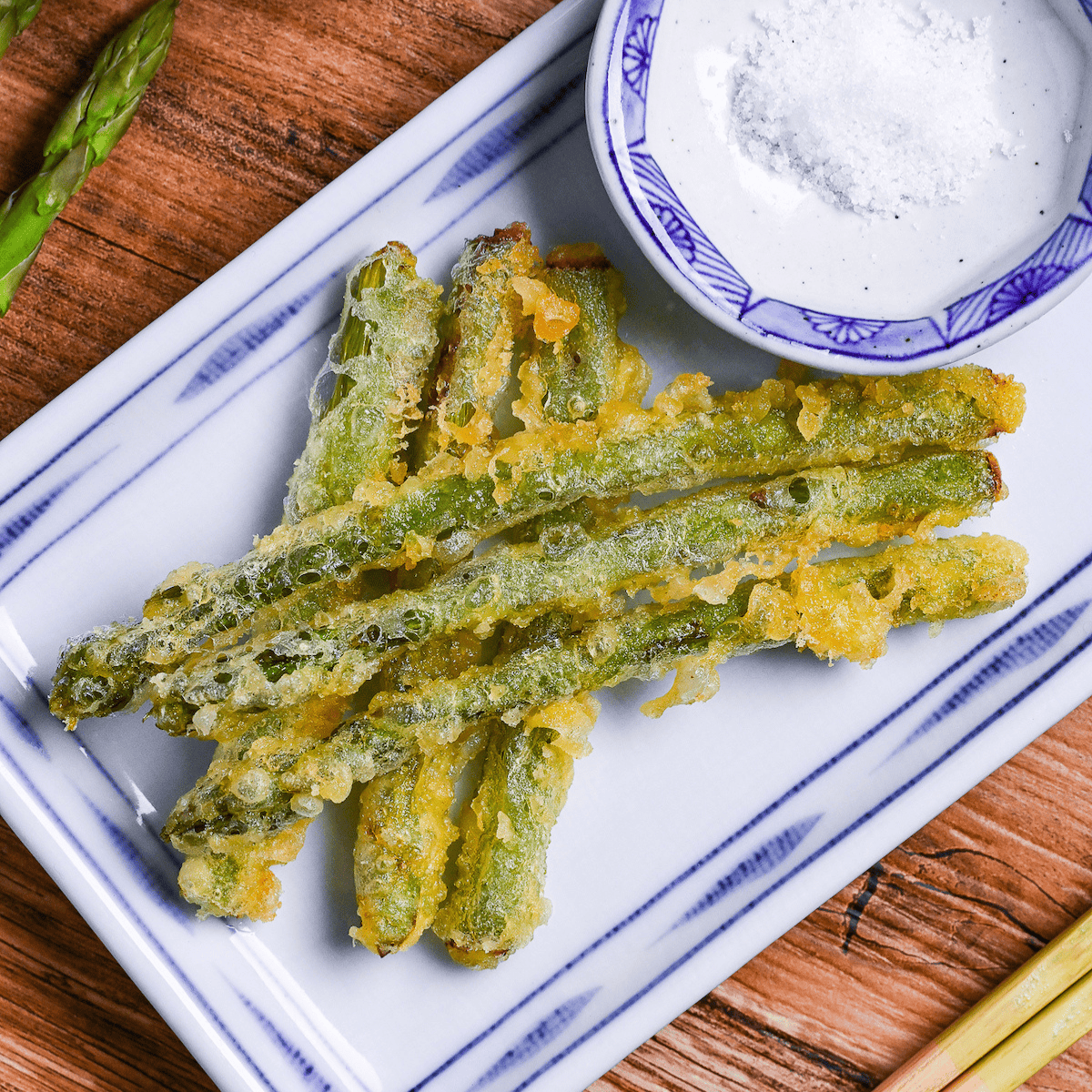
Asparagus Tempura
Recipe Snapshot
- What is it? Asparagus tempura is a single-vegetable tempura, raw spears dipped in a thin batter and fried, then eaten with salt or tentsuyu (tempura dipping sauce). No blanching and no marinade.
- Flavor profile: The thin coating breaks with a short dry snap. The spear inside keeps a spring, green sweetness builds as you chew, and no oil weight stays behind.
- Why this recipe works: Cornstarch goes into the flour, the 1 move left standing after many rebuilds, so a path to a heavy coating closes. Dusting flour gives the batter something to grip.
- How to make it: Chill the flour and the water first, then mix the batter just before frying. 1 pot is enough. Dust each spear, dip, and lower it into 170°C (338°F) oil.
- What to expect: It serves 4 and takes 40 minutes, 30 of which is chilling, so hands-on time is short. Wet spears are the stumble, the batter slides and the oil spits.
Summarize & Save this content on:
What Is Asparagus Tempura?
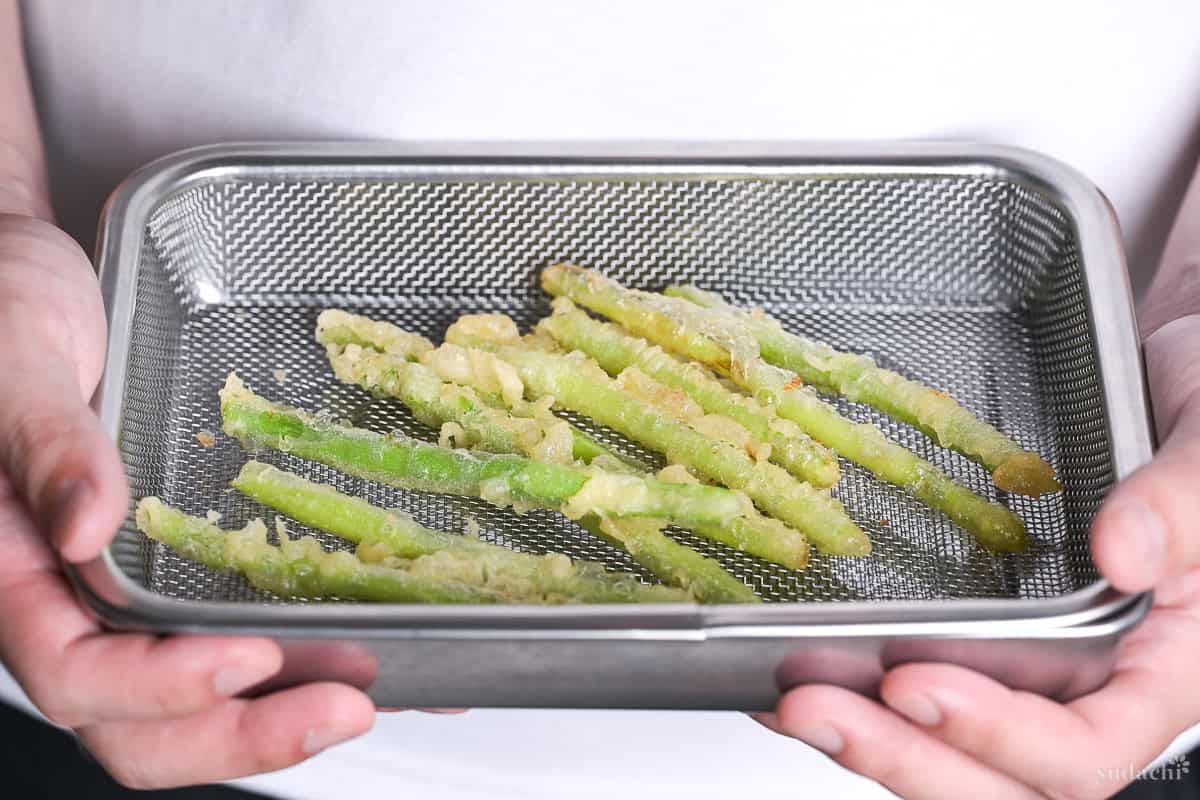
Asparagus tempura is a Japanese single-vegetable tempura, whole spears dipped in batter and fried without being cut. It turns up as a side dish at home, on top of soba or udon, and as the tempura in a rice bowl. In North America, asparagus tempura usually means a sushi roll built around a battered spear. That is a maki roll invented over there. What I am making here is the fried spear itself, served as it is.
My batter leaves the standard home version in 3 places. First, I blend cornstarch into the cake flour. After rebuilding the same batter many times over, what I could see clearly was that adding starch cuts down the ways it can fail. It is not a finishing move you add once you are good at this. It is insurance you take out at the start. Second, the water is half carbonated and half ice-cold. All carbonated water gives the most lift, and it also spits hardest the moment it meets the oil. On a home stove this ratio sits where lift and safety meet. Third, egg yolk instead of whole egg. That is not a preference but a matter of volume, since my tempura batter recipe switches to yolk when you halve it. A yolk-only batter fries deeper in color and richer, and it holds its crispness for less time.
Tempura Asparagus Ingredients
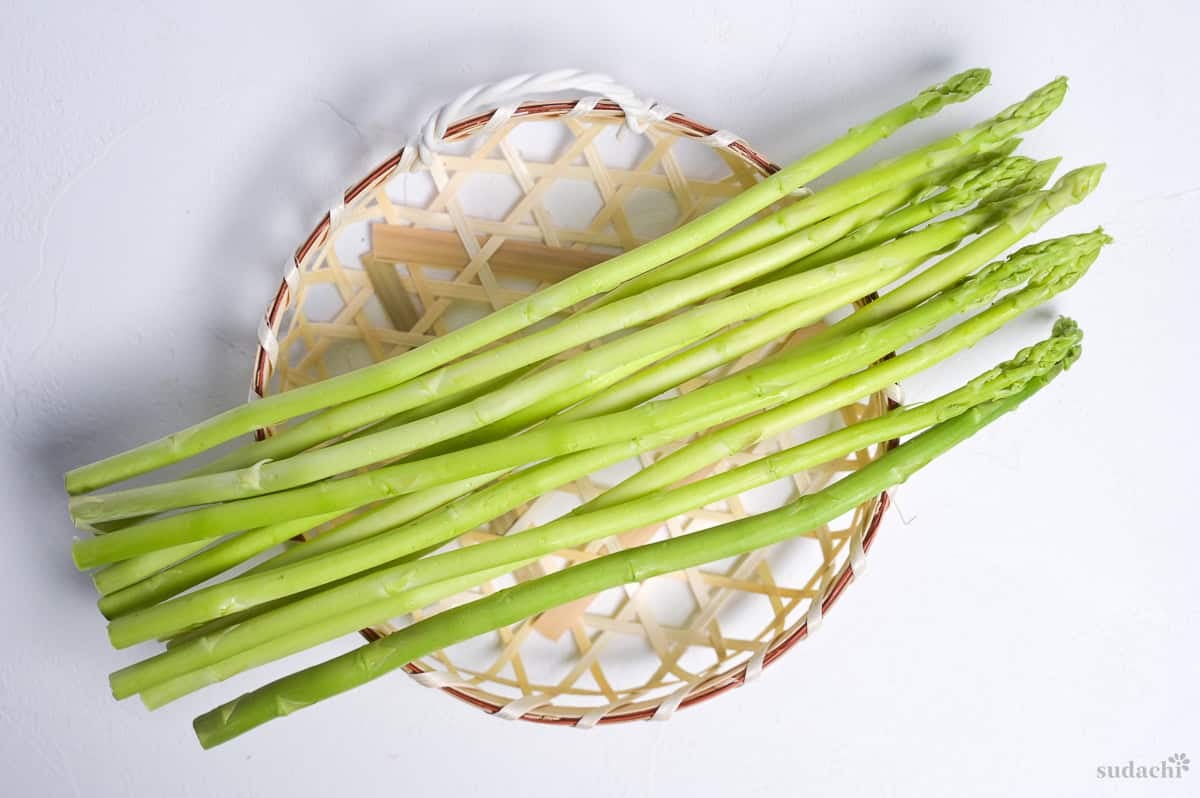
- Asparagus: The only star here, and it asks nothing of you before it goes in. Frying pulls the sweetness forward while the inside keeps a raw spring. No blanching and no marinade, so you wash the spears, pat them dry, and that is the whole prep.
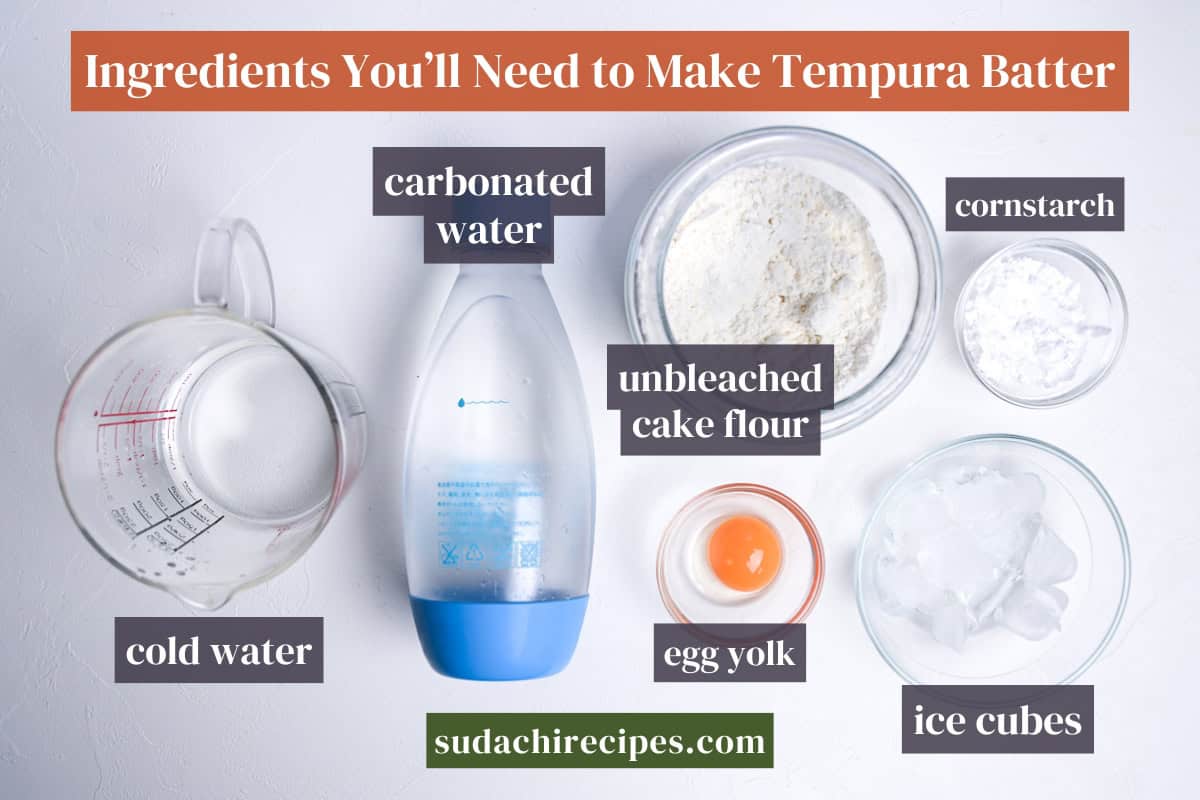
- Cake flour: This flour builds the frame of the coating. The less protein it carries, the less gluten it can form, and the lighter the coating fries, so the bag to reach for in English is cake flour rather than all-purpose flour. Grab any box marked cake flour and you are set, then? Not quite. Most cake flour milled in the US is chlorinated, and chlorinated flour takes on water and holds it. Tempura wants the opposite. The flour has to let its water go fast in hot oil so the coating sets before the oil can move in. Plain flour in the UK and Australia runs a touch higher in protein, but it sits on the unchlorinated side of the shelf, which puts it closer to the mark.
- Egg yolk: The yolk brings richness, a pale color, and enough body to hold the batter together. This one takes the yolk alone rather than the whole egg.
Substitutions, Variations, and How to Customize
The flour, the water, and the egg in this batter all bend to what you already have, so start from whatever is within reach.
Substitutions:
- Cake flour → All-purpose flour plus cornstarch: The surest way out when cake flour is nowhere on the shelf. Cut cornstarch into all-purpose flour at somewhere between 2 to 1 and 4 to 1, and the protein ratio drops far enough to land near the lightness of cake flour. All-purpose on its own still fries, but the coating comes out a step heavier.
- Cake flour and cornstarch → Pre-mixed tempura flour: The starch and the leavening are already blended into the bag, so cold water is the only thing you add for a light coating. Asian and Korean groceries usually keep it in the flour aisle. Leave the extra cornstarch out if you go this way, because it is in there already.
- Carbonated water → Ice-cold water: This works with no carbonated water at all. The bubbles take the coating 1 step lighter. If you go all water, chill it harder than you normally would.
- Part of the ice-cold water → Vodka: Swapping part of the water for vodka loosens the batter without building gluten, and the coating stays crisp for longer. It is an upside play rather than a requirement. Lean on it too hard and the coating turns thick and firm, drifting away from the thin Japanese style.
- Egg yolk → Egg mayonnaise: The egg and the oil arrive already emulsified, so the richness lands closest to the yolk. Reach for it on a day when you are out of yolks.
Variations:
- Egg-free (shojin age): Leave the egg out and build the batter from rice flour, or from cake flour with cornstarch. The color comes up paler. If that is the direction you want, my egg-free tempura batter recipe covers it.
- Split the spears lengthwise: Quarter the stalks lengthwise before they go into the batter and you get a thinner, lighter bite than a whole spear gives. It works best with thick ones.
- Make it part of a mixed platter: Put the leftover batter to work on shrimp tempura, eggplant, sweet potato, and lotus root, and serve the whole lot as a tempura platter. Fry each one in its own batch so every one of them comes out right.
How to Customize:
- Change the salt: Matcha salt, curry salt, salt with lemon squeezed over it. The same fried spear becomes a different plate with nothing changed but the salt.
- Tentsuyu and grated daikon: Dip in tentsuyu instead of reaching for salt. Grated daikon alongside it cuts the weight of the oil and leaves the finish lighter.
How to Make My Asparagus Tempura
Before you start (Mise en place):
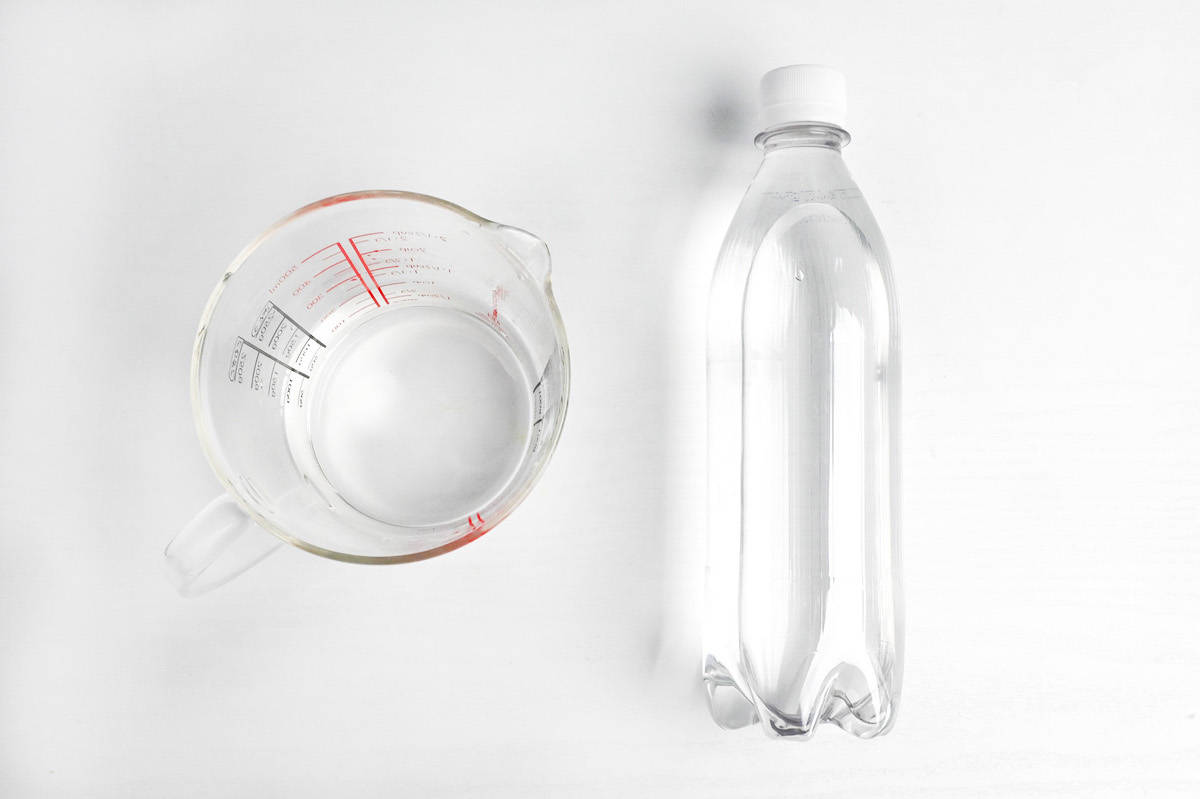
- Pour the ice-cold water into a container and put it in the fridge. The carbonated water goes in unopened, and the egg yolk goes in with them.
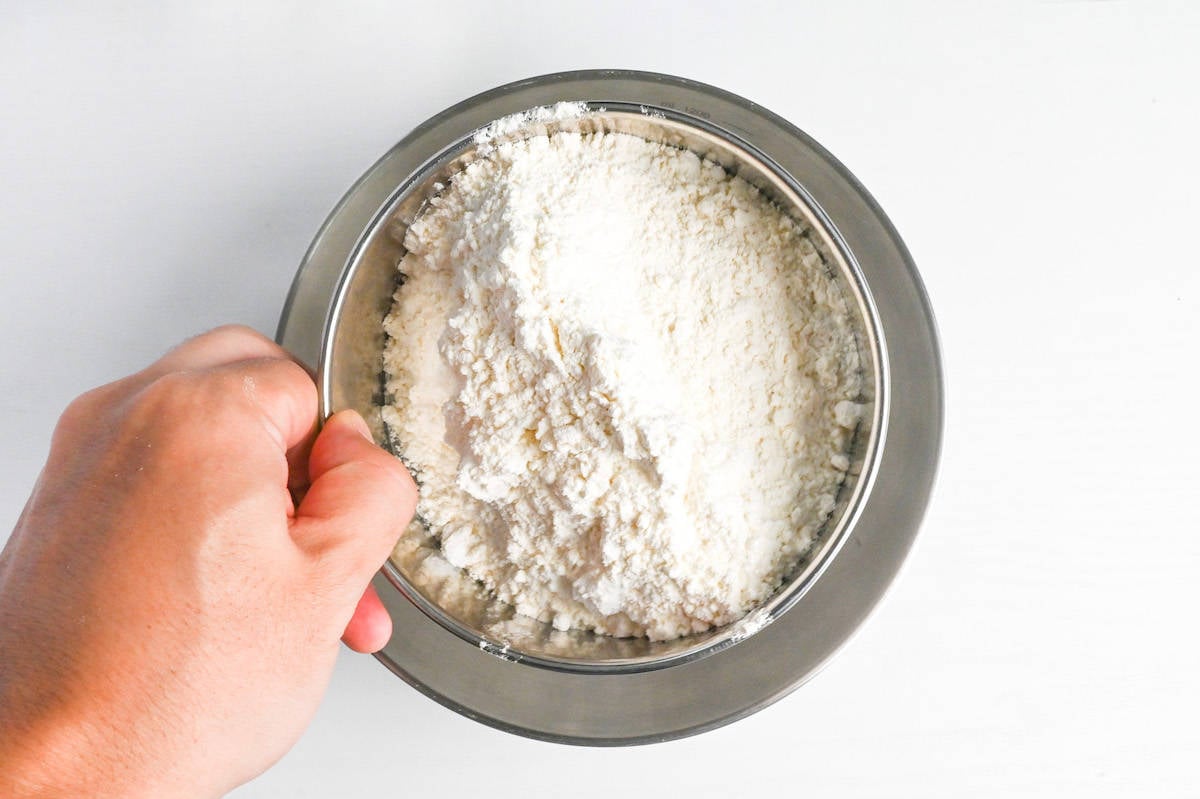
- Sift the cake flour and the cornstarch together into a bowl and put the bowl straight into the freezer.
- Give both of them 30 minutes. The heat does not go on until that is done.
To develop this recipe, I used a tempura pot with a built-in thermometer.
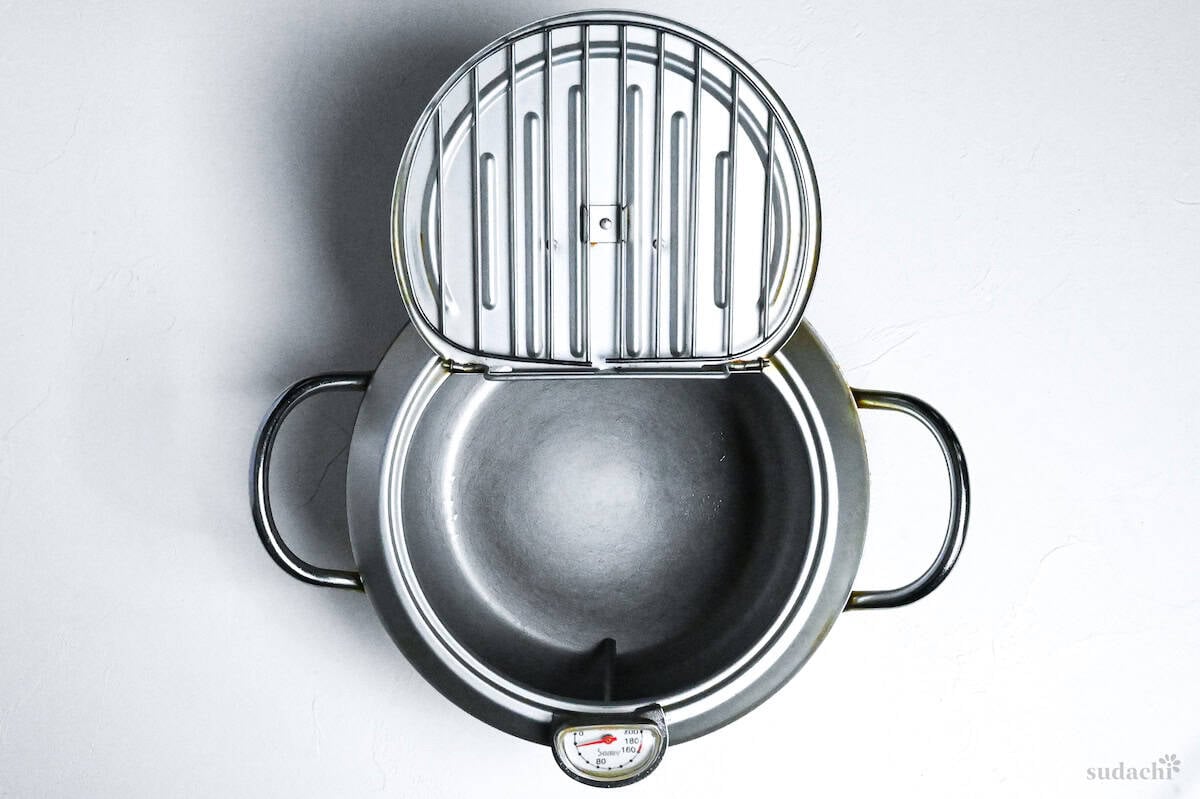
i. Pour oil into a heavy-bottomed pot, at least 5 cm (2 inches) deep, and start heating it toward 170°C (338°F).
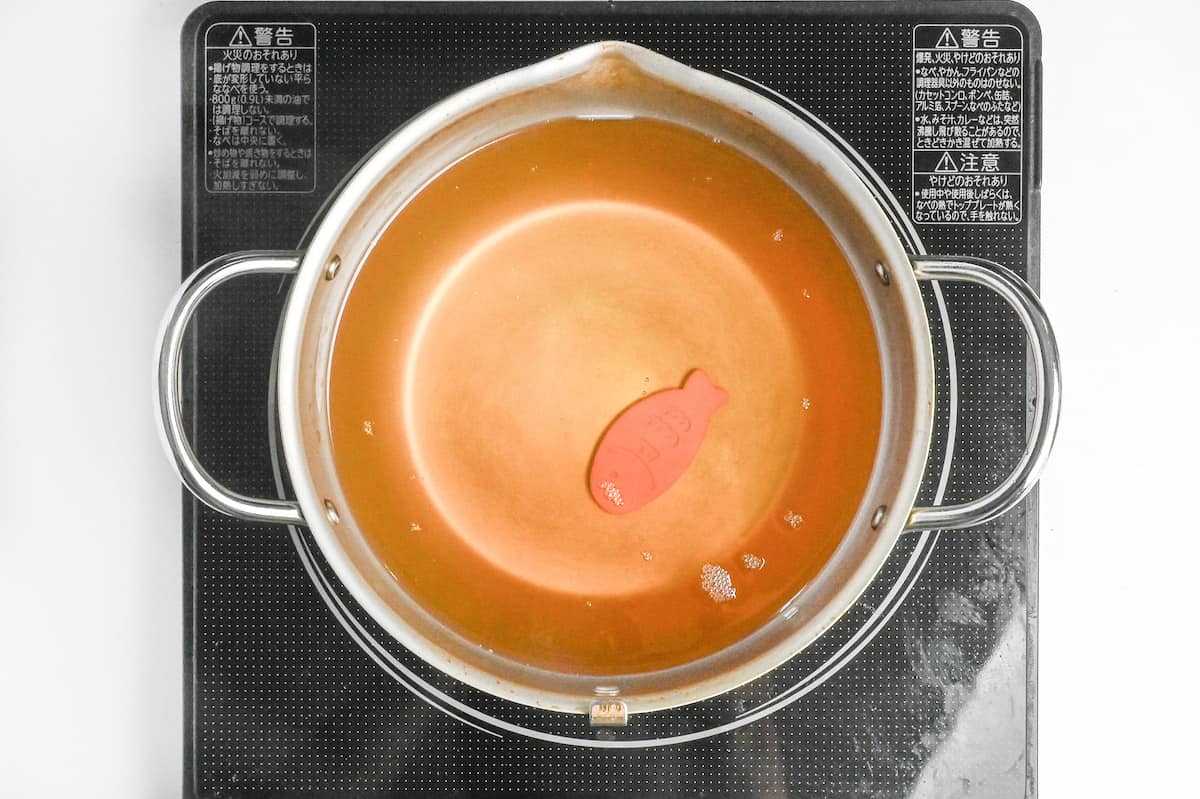
ii. While it heats, wash the asparagus and dry it well with paper towels. Water on the surface makes the batter slide and the oil spit.
iii. Snap or cut about 1 cm off the woody base. If the skin low on the stalk feels tough, take a peeler to the bottom third.
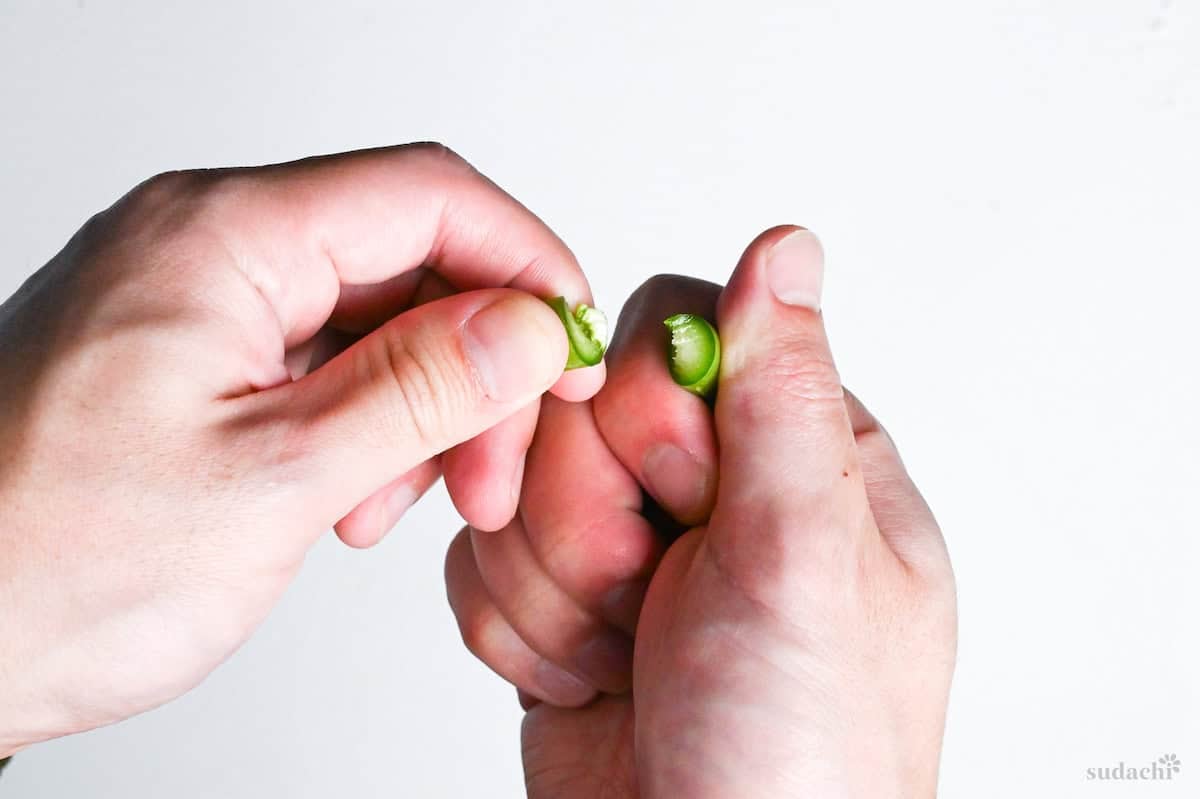
iv. Use the spear whole if you can. Cut it in half only when the pot is too small to take it.
A knife leaves a cut face, and while the spear fries, the water and the green smell walk out through it. Keep the spear whole and both are still there when you bite. Halve it for the pot if you must. That costs you a single cut, and no more.
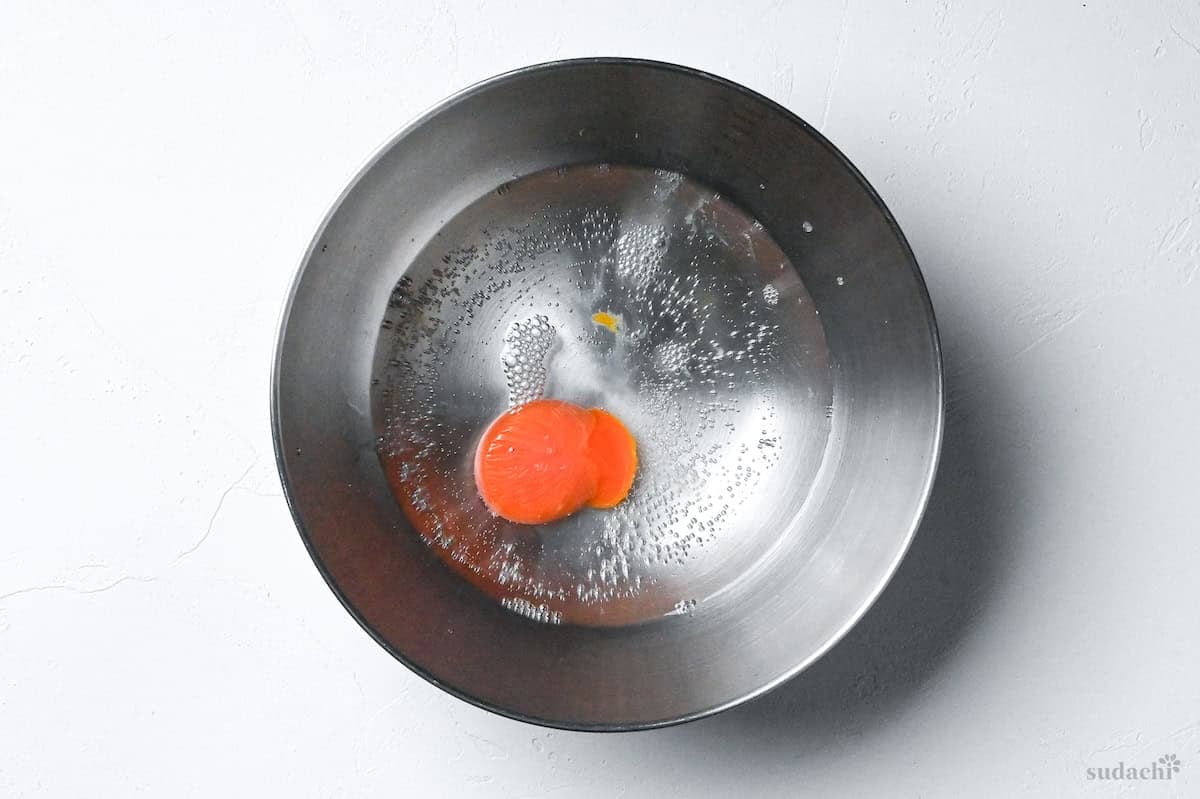
i. Combine the chilled water and carbonated water, drop in the egg yolk and mix lightly.
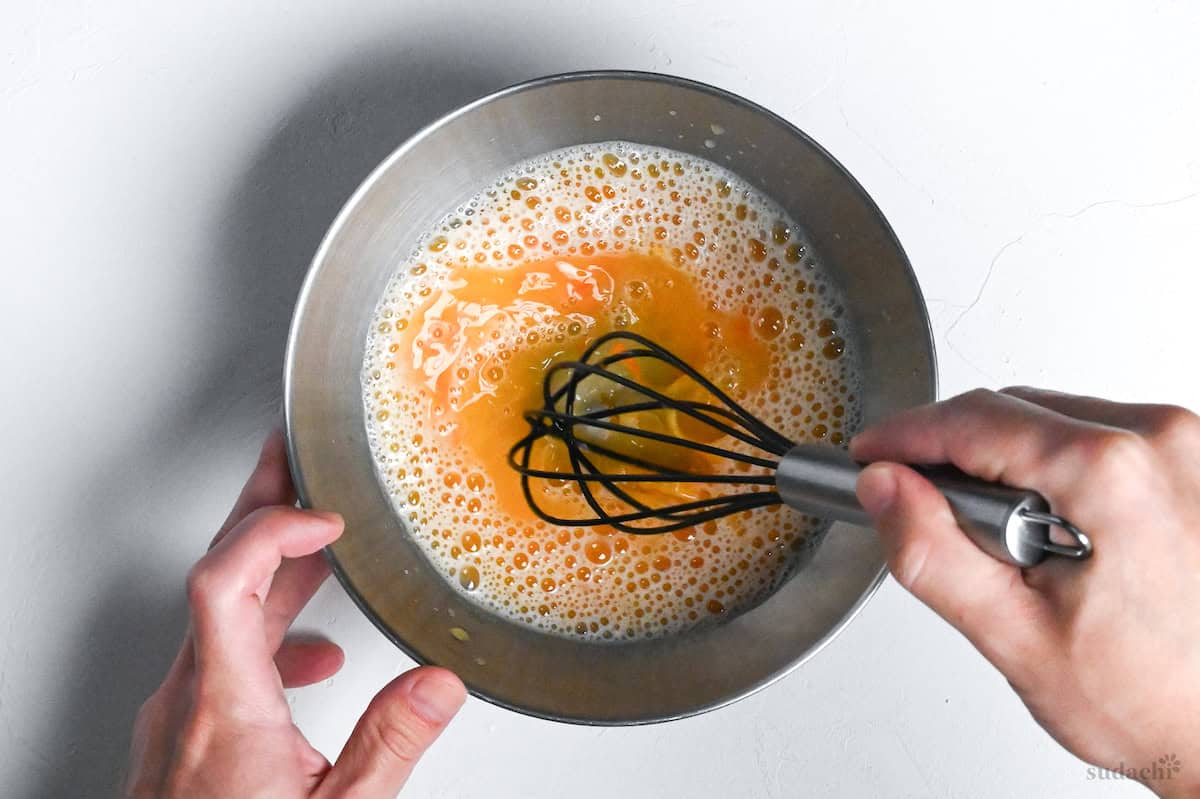
ii. Add the freezer-cold flour in thirds, cutting a cross through it with chopsticks each time. Stop when no dry flour shows. Lumps are fine.
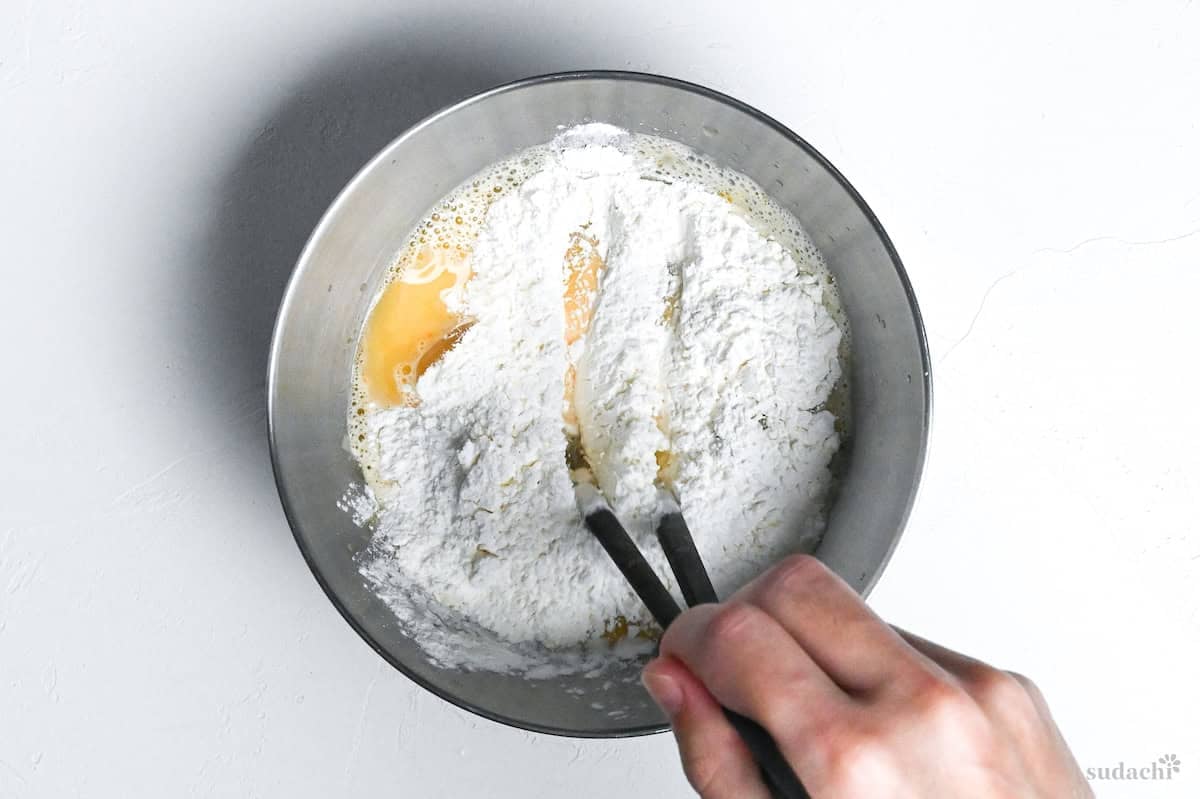
iii. In batches, or in a warm kitchen, drop in a few ice cubes and push them aside, clear of your chopsticks.

iv. Test the oil with a little batter. Sinking halfway and floating straight back up means it is time. Instant color means too hot, and no bubbles means too cold.
Gluten forms when the proteins in wheat link up, and the warmer things are, the faster they link. So the flour and the water both go cold. The water does the heavier lifting. It outweighs the flour about 2 to 1 and warms slowly, so it is what holds the temperature of the whole bowl down.
i. Dust each spear with a thin coat of cake flour, evenly, from tip to base.
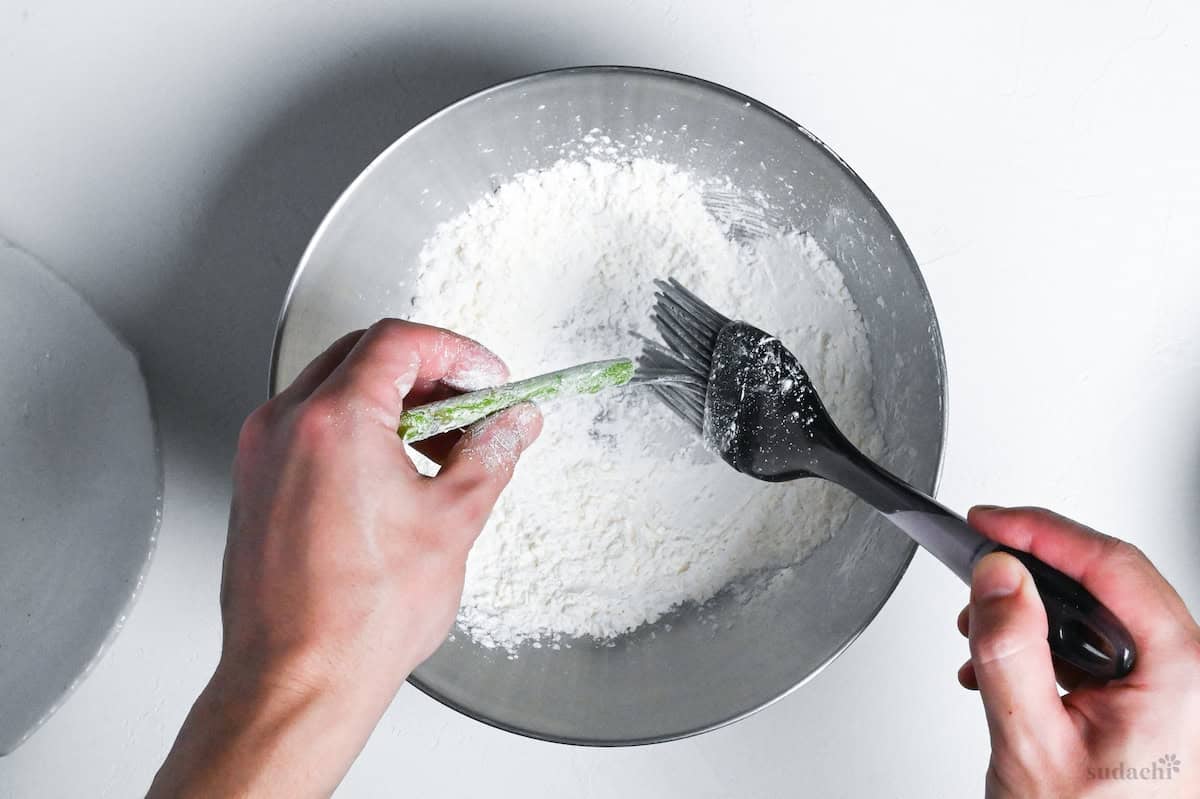
ii. Knock the excess off properly. Too much flour builds a thick coating, and a thick coating is the one that peels away.
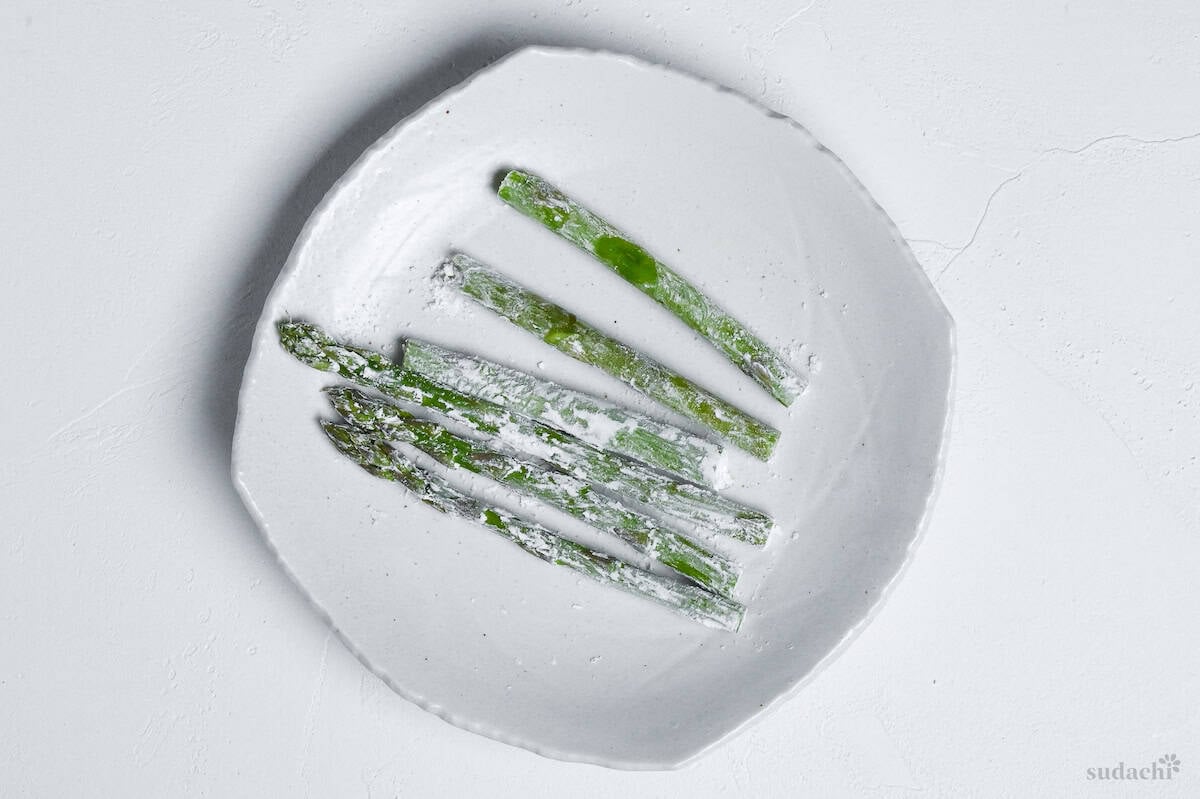
The surface of an asparagus spear is smooth, and batter slides right off it. Lay a thin sheet of flour down first and the batter has something to hold. Almost every coating that falls off in the oil comes from skipping this, or from piling the flour on too thick.
i. Run the floured spear through the batter, let it drip for 1 second, and lower it into the oil. Keep the spears apart so they do not overlap and stick together.
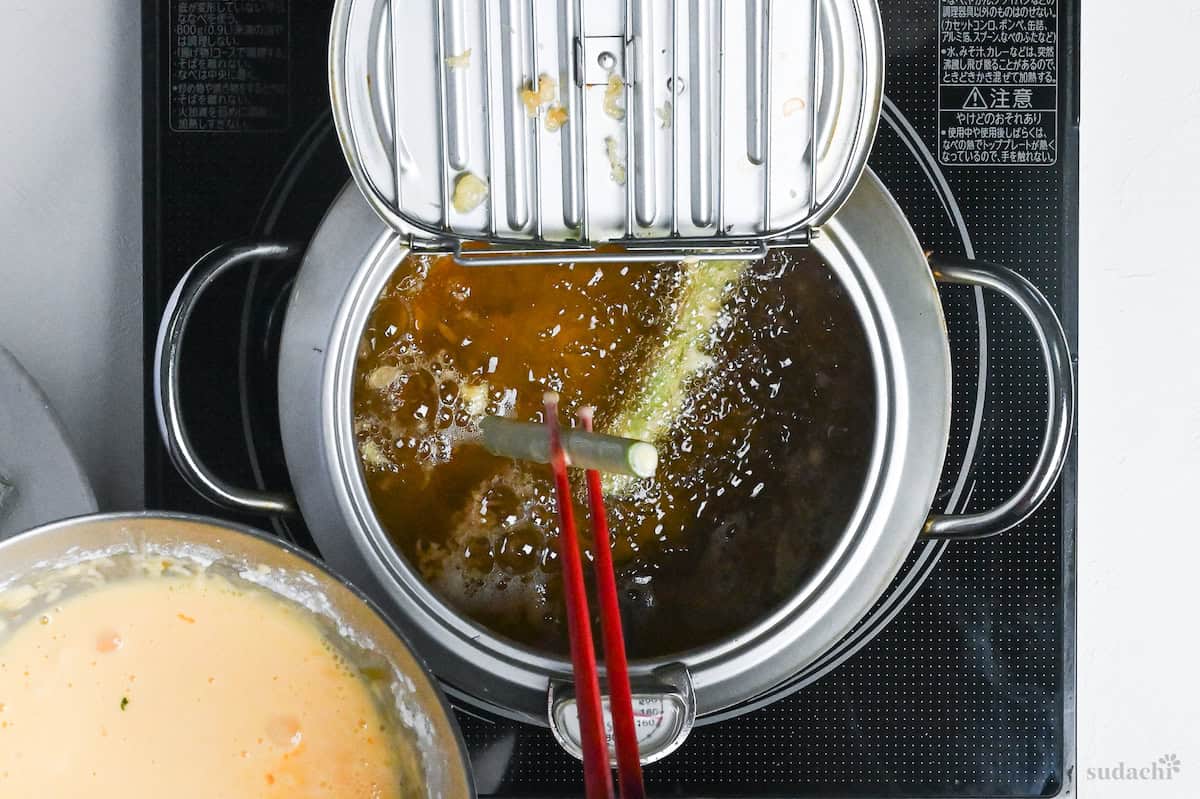
ii. Leave it alone for the first 30 to 45 seconds. While the bubbles stay fine and the sound stays light, water is leaving at the right speed.
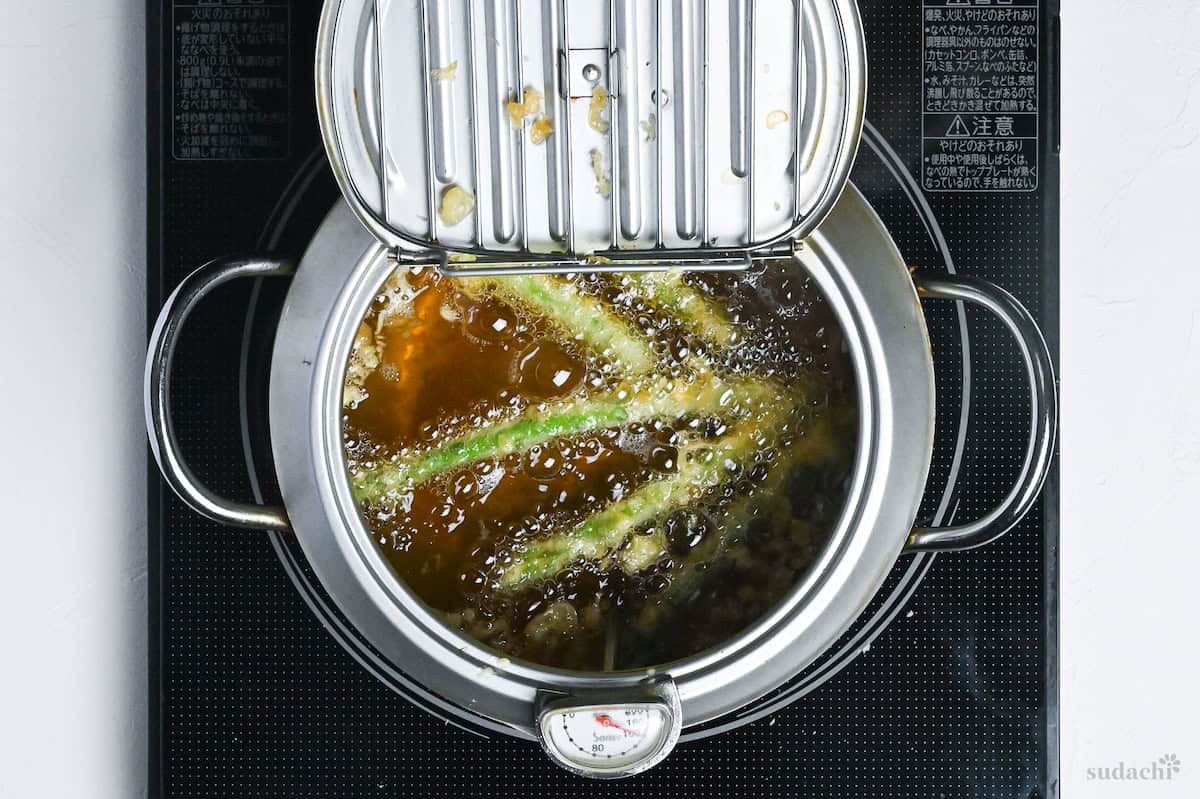
iii. After that, roll it with chopsticks so it fries evenly all over.
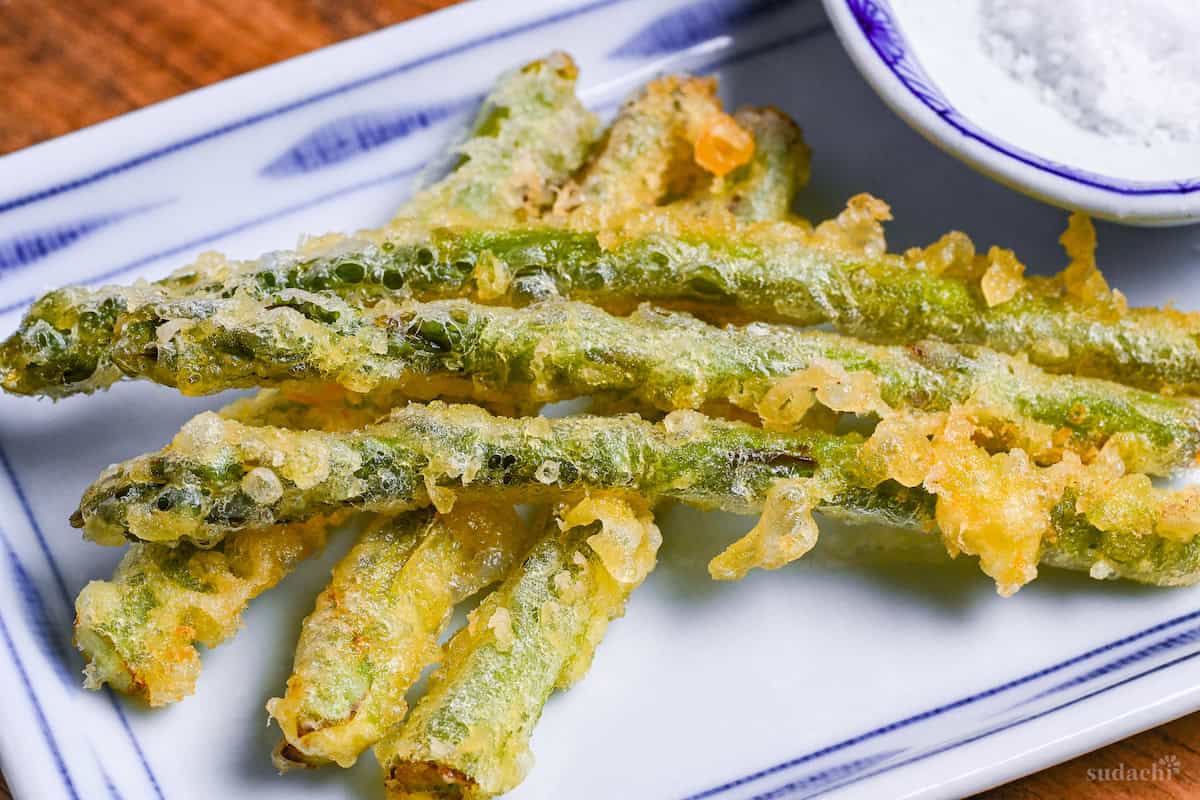
iv. Lift it out while the coating is a pale gold and the asparagus is still bright green. Figure on 90 seconds.
The big bubbles at the start turn fine, and the frying sound climbs and lightens. That change is what decides when the spear comes out. 90 seconds is a starting point, and it moves with how thick each spear is.
i. Lift each spear straight onto a rack as it comes out, spaced apart, and let the oil drain.

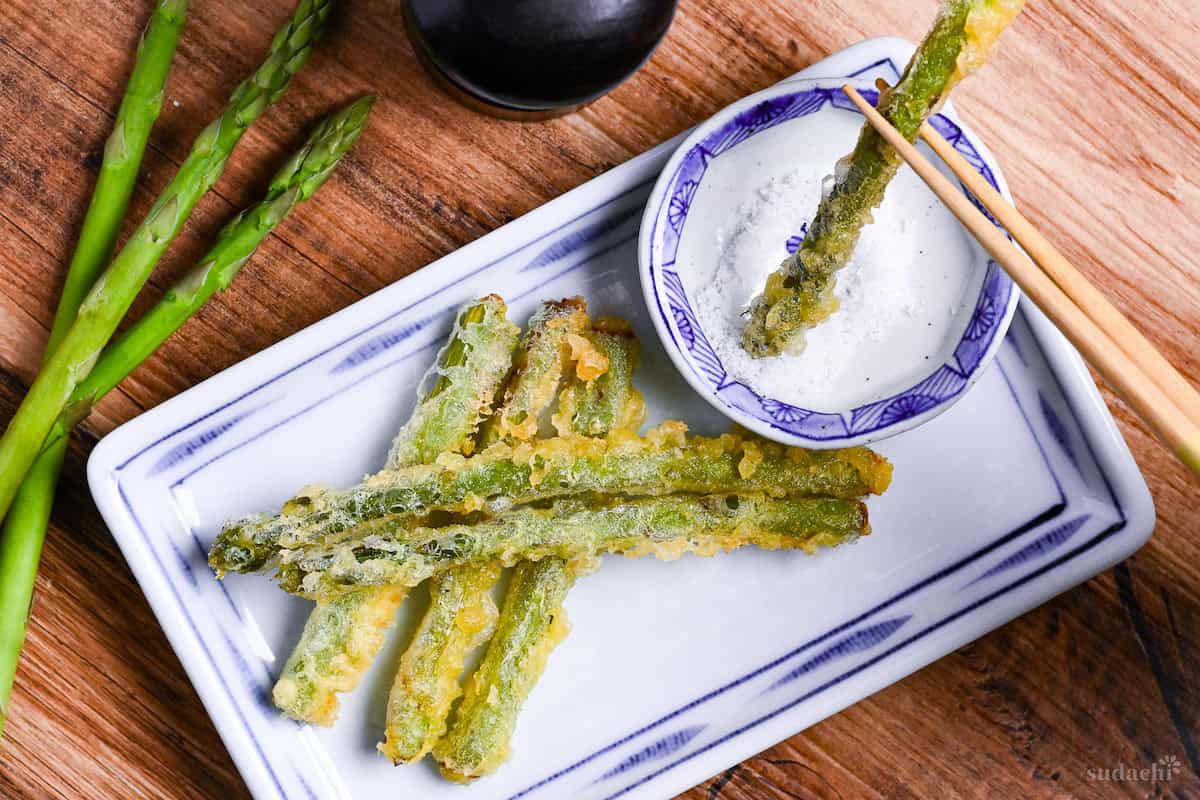
ii. Eat it hot with salt. Tentsuyu works too, and so does laying it out with other tempura as a platter.

Tips for the Best Tempura Asparagus
- Only put a few spears in the pot at a time. Cold batter and cold asparagus going in together pull the oil temperature down, and in cooler oil the batter drinks the oil before it sets. If the pot looks half empty, you have it right. Fry in 2 or 3 rounds and give the oil temperature a moment to climb back up between them.
- Mix the batter only after everything else is ready. Flour starts changing the moment it meets water, so there is no time to go looking for something once it is mixed. Get the oil heating, pat the asparagus dry, dust it with flour, set a rack out. Then, and only then, bring flour and water together in the bowl.
- Eat it as it comes out, do not let it wait. Tempura is at its best for the few minutes after it leaves the oil, and while it sits on a plate the coating goes damp from underneath. Instead of frying everything first, sit everyone down and hand each spear over straight off the rack. In Japan that goes without saying. Outside Japan it is the first place people slip.
All 3 of these are settled before anything touches the oil. Asparagus tempura spends so little time in the pot that most of the work is done while the burner is still off.
Storage & Meal Prep
Fridge: Not recommended.
Freezer: I would freeze rather than refrigerate. Reheat only in an oven, air fryer or toaster oven.
Meal prep: Measure and chill the batter ingredients ahead of time, but never mix it in advance, since flour changes once it meets water. Trim and peel the spears early.
Reheating: An oven, air fryer or toaster oven, 3 to 5 minutes on a rack at 200°C (400°F). Never the microwave, which steams it soft.
What to Serve With Asparagus Tempura
- Perfect Japanese Short-Grain Rice
- Classic Tofu Miso Soup
- Easy Takuan (Pickled Daikon)
- Zaru Soba (Chilled Buckwheat Noodles)
Tempura Asparagus Troubleshooting
There are 3 usual causes. You overmixed the batter, the batter went warm, or the oil temperature fell, and the oil is the one that slips easiest, because a crowd of cold spears pulls 170°C (338°F) down fast and the batter drinks before it sets. Fry fewer at a time from the next round, and give the oil a moment to climb back between them. If batter is still left in the bowl, mixing a small fresh one from freezer flour and fridge water is quicker than rescuing the warm one. The spears you already fried can go on a rack in a hot oven or toaster oven for a few minutes, which drains the extra oil off them.
Either the dusting flour got knocked off, or there was too much of it, or the surface was still wet. Asparagus skin is smooth, so with nothing dusted onto it the batter has nowhere to hold. A thick layer of flour goes the same way, sliding off in a single sheet. For the spears you have left, dry them properly with paper towels, dust thinly, tap the excess off with a finger, and dip again. The ones that lost their coating are good as they are, drained and salted like plain fried asparagus.
You fried it too long. The same thing happens when the oil runs cool, because the spears take longer to cook through and stew in the meantime. Next time, lift them out while the batter is a pale gold and the green is still bright. The guide is 90 seconds, but it moves with the thickness of each spear, so take your cue from the bubbles going fine and the frying sound turning high and light. The limp ones are still good with tentsuyu and grated daikon, or laid on hot soba or udon, where a coating that has lost its bite suits the broth.
More Japanese Deep Fried Recipes
- Crispy Chicken Karaage
- Agedashi Tofu in Dashi Broth
- Nasu no Agebitashi (Fried Eggplant in Dashi)
- Osaka-Style Kushiage Skewers
Heating a whole pot of oil just for asparagus always feels like a waste of good oil. Everything else I would drop into it while the oil is still hot lives in my Japanese deep fried recipe collection.
Asparagus Tempura

Ingredients
- 8 spears asparagus
- cooking oil neutral flavor for deep frying
- unbleached cake flour or starch for dusting
Tempura Batter (see note)
- 75 ml cold water chilled
- 50 ml carbonated water chilled
- 1 egg yolk
- 15 g cornstarch
- 75 g unbleached cake flour
- ice cubes
Serving suggestion (optional)
The ingredient brands and tools I trust are in my Japanese pantry guide and my cooking tools guide.
Can’t find certain Japanese ingredients? See my substitution guide here.
Instructions
- Before you start, chill all of the tempura ingredients thoroughly. Sift 15 g cornstarch and 75 g unbleached cake flour into a bowl and place it in the freezer. Keep 75 ml cold water, 50 ml carbonated water (sealed) and 1 egg yolk in the fridge until right before mixing. (At least 30 minutes)

- Start heating your cooking oil to 170 °C (338 °F). While you wait, wash 8 spears asparagus and pat them dry with kitchen paper. Break off the woody stems, taking about 1cm/ ½ inch off the bottom of the stalks. If you have a small cooking pot, cut each stalk in half.
- When your oil is almost ready, take a mixing bowl and add the 75 ml cold water, 50 ml carbonated water and 1 egg yolk straight from the fridge. Whisk gently until combined.
- Take the dry ingredients from the freezer and add them to the egg mixture in 3 additions. Instead of whisking, use chopsticks to draw crosses in the batter until there is no more dry flour. Be careful not to overmix, lumps are fine in tempura batter.
- If you are making multiple batches or are in a warm environment, add a few ice cubes to the batter.
- Coat the asparagus in a thin layer of unbleached cake flour. Tap off any excess, too much flour can cause the batter to fall off.
- Once the oil is hot, dip the asparagus into the batter and place straight into the pot. Deep fry for 90 seconds or until the bubbles have settled down and the batter is lightly golden.
- Transfer to a wire rack to drain excess oil.
- Serve with salt, your favorite dipping sauce, or as part of a larger assortment of tempura. Enjoy!


Leave a rating and a comment