

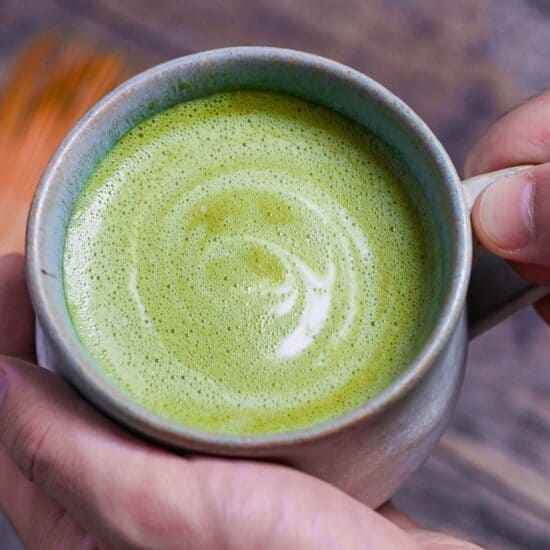


Want to enjoy cafe-quality matcha latte in the comfort of your own home for a fraction of the cost? Then you’re in the right place! Knowing the proper ratios, techniques, and how to choose your ingredients are all vital in getting that flavor that takes you right back to that cosy Japanese cafe you once visited.
This recipe includes tips and tricks so that you can make the most delicious hot matcha latte at home, with adjustments so that you can make it your own.
And if you’re looking for an iced version, check out my iced matcha latte recipe – that recipe has been especially designed to highlight the flavor of matcha when served cold.
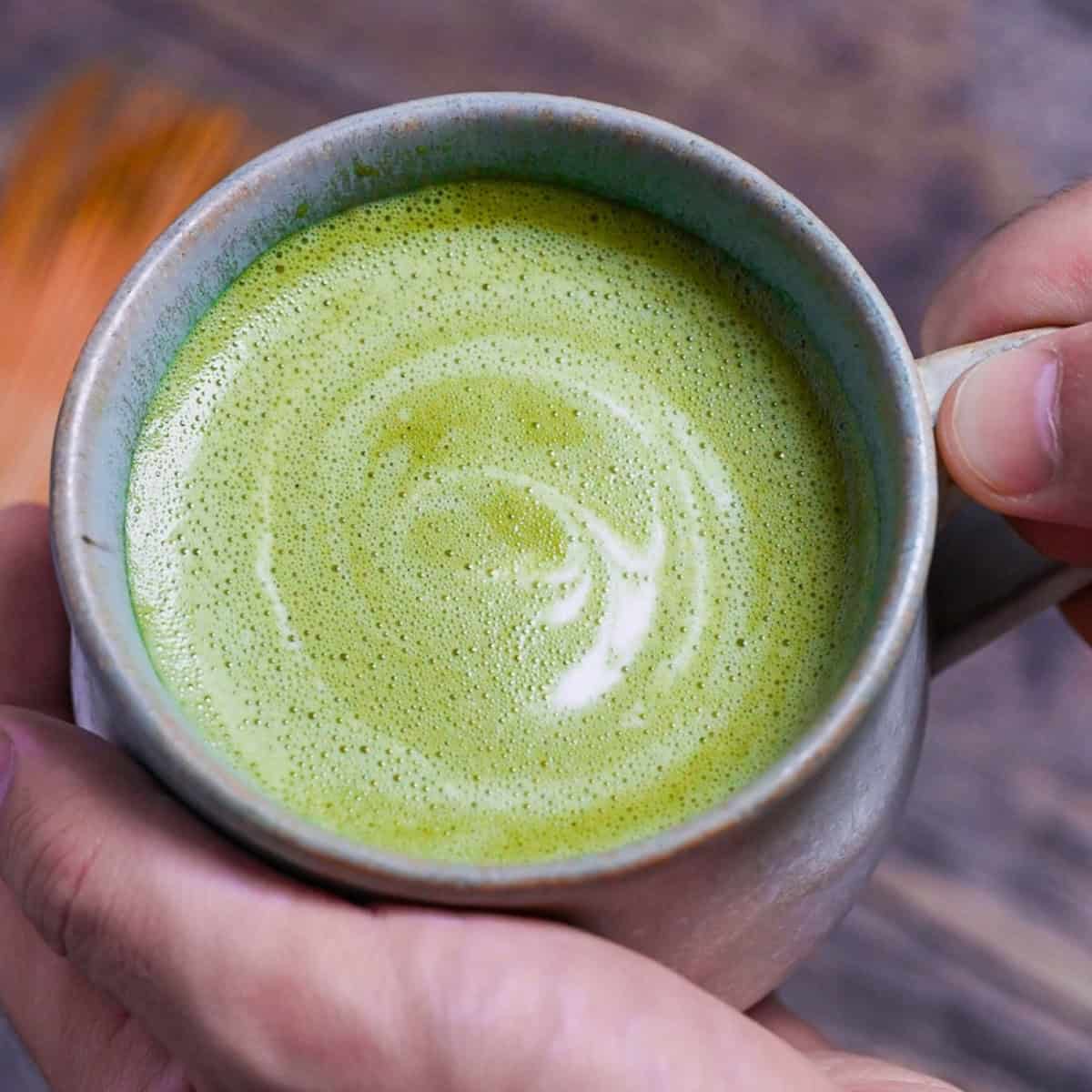
Hot matcha latte
Recipe Snapshot
- What is it? A creamy, cafe-style drink that blends vibrant matcha with silky steamed or frothed milk for an energizing treat you can enjoy at home.
- Flavor profile: Creamy, earthy, mellow.
- Why you’ll love this recipe: It’s quick, customizable and designed to be extra smooth, with a perfectly balanced matcha flavor that doesn’t taste bitter. My milk and temperature guidelines will also help you achieve consistent results every time!
- Must-haves: Good quality matcha, milk or plant-based alternative, chasen or milk frother.
- Skill Level: Easy, just heat and whisk.
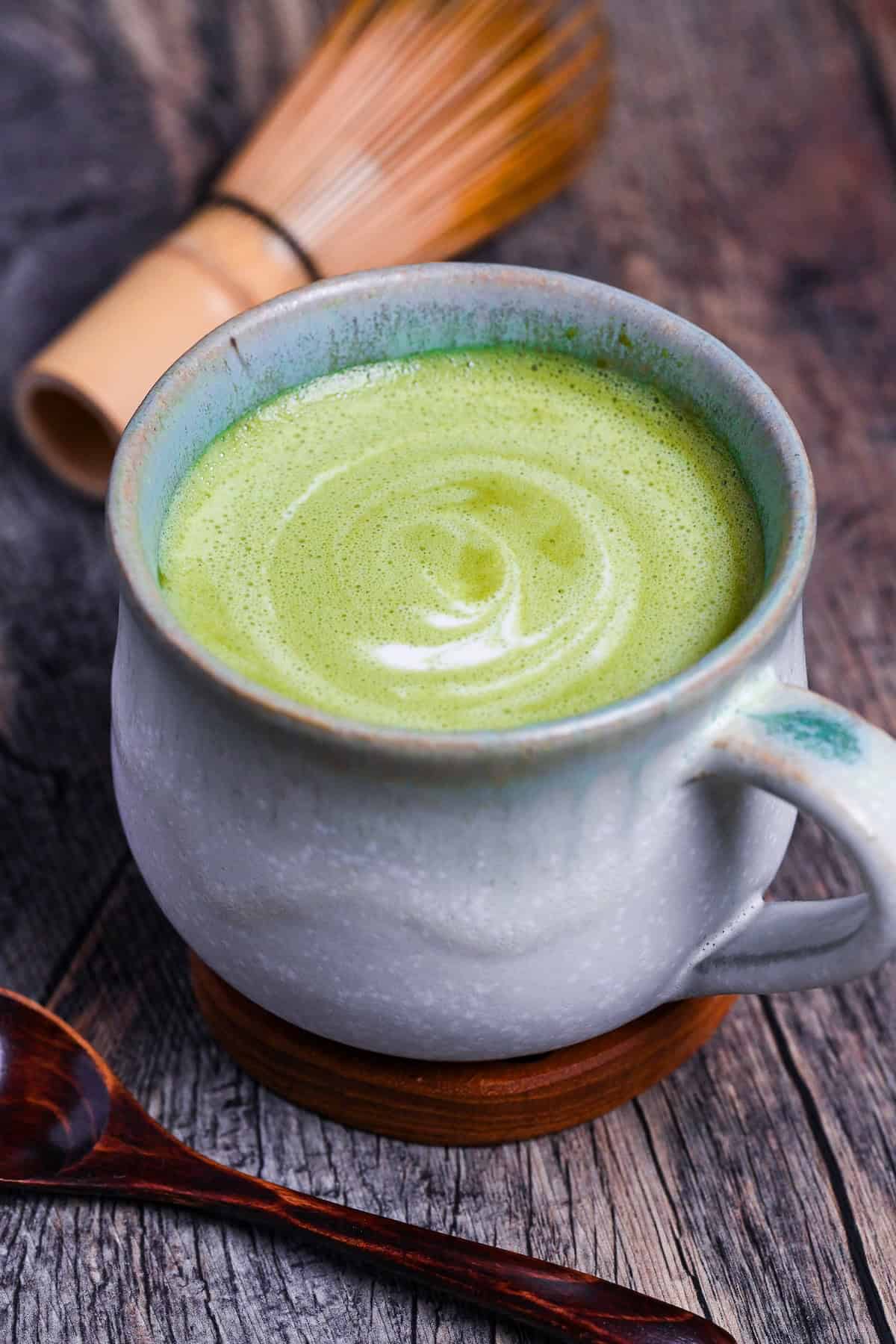
What Makes The Best Matcha Latte?
If you came here looking for the best matcha latte recipe, here’s the truth: there isn’t just one. Like coffee, matcha is deeply personal, and the perfect balance for one person might fall flat for another.
It all starts with the ingredients, and a good quality matcha paired with the right milk makes all the difference. Do you want a bold matcha flavor, or something softer and creamier? How about sweetened? It’s all about preference.
So instead of a one-size-fits-all recipe, I put together this guide packed with everything you need to know so you can make your own best matcha latte at home!
What is Matcha? (And Which One Should I Use For Matcha Latte?)
Matcha is a vibrant green powder made from the leaves of the Camellia Sinenesis (tea) plant. The leaves are shaded from direct sunlight for 3-4 weeks before harvesting which increases chlorophyll, making the color brighter and the leaves taste fresher. It also boosts umami through the amino acid L-theanine, which would usually turn bitter in full sunlight.
How is Matcha Made?
Once the leaves are harvested, they are steamed, dried and ground using large granite stone mills. Since matcha is heat-sensitive, the mills grind them slowly to preserve the flavor, aroma and color of the tea.
The highest quality of matcha comes from the first harvest (ichibancha) in spring when the leaves are young, supple and fragrant. Matcha made from the first harvest is particularly expensive, and often used for Japanese tea ceremonies or special occasions. It should be enjoyed straight (hot water only, no milk or sugar) to appreciate it to the fullest.
The leaves from later harvests become less delicate and more robust, with less natural sweetness and more bitterness. But this is not a bad thing, and actually, they can work particularly well in cafe style drinks and baked goods, where milk or sugar might overpower a more delicate matcha.
Ceremonial vs. Culinary
If you’ve been shopping for matcha, you might have come across the terms “ceremonial” and “culinary”. These are marketing terms used mostly in the US to indicate quality, however these “grades” are not regulated, and buying “ceremonial” matcha does not guarantee that the matcha is truly high quality. There are no “ceremonial” or “culinary” matcha labels in Japan.
The type of matcha you should choose really depends on how you like to drink it. If you want to drink straight matcha, or you enjoy a strong matcha latte without sweetener, then the higher grade will work best for you. If you prefer a mild or sweetened matcha, then the lower grades work perfectly fine, so keep this in mind when shopping.
Matcha Latte Milk Guide (with Temperatures)
I tested 4 different milks, here is what I thought tasted best with matcha.
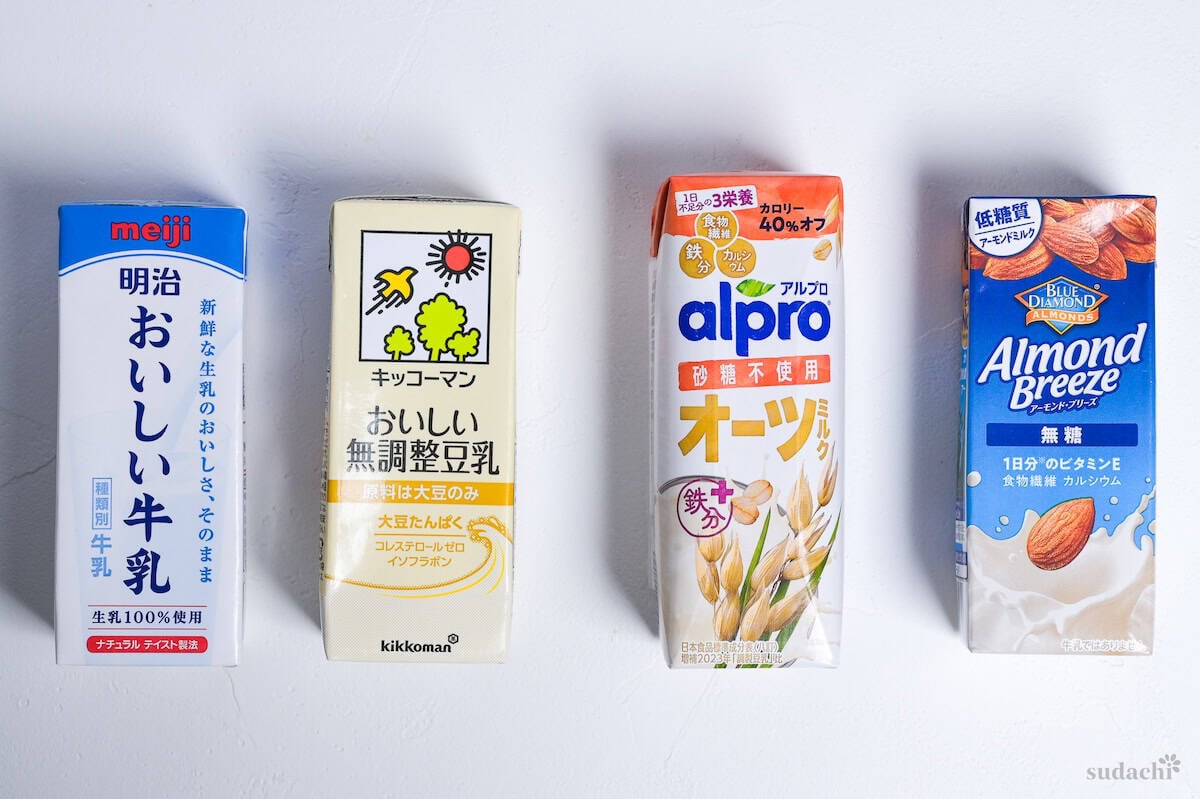
Whole Milk (Meiji)
If you’re trying matcha for the first time and you like dairy, whole milk is a great starting point. Unless specified, it is the default option in Japan, often made with high fat milk from Hokkaido. It froths well, creating thick microbubble foam with a rich, creamy flavor and silky texture that works perfectly with the matcha. It’s good even without sugar.
- Rating: ★★★★★
- Best Temperature: 55-65°C (131-149°F)
- Texture: Silky, good foam
- Flavor: Classic, creamy.
Unsweetened Soy Milk (Kikkoman)
Soy milk matcha latte is the second most popular option in Japan. Overall, the taste is quite natural and grassy, and it compliments the flavor of matcha. It foams well and is very pleasant to drink, though some might notice slight dryness compared to dairy milk.
- Rating: ★★★★★
- Best Temperature: 55-60°C (130-140°F)
- Texture: Smooth, slightly dry.
- Flavor: Earthy.
Oat Milk (Alpro)
My first test was with Apro oat milk. The milk’s flavor was very subtle and allowed the matcha flavor to shine. This is great if you want a stronger flavor without using more matcha, but without natural sweetness from the milk, the bitterness was more obvious. Using Apro oat milk calls for more sugar or a higher quality matcha, it’s less forgiving than other options. I also found it quite watery and didn’t foam at all.
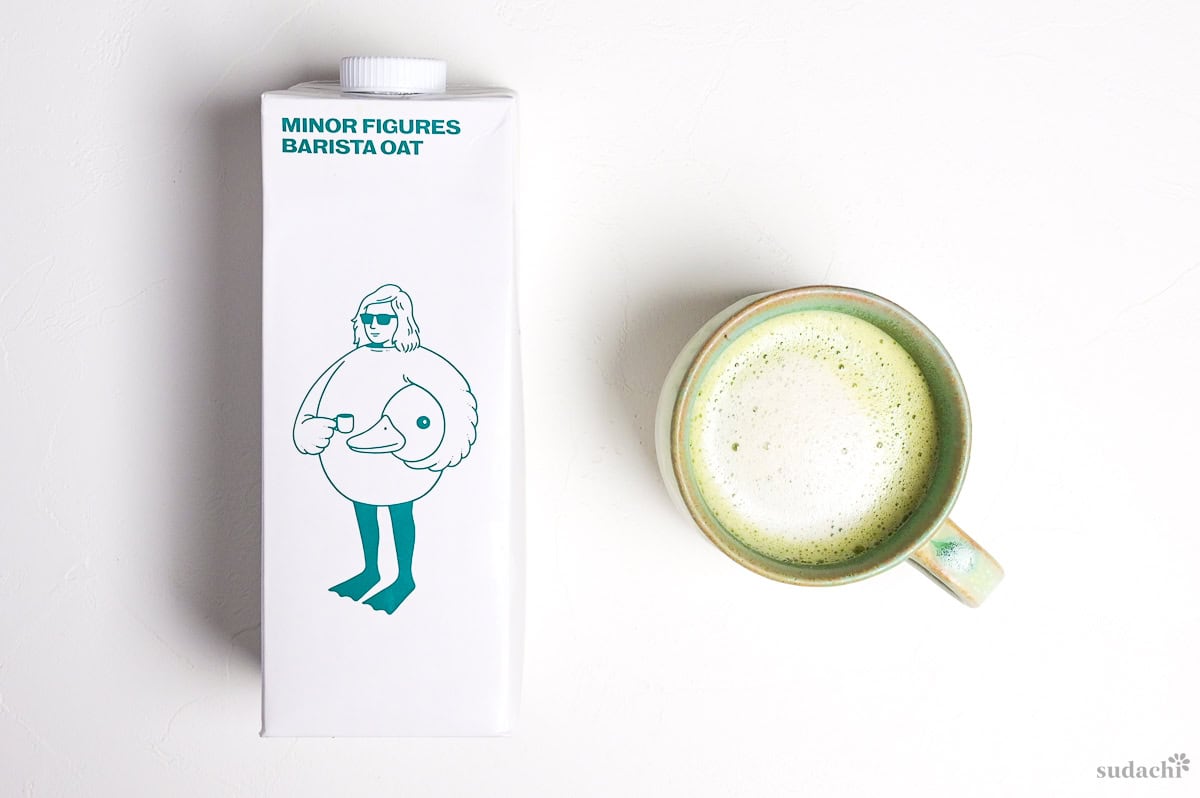
When I tested again with Minor Figures barista style oat milk, it was a lot creamier and frothed up nicely. The matcha tasted really good too, but it was quite expensive compared to other plant-based milks.
- Rating: ★★★★☆ (3/5 for Alpro, 5/5 for Minor Figures)
- Best Temperature: 60-65°C (140-149°F)
- Texture: Alpro oat milk was quite wet (not foamy), but barista style was creamier and frothier.
- Flavor: Matcha-forward.
Almond Milk (Almond Breeze)
The texture of the almond milk was silky and frothed similarly to cows milk, however I thought the almond flavor overpowered the matcha, and the flavor combination didn’t really match well. If you love almond milk, you can probably look past this (my wife liked it, but I didn’t).
- Rating: ★★☆☆☆
- Best Temperature: 55-60°C (130-140°F)
- Texture: Silky, good foam.
- Flavor: Clashing with matcha (in my opinion)
It’s a tie between whole milk and soy milk for me! They both deliver great texture, and complement the matcha perfectly!
Since I first posted this, the barista style oat’s milk is also entered the top 3. A really nice plant-based option if you don’t mind spending a bit more.
What’s your favorite? Let me know in the comments!
Matcha Latte Ratios (grams, strength, cups)
Once you’ve purchased your matcha and chosen your milk, it’s time to work out your perfect ratio.
Choose Your Strength
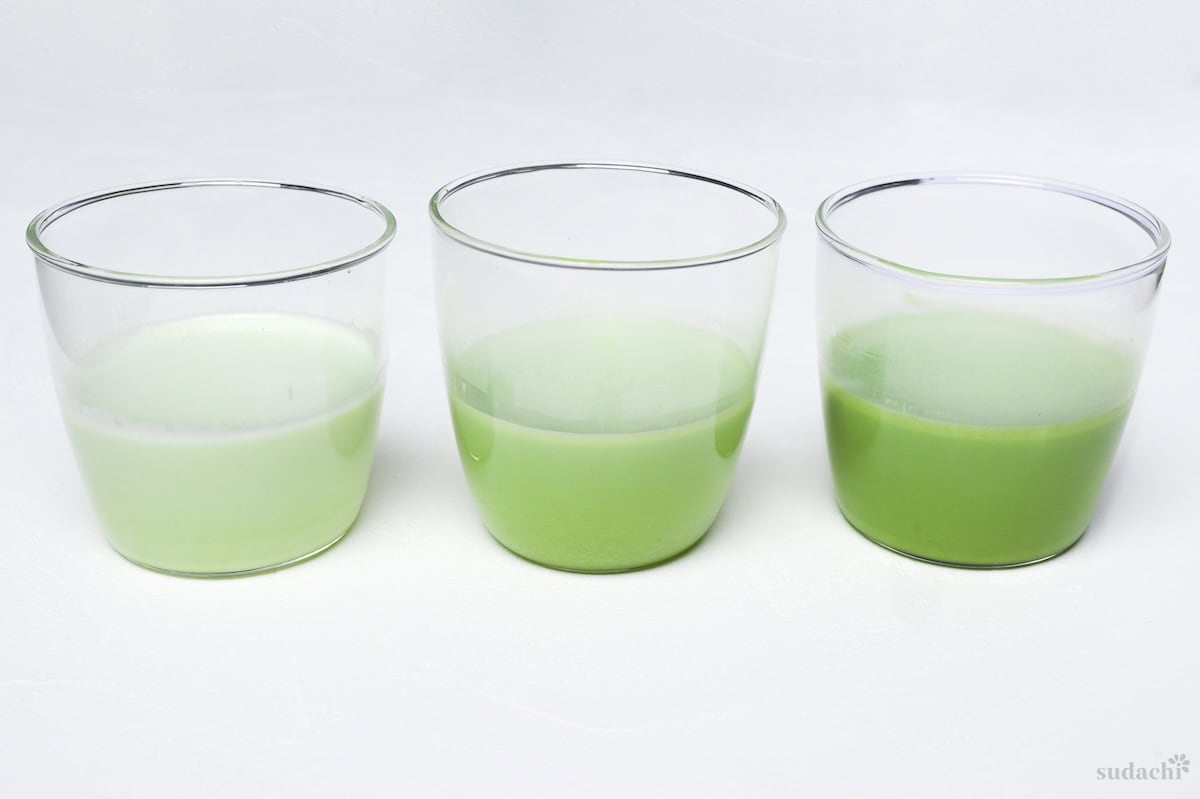
For a standard (10-12oz/300-350ml) cup using 250ml milk, here is the amount of matcha you will need:
- Mild: 1-1.5g matcha (approx ½-¾ tsp) for a subtle matcha flavor and milk-forward taste, great for people trying matcha latte for the first time.
- Standard: 2-2.5g (approx 1-1¼ tsp) perfectly balanced for a classic cafe taste.
- Strong: 3-4g (approx 1½-2 tsp) for matcha lovers who like it more intense. Works best with higher quality matcha.
Scale to Size
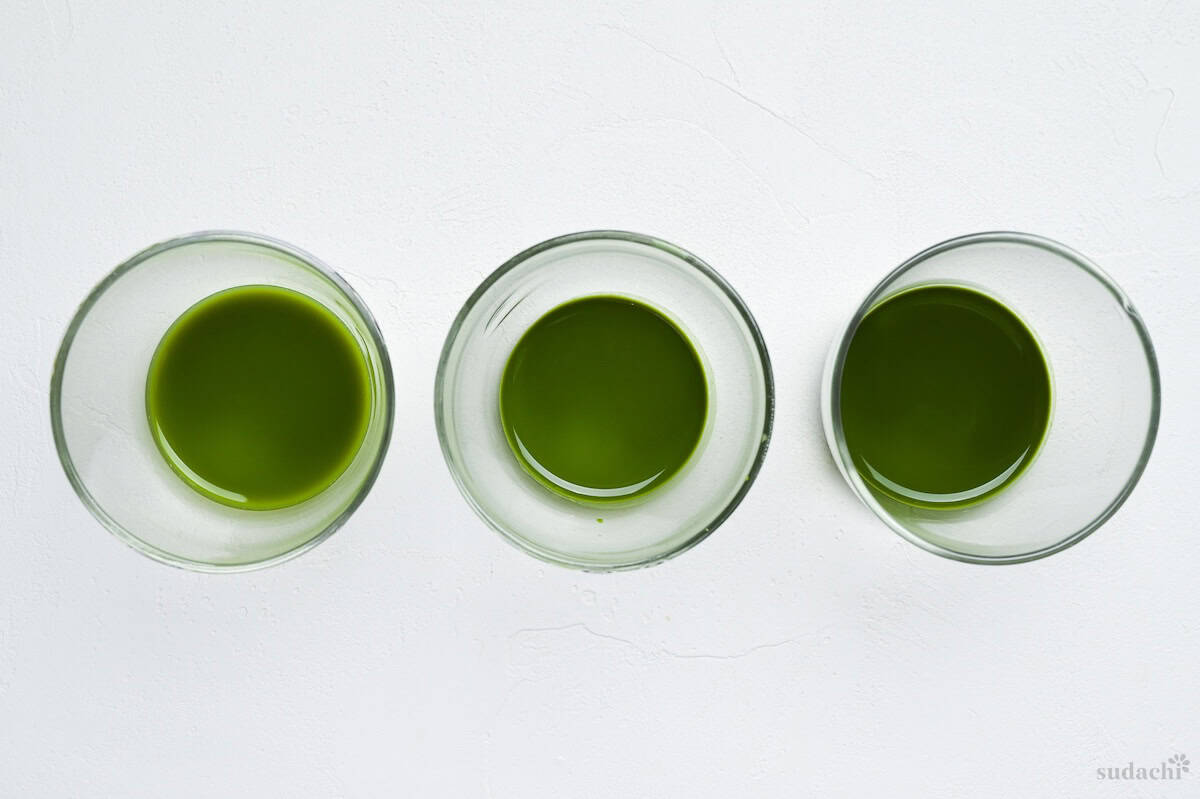
Measure your favorite mug, then adapt the recipe accordingly.
| Strength → Size ↓ | Mild | Standard | Strong |
| Small (6-8 oz/180-240ml) | Matcha: 1g (approx ½ tsp) Water: 30ml (2 tbsp) Milk: 150-180ml | Matcha: 1.5-2g (¾-1 tsp) Water: 30ml (2 tbsp) Milk: 150-180ml | Matcha: 2.5-3g (approx 1¼-1½ tsp) Water: 30ml (2 tbsp) Milk: 150-180ml |
| Medium (10-12oz/300-350ml) | Matcha: 1.5g (approx ¾ tsp) Water: 30ml (2 tbsp) Milk: 240-260ml | Matcha: 2-2.5g (approx 1-1¼ tsp) Water: 30ml (2 tbsp) Milk: 240-260ml | Matcha: 3-3.5g (approx 1½-1¾ tsp) Water: 45ml (3 tbsp) Milk: 240-260ml |
| Large (14-16oz/400-470ml) | Matcha: 2g (1 tsp) Water: 45ml (3 tbsp) Milk: 320-350ml | Matcha: 3-3.5g (approx 1½-1¾ tsp) Water: 45ml (3 tbsp) Milk: 320-350ml | Matcha: 4-4.5g (approx 2-2¼ tsp) Water: 45ml (3 tbsp) Milk: 320-350ml |
Flavor Variations
Mix it up with some of these flavor variations!
- Sweeteners: Optional but a great opportunity for customization. Experiment with white sugar, light brown sugar, dark brown sugar, or even syrups like agave syrup or honey.
- Flavored syrups – Vanilla syrup, lavender syrup or kuromitsu (dark brown sugar) taste delicious with matcha!
Matcha Latte Tools
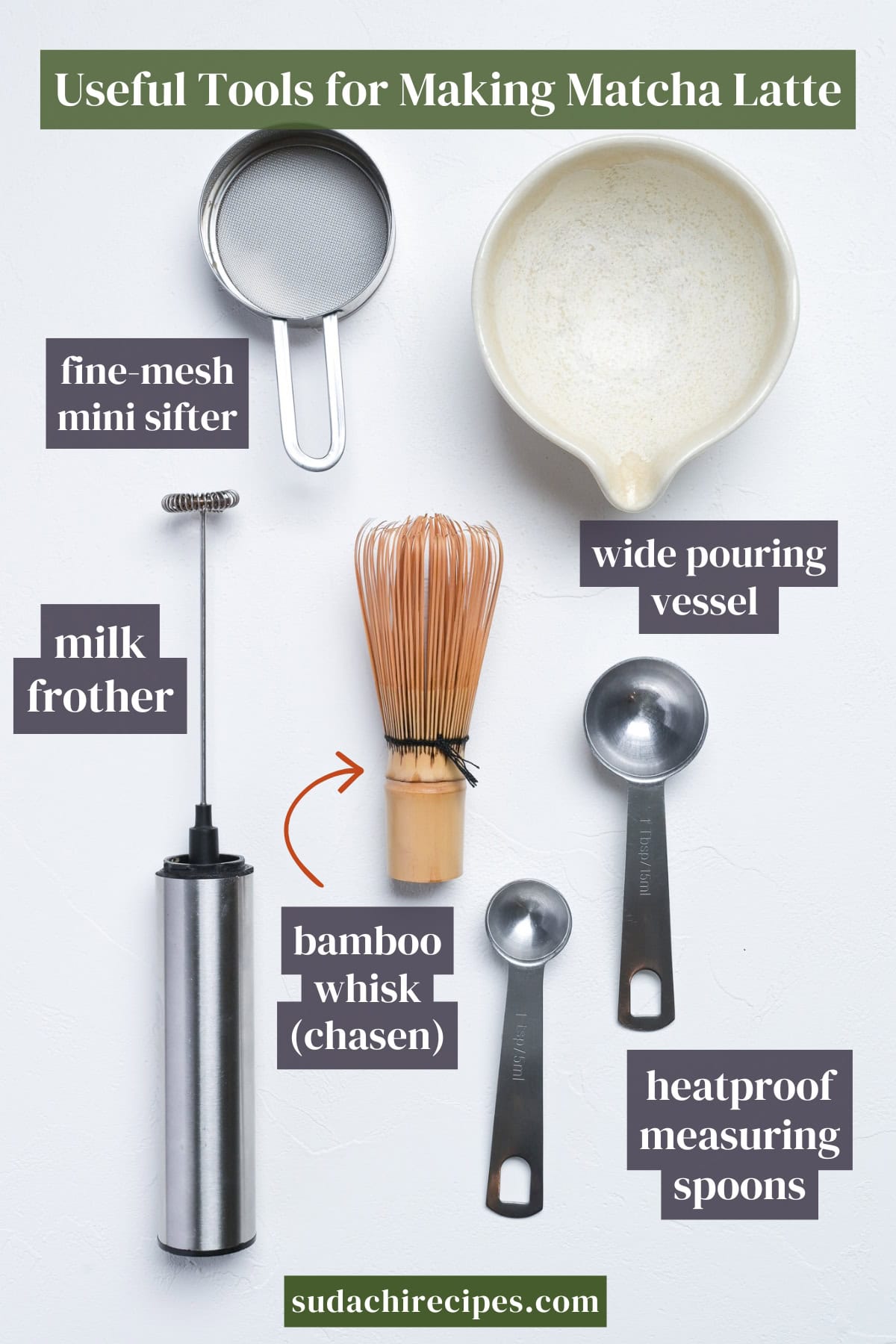
- Mini Sifter: Matcha is prone to clumping, so sifting it before adding water will ensure your base is smooth and distributes evenly throughout the milk.
- Wide pouring vessel: A wide bowl or jug makes whisking a breeze, and a spouted one is perfect for pouring. It’s not essential, but nice to have. Alternatively, you can whisk the matcha directly in the serving cup if it’s wide enough.
- Chasen: A Japanese bamboo matcha whisk (chasen) is designed to effortlessly whisk matcha and water together creating a perfectly smooth and frothy texture. If you don’t have one, don’t fret, there is another option below.
- Milk frother: The bonus of using a milk frother is that you can use it to both froth your milk and your matcha.
- Heatproof measuring spoons: I don’t know about you, but I don’t want to get the scales out every time I make a drink. A standard matcha latte uses about 1 tsp matcha and 2 tbsp of hot water, measuring spoons are so convenient for making matcha latte quickly!
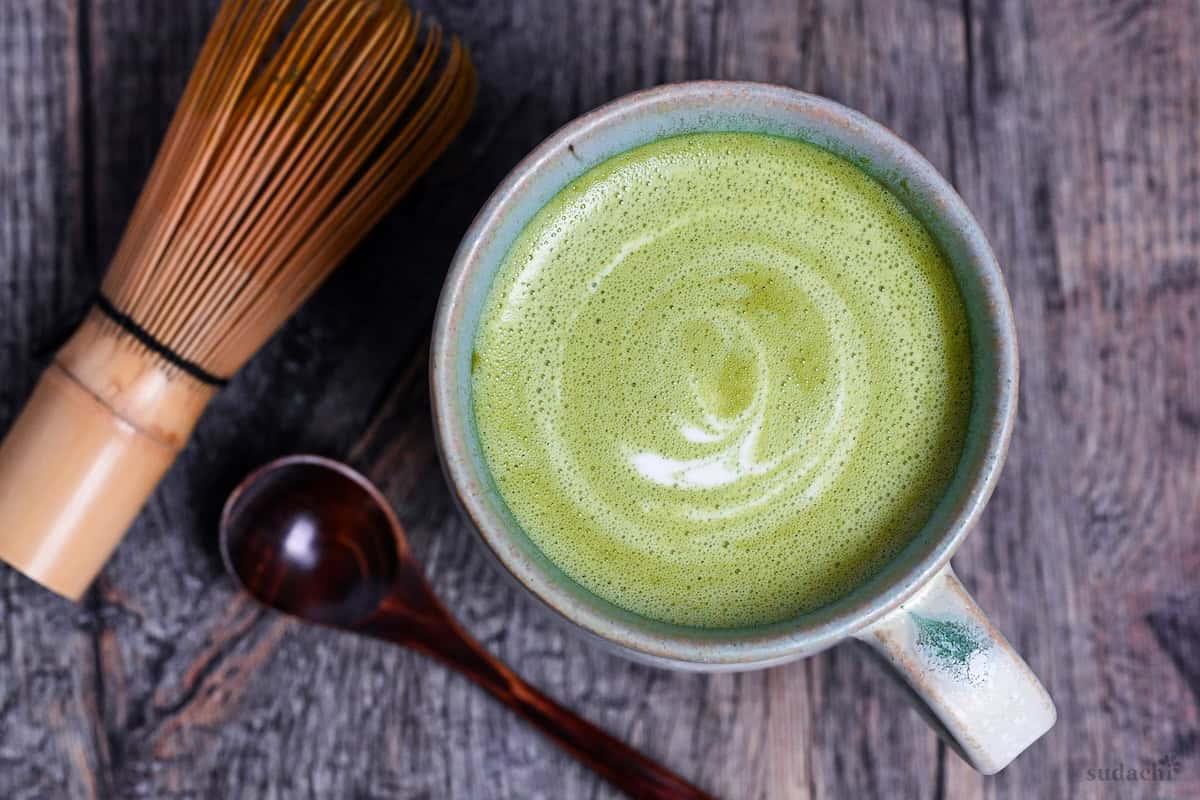
How to Make My Hot Matcha Latte
Is sifting necessary? Absolutely. Matcha is prone to clumping, sifting will make the powder super-fine, resulting in a smoother drink with an evenly dispersed flavor.
If you skip this step, you risk a weaker latte with random lumps of matcha floating through.
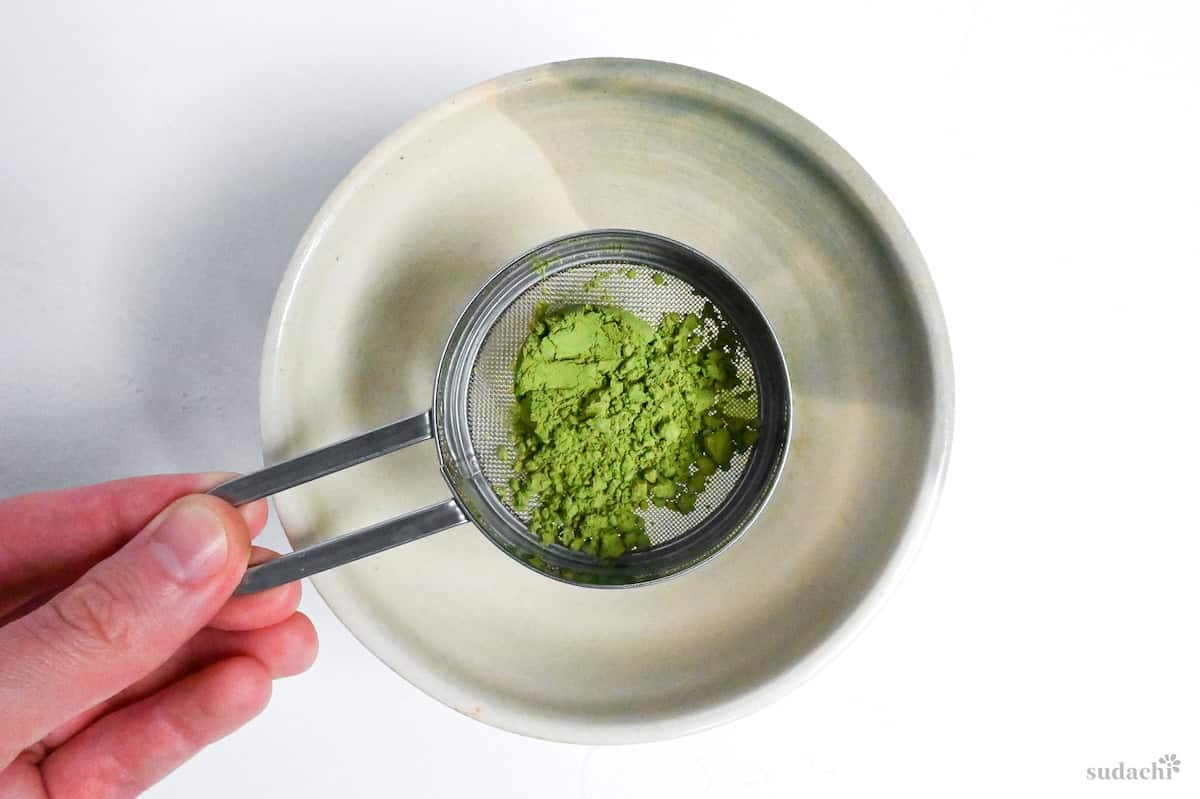
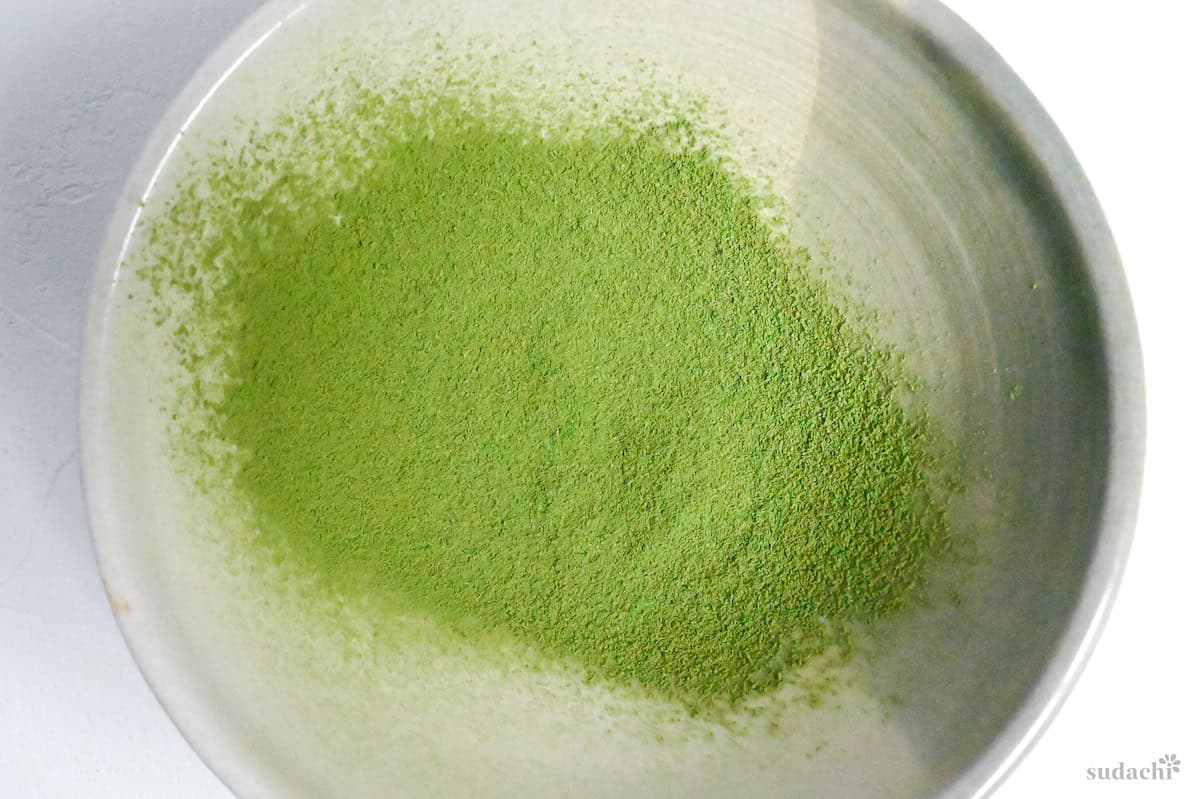
If you’re using a wide cup, go ahead and sift the matcha straight in. For narrower vessels, I recommend sifting your matcha into a wide bowl for easier and more thorough whisking, then pour it into your serving cup after.
i. Heat your water to 70-80℃ (160-176℉) which is the ideal temperature to achieve the best matcha flavor without bringing out bitterness. If you don’t have a thermometer, boil the water and let it cool for a few minutes.
If you’re using a chasen (bamboo whisk) briefly dip it in warm water to soften the bristles. We’re talking about 30-60 seconds. Avoid soaking for too long, as this can damage it.
I use 30ml/2 tbsp of hot water per serving (the same as a shot of espresso) and use an electric kettle to heat my water, but since you only need a small amount, you can use a microwave it instead. 2 tbsp of water takes approximately 30 seconds at 600W to reach 80℃ (176℉).
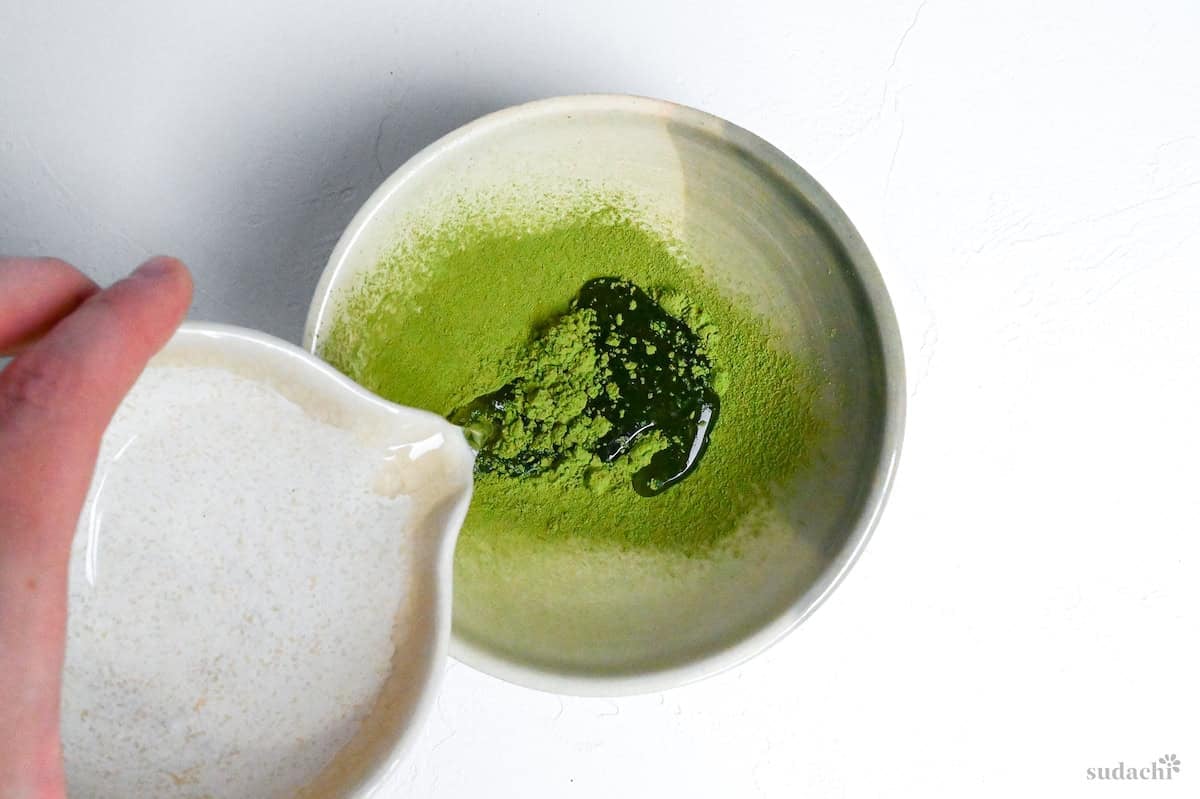
ii. Pour half of the hot water over the sifted matcha and whisk until it forms a smooth paste. Starting with a paste will prevent clumps, even if you’re not using a chasen.
iii. Pour in the rest of the water and continue to whisk. Whisk back and forth in what is often called the “W” or “M” motion. This method is more effective than whisking in a circular motion and creates a smoother result with more foam.

Whisk until micro bubbles form on the top. The longer you whisk, the thicker it becomes.
Keep in mind that matcha doesn’t truly dissolve. Instead, it suspends in the water. The more you whisk, the better the emulsion and thicker the foam. This is exactly why sifting and whisking is the key to a good matcha latte.
If you don’t have a chasen, the next best thing is an electric milk frother. If you don’t have either of those, shaking the matcha and water together in a heatproof lidded container is another way to make the base.
Heat your choice of milk using your preferred method.
The ideal milk temperature for making lattes falls between 55-65°C (131-149°F). If it exceeds 70°C (158℉) then your matcha latte might end up tasting slightly off.
Some plant-based milk alternatives are more delicate and prone to scorching, splitting or curdling, and should be heated to a slightly lower temperature.
- Soy Milk 55-60°C (130-140°F)
- Almond Milk 55-60°C (130-140°F)
- Coconut Milk 55-65°C (130-149°F)
- Oat Milk 60-65°C (140-149°F)
You can usually tell if you’ve overheated your milk because it will start to bubble, steam, form a skin, or smell unpleasant.
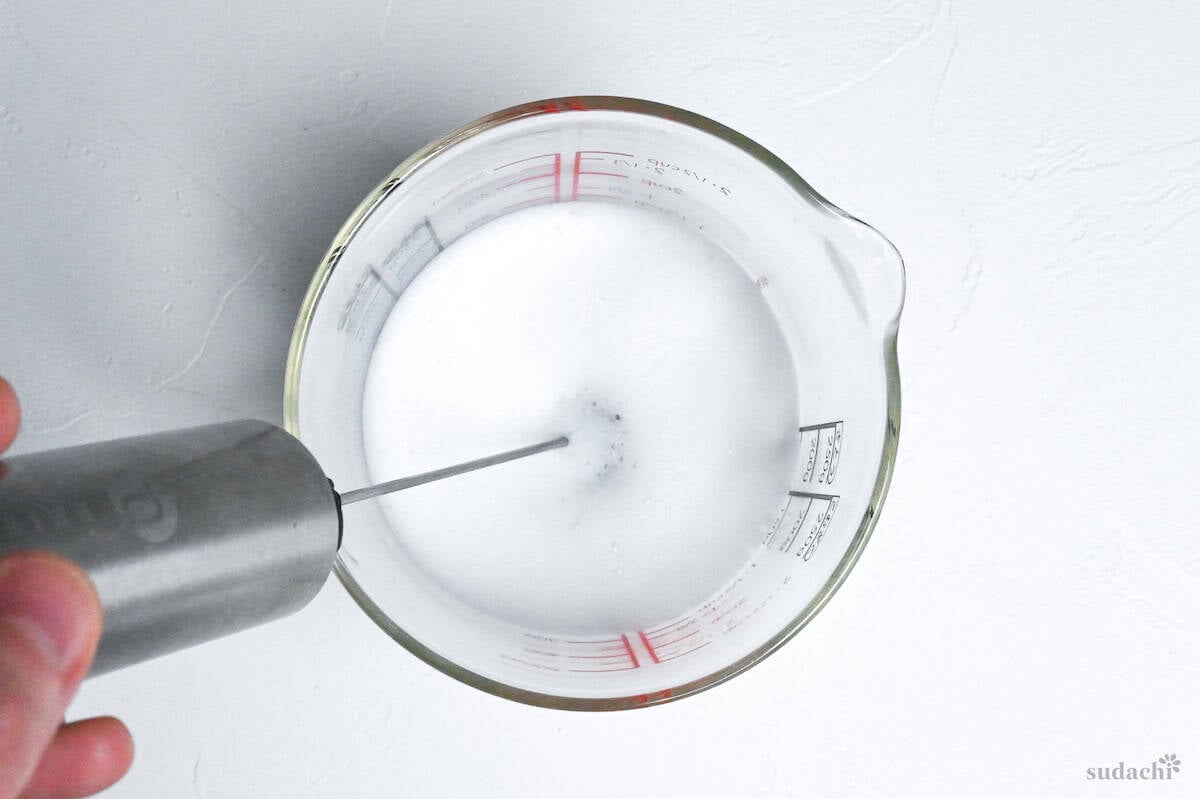
If using a microwave, pour the fridge-cold milk into a large heatproof jug and heat for approximately 1 minute 30 seconds at 600W (for one cup). Take it from the microwave and whisk until foamy or increased by one-third in volume.
If you heat your milk in a saucepan, use a medium-low heat and submerge the electric milk frother as it heats. If your pan is too big, you might need to tilt it to submerge the frother into the milk. Stop frothing when volume has increased by one third, and be careful not to boil, lift the pan off of the heat before it overheats.
Warm your serving cup either by filling with hot water and dumping it right before assembling your drink, or if it’s microwave safe, microwave the empty cup for 10 seconds. This will stop your matcha latte from cooling down quickly.
Pour the matcha into the serving cup. If it’s been sitting for a while, whisk it once more and then gently pour your silky heated milk over the top.
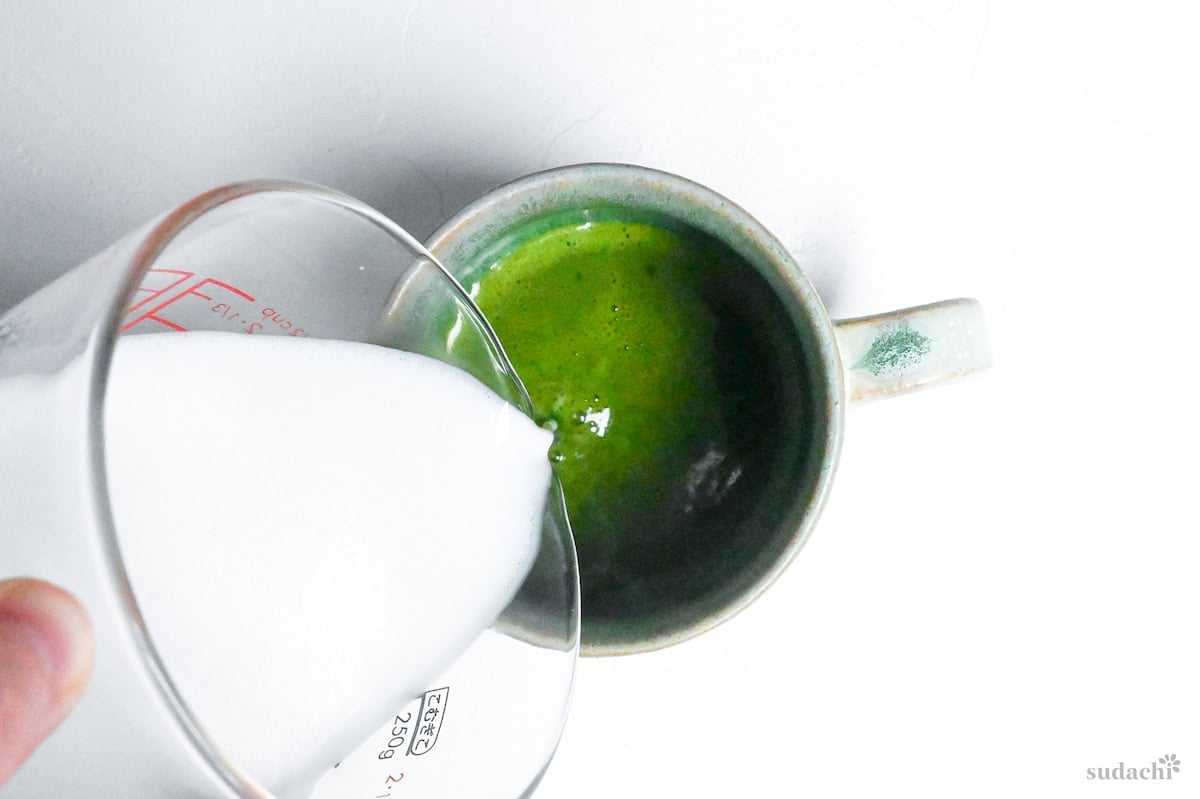
I typically use 1-2 tsp of sweetener, but for a Starbucks level of sweetness, you will need about 1 tbsp.
This is all down to personal preference so you might need to test it a few times. If you’re unsure, add less than you think, then add a little more at a time, while mixing and tasting.
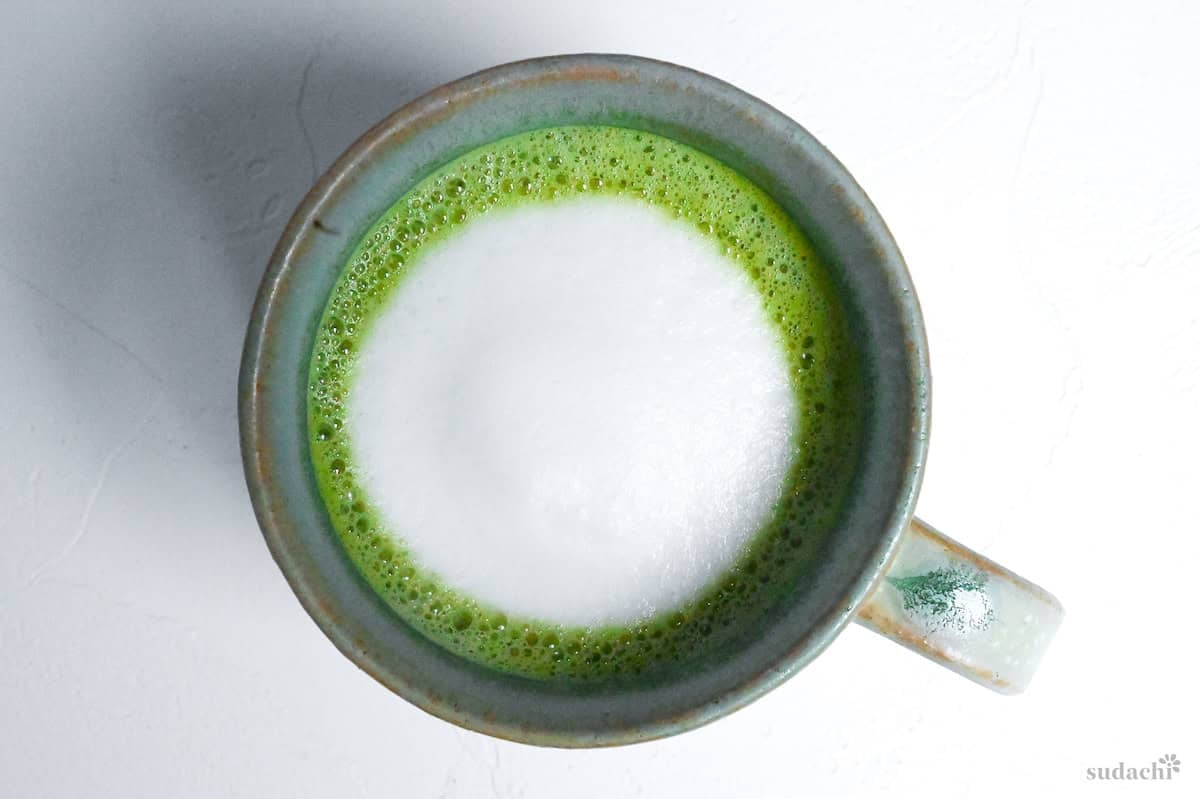
Serve immediately and enjoy!
Jump to Full Recipe Measurements
Essential Tips & Tricks
- Sift matcha to remove clumps for better foaming.
- Soak your bamboo whisk (chasen) for 30-60 seconds in warm water to soften bristles.
- Heat the water to 70-80℃ (160-176℉). This extracts the best flavor without bitterness.
- Pour half of the water over the sifted matcha, whisk into a paste and then add the rest of the water. This method will ensure a smooth, lump-free matcha base.
- Whisk back and forth (W motion) rather than in circles for a smoother result with more foam.
- Whisking longer produces better microfoam, but not essential.
- Heat milk no higher than 70℃ /176℉ and plant-based no more than 60°C/140°F to avoid scorched milk taste.
- Warm your cup before pouring in the matcha and milk (either fill with hot water and empty, or microwave for 10 seconds). This stops your drinking cooling down quickly.
- Add sugar, agave syrup or vanilla syrup for cafe-style sweetness.
With these simple tips in mind, you’re set for success every time you make matcha latte at home.
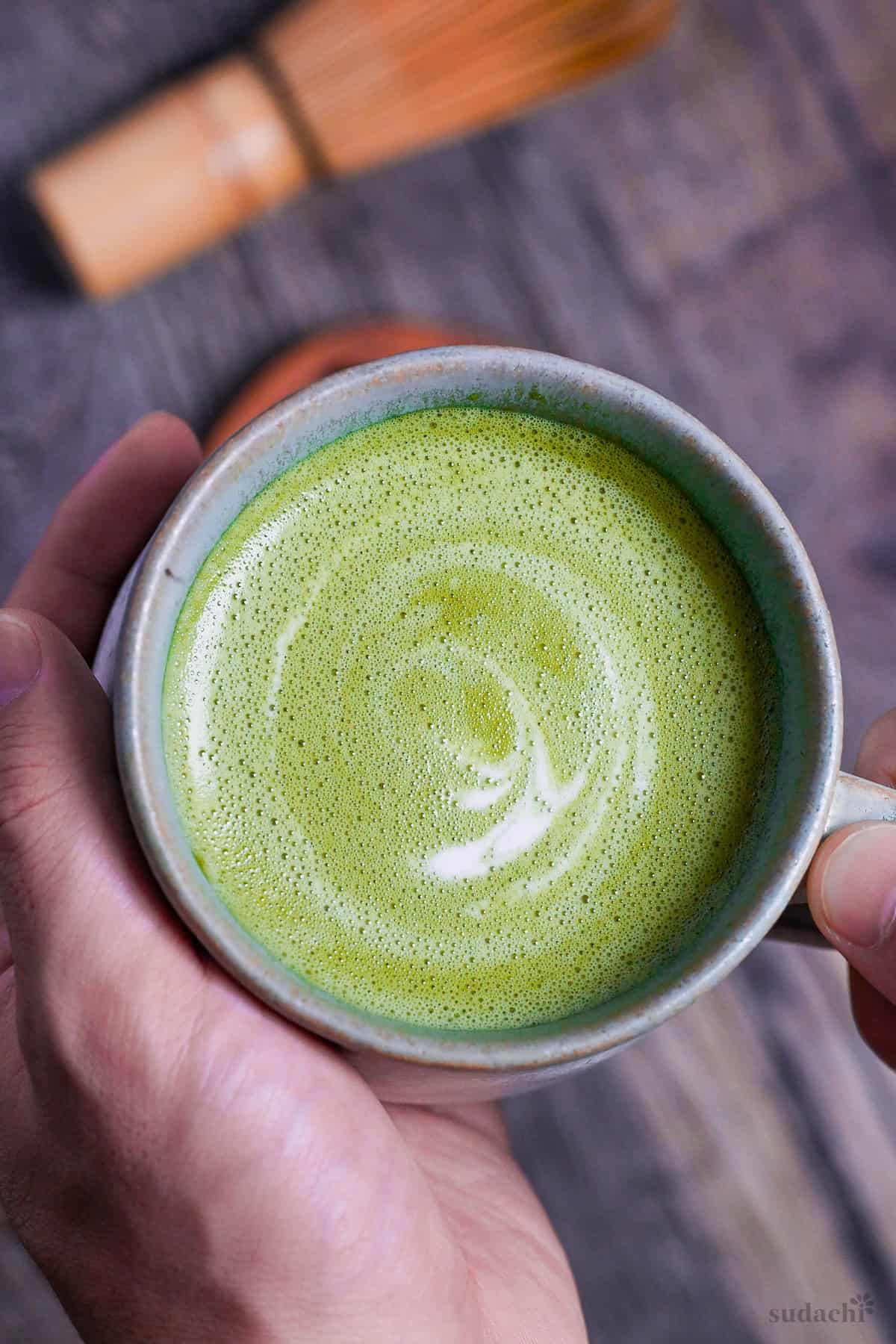
Matcha Latte FAQ
There isn’t any strict rule on what kind of matcha you should use for lattes. That said, if you’re adding sweetener, there’s no need to use the highest grade of matcha. As long as you’re using a good quality matcha that is vibrant green and fresh, you should be good!
Sifting with eliminate clumps right from the bat, then using a bamboo matcha whisk (chasen) to whisk it will keep it smooth. If you don’t have a chasen, an electric milk frothing tool is a great alternative.
This is a matter of opinion, but I’ve found that whole cow’s milk froths up smoother than skimmed versions. For plant-based alternatives, it really depends on the brand and preference. I’ve tested three plant-based milks, oat milk and soy milk are great for allowing the matcha flavor to shine, but almond milk overpowers it (in my opinion).
Sure, you can add ice and cold milk to this recipe, but I find that cold versions need more matcha and sweetener to get the right flavor. Check out my iced matcha latte recipe if you want to see the different steps and ingredient quantities!
There are a number of variables that can make your matcha taste bitter. One is heating the water over 80°C / 176°F which releases bitter compounds. You might have also used too much matcha, so try less next time. Finally, using low-quality or old matcha can produce a bitter taste – this will be indicated by the color (faded and yellow-y) and smell (musty). For the best flavor, use vibrant green and fresh smelling matcha and let your water cool a little after boiling.
Yes, it contains caffeine. Typically less than coffee, but it varies.
More Japanese Drink Recipes
If you’re a fan of Japanese drinks, check out some of my other recipes:
Did You Try This Recipe?
I would love to hear your thoughts!
💬 Leave a review and ⭐️ rating in the comments below. 📷 I also love to see your photos – submit them here!

Hot Matcha Latte

Equipment
- 1 handheld milk frother
Ingredients
- 2.5 g matcha powder (approx 1 ¼ tsp) For mild: reduce to 1.5g / ¾ tsp. For strong increase to 3.5g / 1 ¾ tsp.
- 30 ml hot water heated to 70-80℃ (160-176℉)
- 240 ml milk of choice
- sweetener of your choice to taste
The ingredient brands and tools I trust are in my Japanese pantry guide and my cooking tools guide.
Can’t find certain Japanese ingredients? See my substitution guide here.
Instructions
- Place your chasen (if using) in a cup of warm water for 1 minute. While it soaks, sift 2.5 g matcha powder into a wide bowl.

- Measure out 30 ml hot water and pour half of it over the matcha powder. Whisk until a smooth paste forms, then add the rest of the water and whisk until foamy and smooth.
- Heat 240 ml milk of choice to 60 °C (140 °F) for plant-based, or 70 °C (158 °F) dairy, using your preferred method. This will take about 1 minute 30 seconds at 600W in the microwave, or about 2 minutes over medium-low heat the stove top. Use a milk frother to incorporate air into the milk until increased by one-third in volume.
- Pour the matcha into a warmed serving cup, then pour the steamed milk over the top.
- Stir in the sweetener of your choice if you like, and enjoy!

Notes
- Be sure to use fresh matcha that is bright green with a pleasant aroma.
- Heat the water to 70-80℃ (160-176℉) to draw out matcha’s best flavor without bitterness.
- Whisk back and forth (W/M motion) for a smooth result with better foam.
- For thicker matcha base with more microfoam, whisk for longer.
- Avoid scorched milk by heating cows milk no higher than 70℃ /176℉, and no more than 60°C/140°F for plant-based.
- Warm your cup before pouring in the matcha and milk (either fill with hot water and empty, or microwave for 10 seconds). This stops your drinking cooling down too quickly.
- Sweeten with sugar, agave syrup or vanilla syrup for cafe-style sweetness.
- Nutritional information is based on standard strength with whole milk and no sweetener.

Just a note. Scolded isn’t the right word to use. I believe you mean to say scalded or scald which means burnt or over cooked. Scold means to reprimand. Great article. I learned something new though I’ve been making matcha lattes for years.
Hi Dorothy,
Yes I meant scalded, thank you for pointing that out! I’ve corrected it now.
I’m glad you learned something new from the article! Thank you again!