

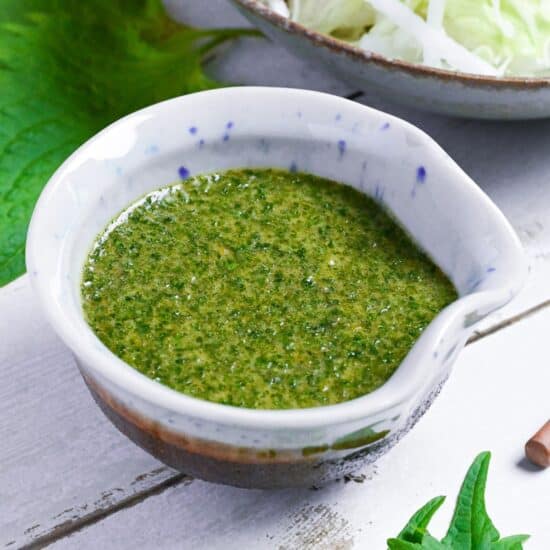


Featured Comment
My dressing was a tad darker and I needed more oil. But flavor was spectacular, I wanted to drink it. I tossed it with vermillion rice, shrimp and summer vegetables from my garden. But I think it would also be a great marinade for salmon.
★★★★★
– Casey
You lift the lid a second after the blades stop and the smell comes up at you, cold and green and sharper than basil ever gets.
That is 10 leaves, whole, gone into a jar you could hold in your palm.
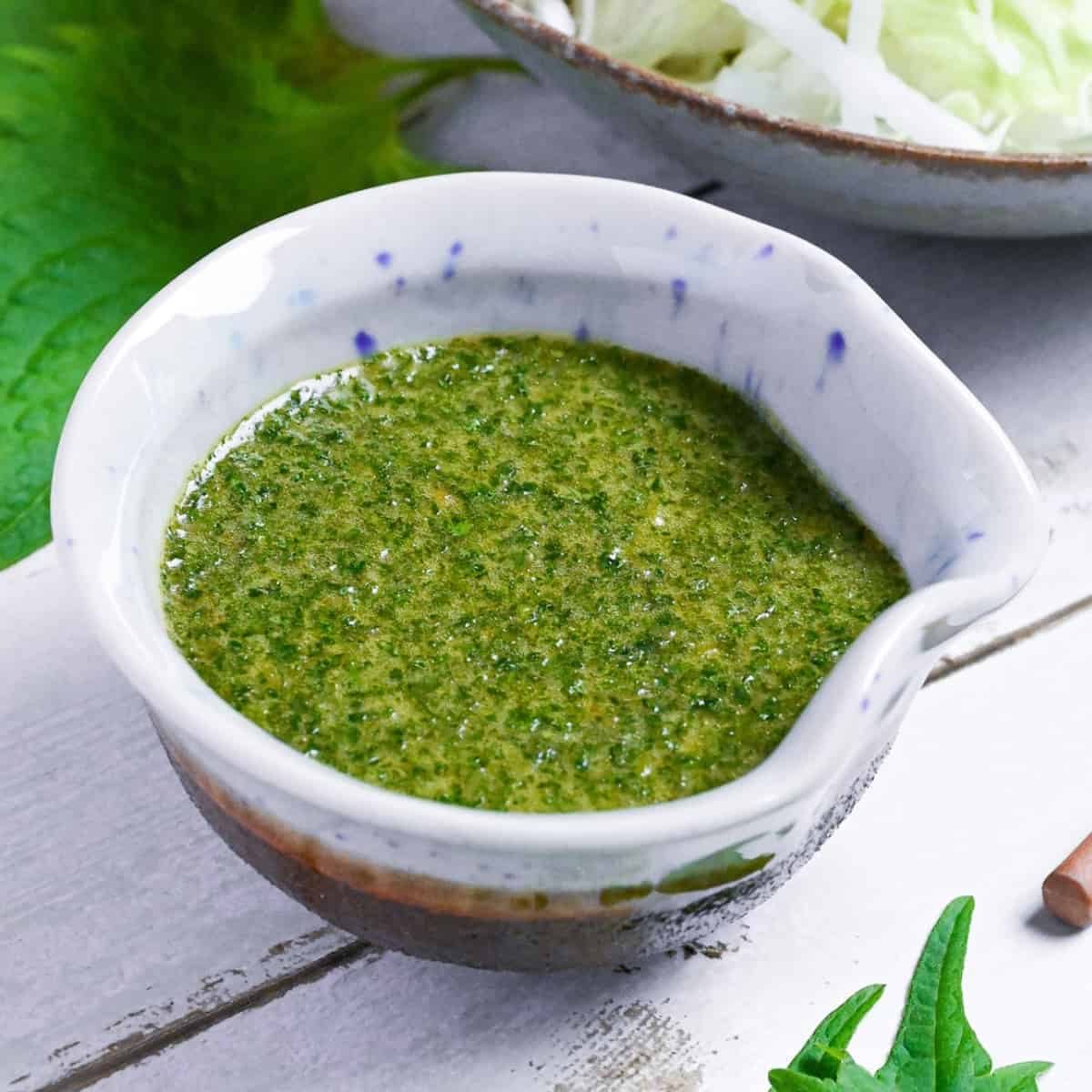
Shiso Dressing
Recipe Snapshot
- What is it? A Japanese dressing in which finely cut green shiso carries the flavor, over a base of soy sauce and rice vinegar. Everyday home cooking in Japan, can be used far beyond salad.
- Flavor profile: A Japanese-style vinaigrette, sharp and savory, with a cold green top note closer to mint than basil. The olive oil gives it enough body to cling to cold tofu.
- Why this recipe works: 10 leaves to a small jar keeps the shiso in front of the soy sauce. The garlic goes in grated so it disappears instead of turning up in pieces.
- How to make it: Everything goes into a food processor at once and comes out green. No cooking, and nothing that has to stay mixed. A knife and bowl work too.
- What to expect: 5 minutes start to finish, and it makes a small jar. The only judgment call is when to stop the processor.
What Is Shiso Dressing?
Shiso dressing is a Japanese dressing built on rice vinegar and soy sauce, with chopped green shiso carrying it. Grassy and sharp rather than creamy, savory underneath. In Japan it is shelf stock, several brands at a time on an ordinary supermarket shelf, the way an American fridge door carries ranch, and nobody there treats it as a specialty item.
The leaf is green shiso, sold as aojiso (青じそ) and ohba (大葉), the same plant under 2 names. Ohba means big leaf, the name printed on the packs at the grocer. It is not the reddish-purple shiso that dyes umeboshi (pickled plums).
For my own jar I go heavy on the leaves and grate in garlic. I want the shiso out in front, loud enough that you know what you are eating before the bite is over. The garlic sits under it and gives the whole thing a savory floor.
Shiso Salad Dressing Ingredients
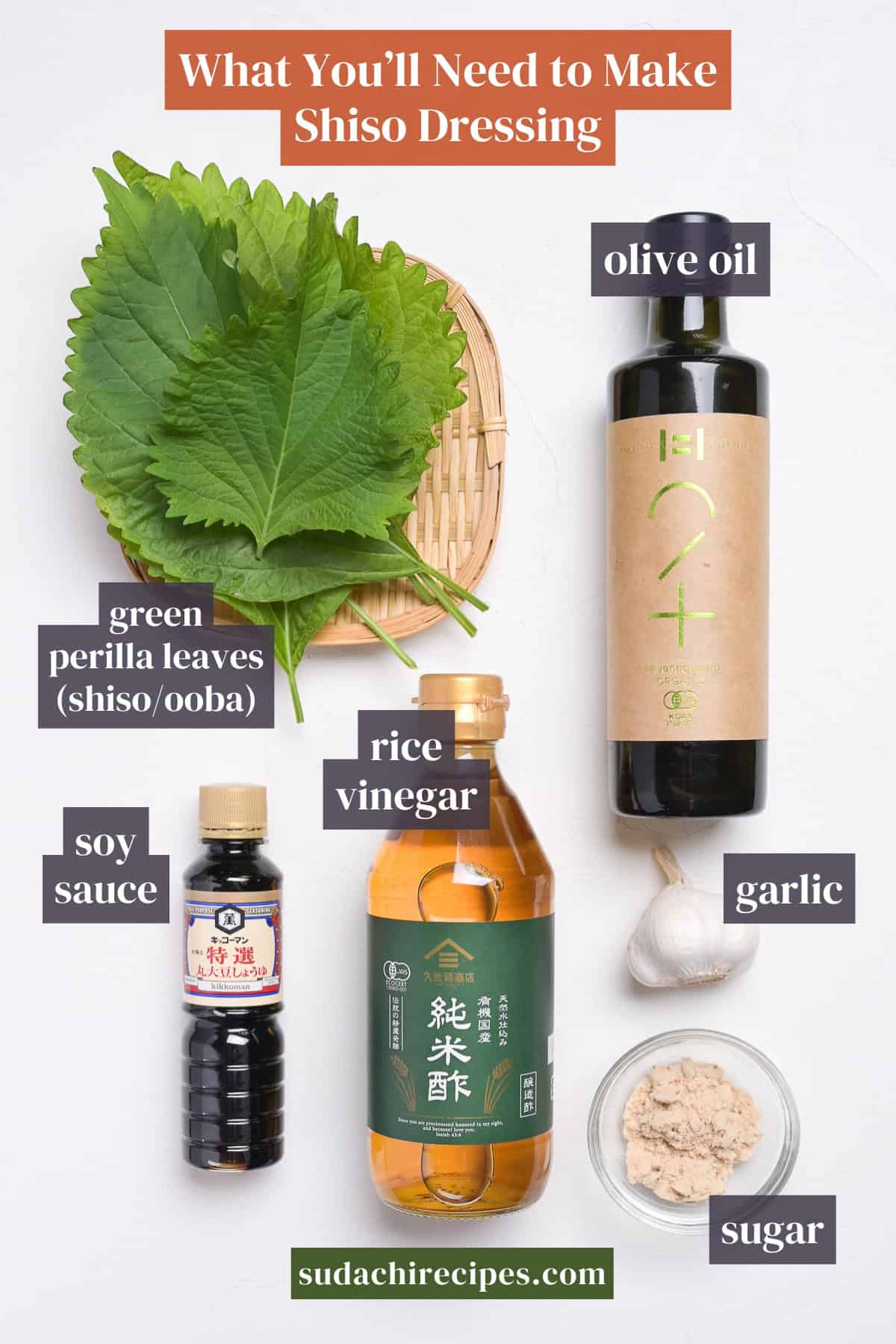
- Green shiso (aojiso): Buy it green. The reddish-purple shiso for umeboshi is a different leaf doing a different job, and it will not give you this flavor. Japanese grocers sell green shiso in flat packs of 10 or 20 leaves, often labeled ohba (大葉). Plenty of Asian grocers shelve it under perilla. Look for leaves lying flat with crisp edges, and pass on any with dark bruising along the veins. Bruising is the last thing to show up, so a pack that already looks tired has been tired for a while.
- Unseasoned rice vinegar: The sour spine of the whole thing, milder and rounder than white vinegar, so it never bulldozes the leaf. Check the ingredient list before you buy, because if sugar and salt are printed there you are holding sushi vinegar, which arrives pre-sweetened and pre-salted for rice. More on picking a bottle in my guide to Japanese rice vinegar.
- Japanese soy sauce (koikuchi): Standard Japanese soy sauce does the salt, the umami, and the dark backdrop the green sits against. My soy sauce guide covers the rest of the shelf.
Substitution Ideas
- Green shiso → Korean perilla (kkaennip): The closest thing on any shelf, same species, different variety. It is bigger, thicker, and more peppery, so use about 3/4 as much or it walks over the vinegar.
- Green shiso → Vietnamese perilla (tia to): Also close, usually bronze or purple on the underside, and louder again than kkaennip. Same 3/4 rule applies.
- Green shiso → Egoma leaf: This is the one that fools people. It sits in the same fridge at Korean grocers and looks almost identical, but its aroma runs on a different compound and lands closer to anise. Next to a Japanese pack the leaf gives itself away, since egoma runs bigger and tougher with a duller surface, while shiso is thinner and more sharply toothed around the edge. If kkaennip is on the shelf, take that instead.
- Green shiso → Basil and mint, half and half: You get a good herb dressing, not this one. The cool sharp edge of shiso comes from perillaldehyde, and neither basil nor mint carries it, so the result tastes Mediterranean and sweeter.
- Green shiso → Grow your own: If none of these are on a shelf near you, the fix most cooks abroad land on is growing it from seed. Shiso comes up like a weed and reseeds itself year after year, so a single packet tends to settle the supply question for good.
- Unseasoned rice vinegar → Apple cider vinegar: The best of the swaps, 1:1, fruitier and a touch mellower. Distilled white vinegar works too but lands harder, so add a little extra sugar to bring it back.
- Japanese soy sauce → Tamari: The standard gluten-free move, 1:1, slightly richer and usually a little less salty. Taste before you reach for more.
- Sugar → Light brown sugar or honey: Same job, a shade deeper. Honey also thickens the pour slightly, which suits it on cold chicken.
- Garlic → Nothing at all: Leave it out and you lose the savory floor, so what is left is sharper and more purely green, with the leaf completely alone. Worth doing once so you can taste what the garlic was actually holding up.
Have trouble finding Japanese ingredients? Check out my ultimate guide to Japanese ingredient substitutes!

Tips for the Best Shiso Vinaigrette
- Dry every leaf before it goes anywhere near the jar. Wet leaves stick to the wall of the processor instead of dropping into the blade, so half come out shredded and half come out whole, and the fix people reach for is running the machine longer. That extra run is what dulls the green. A salad spinner works, a folded towel works, but do not let a rinsed leaf drip into the bowl.
- Grate the garlic instead of dropping in a whole clove. A processor running for a few seconds will not break a clove down, and you end up with raw chunks in some spoonfuls and nothing in the rest. Grated, or squeezed out of a tube, it spreads through the whole jarful. This is a 10 second job that decides whether the garlic sits under the shiso or jumps out at you.
- Whichever route you take, start with a sharp blade. A dull edge crushes the leaf instead of slicing through it, and crushed cells brown and turn bitter much faster. The same goes for a food processor blade that has been rattling around a drawer for years.
The jar you open tomorrow morning will tell you which of these you skipped.
Storage & Meal Prep
Fridge: Keep it in a clean sealed jar and use it within 2 to 3 days, while the green is bright.
Freezer: I would skip it. In an ice cube tray it holds for months, but it thaws darker and the shiso smell, the only reason to make this, comes back flat.
Meal prep: Mix the base ahead, then blitz the leaves into it when you are ready to eat.
What to Serve With Shiso Dressing
Shiso Vinaigrette Troubleshooting
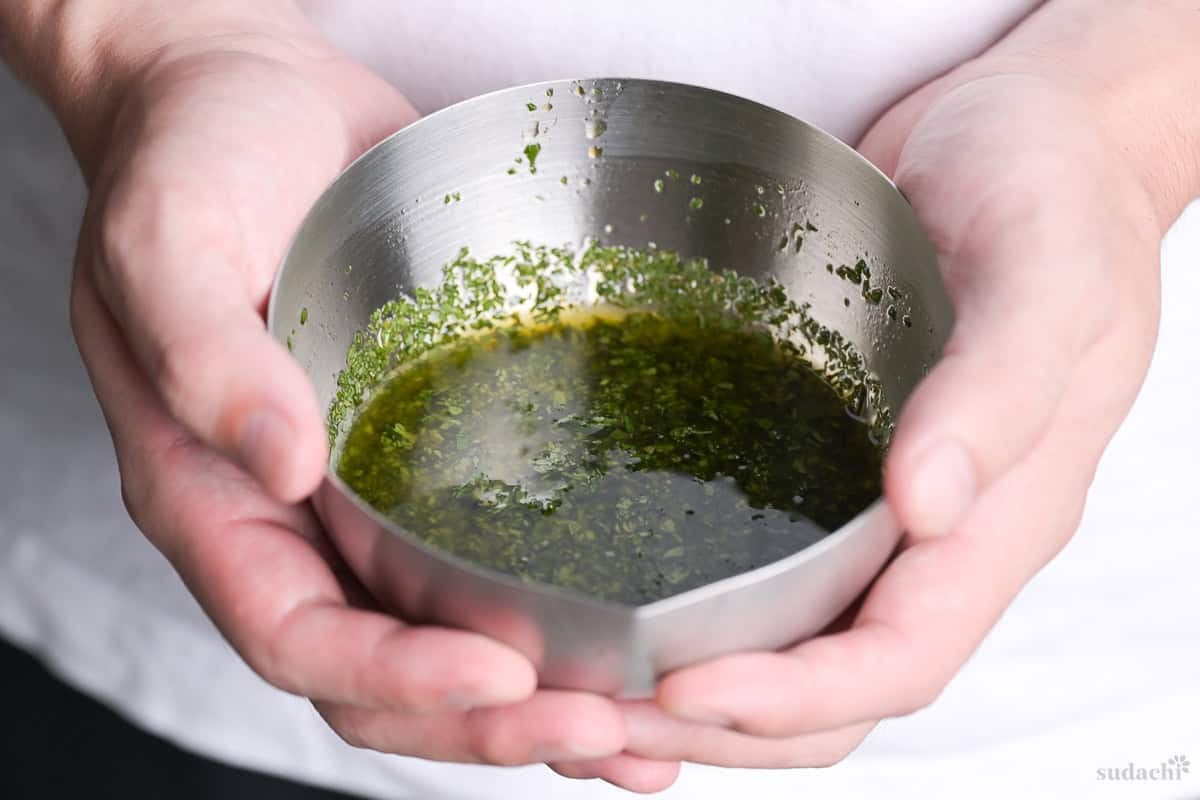
Neither the color nor the bitter edge comes back out, so spend this batch where both matter less, over grilled meat or stirred through a bowl of cold noodles. The cause is the processor running too long, which heats the liquid and whips air into it. Next time, run the machine in short bursts and check the condition each time.
That is the olive oil, not spoilage. Extra virgin oil clouds as it chills and starts to set before it ever looks frozen. Stand the jar on the counter for 10 minutes and shake it hard, and it pours normally again. If you want it ready straight out of the cold, build the next batch with half olive oil and half canola, so only part of the oil can stiffen. You give up some of the weight the olive oil brings, which is a real trade, but it pours.
Work in a little more oil first. Fat softens the edge of vinegar without turning the jar sweet, and it is the move most people skip because sugar is the obvious lever. Shake hard afterwards, because oil sitting on top tastes like nothing at all and will talk you into over-correcting. Only add a few grains of sugar if a gap is still there, and judge it on the food rather than off a spoon, since vinegar comes across much bigger on a spoon than it does on a salad or cold tofu.
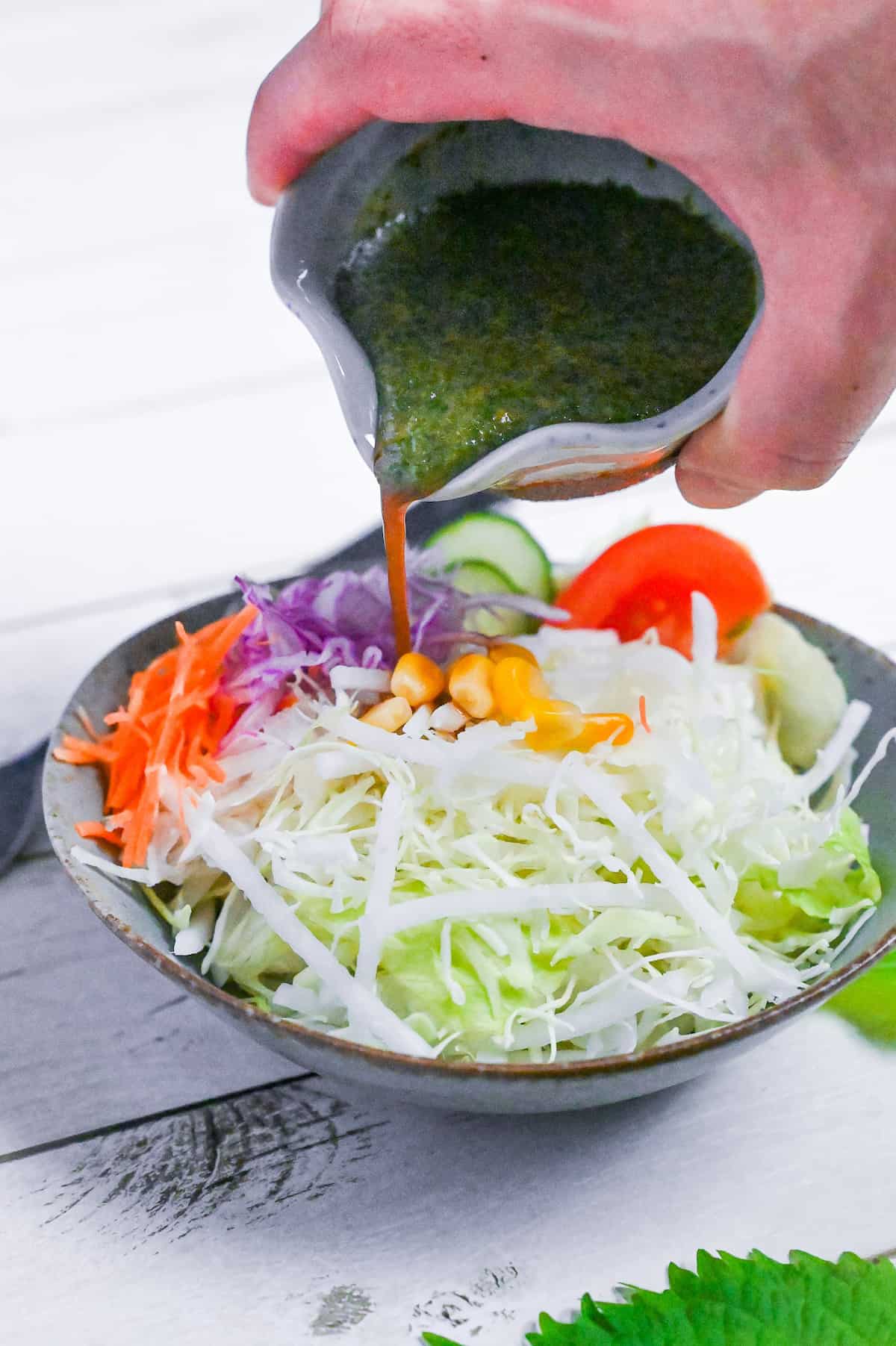
More Japanese Dressing Recipes
There is a dressing for every cold plate you put on the table in my Japanese salad dressing collection.
Did You Try This Recipe?
I would love to hear your thoughts!
💬 Leave a review and ⭐️ rating in the comments below. 📷 I also love to see your photos – submit them here!
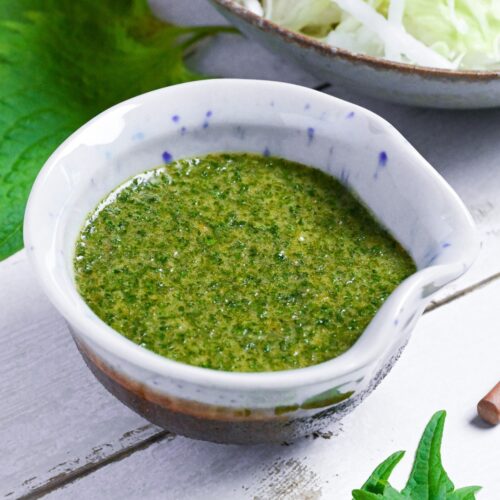
Shiso Dressing (Japanese Perilla Sauce for Salads)

Ingredients
- 1 tsp grated garlic or garlic paste
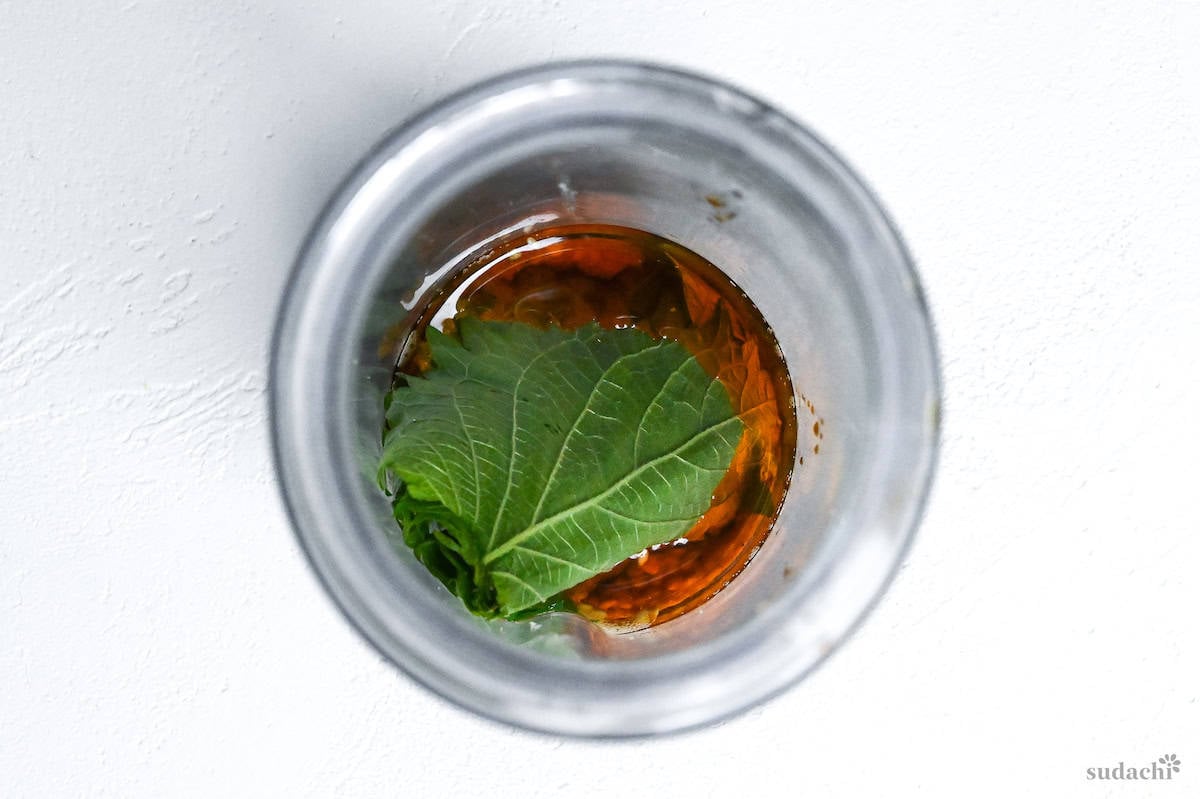
- 10 perilla leaves (shiso)
- 2 tbsp Japanese soy sauce (koikuchi shoyu)
- 2 tbsp unseasoned rice vinegar (komezu)
- 1 tbsp sugar
- 2 tbsp olive oil
The ingredient brands and tools I trust are in my Japanese pantry guide and my cooking tools guide.
Can’t find certain Japanese ingredients? See my substitution guide here.
Instructions
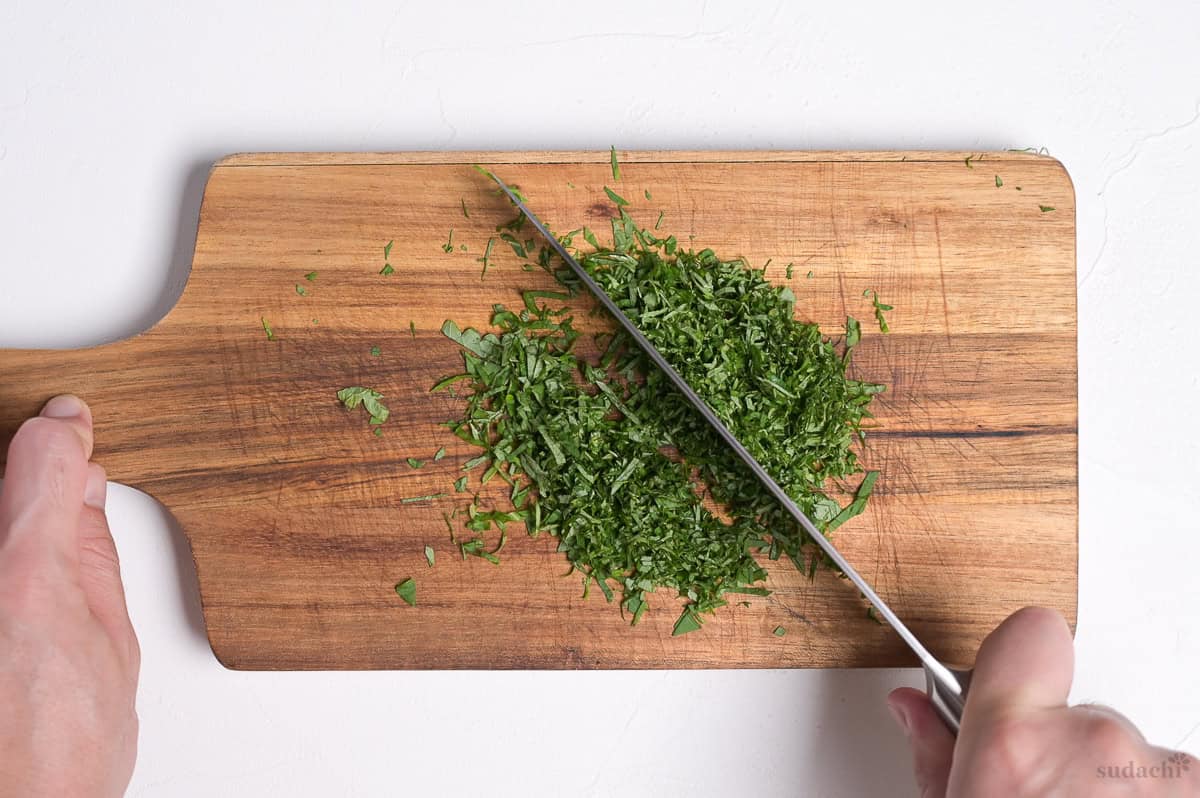
- Add all the ingredients to a small food processor and blitz until the perilla leaves are finely chopped and evenly distributed.

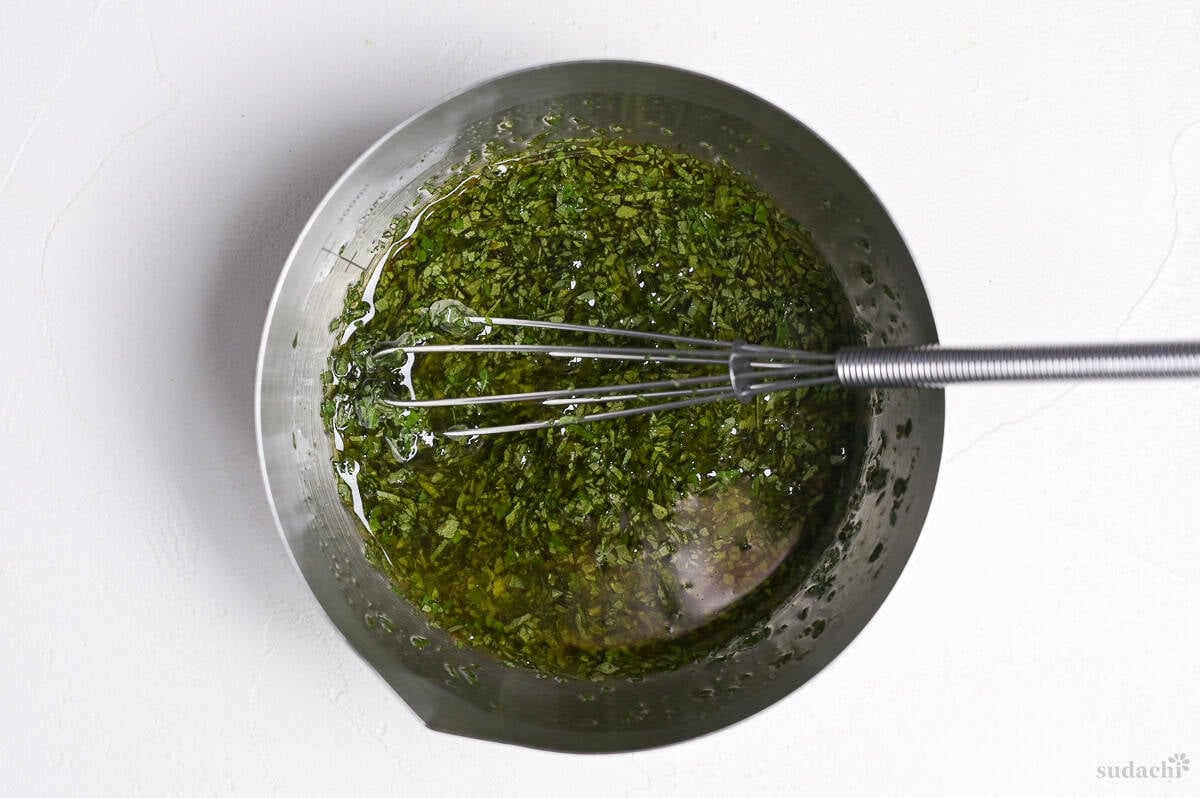
- If you are making it without a food processor, finely chop the perilla leaves (as small as possible) by hand and then add them to a bowl with the rest of the ingredients. Whisk vigorously until well combined.

- Drizzle over your favorite salad, meat or tofu. Enjoy!

My dressing was a tad darker and I needed more oil. But flavor was spectacular, I wanted to drink it. I tossed it with vermillion rice, shrimp and summer vegetables from my garden. But I think it would also be a great marinade for salmon.
Hi Casey,
Thank you for the comment and sharing your experience! I’m glad to hear that you enjoyed the recipe!
Great idea with salmon! I might try it myself next time I make this! 🙂
Yutp
An incredible recipe!!! This dressing is so tasty, when you taste test it, you want extra samples!! I made one small change: use only half the olive oil stated and added canola oil so that it’s usable directly from
the fridge (I doubled the batch for extras the next day!!) thank you so much for this recipe!!
Hi Cathy,
Thank you so much for your lovely comment! I’m happy to hear your enjoyed it! 🙂
Yuto
Always enjoining your recipes. After living in Japan I moved to the Netherlands and miss the Japanese cooking awfully. Nowadays I can find most of the ingredients so your blog comes in very handy. Thanks a million for doing this.
Hi Ewa,
Really happy to hear it! Someone who’s lived in Japan and is now cooking their way back to those flavors is exactly who I’m writing for! Hope you will enjoy more of my recipes! 🙂
Yuto