



Sawaniwan. You’ve probably never heard the name, and recipes for it in English are hard to find. Still, once you know it, I can’t imagine anyone disliking it.
A clear broth packed with thinly cut vegetables. The first sip is soft, light dashi. Yet the pork fat gives it a savory backbone, so nothing feels missing. Bite down and the vegetables answer with a tender snap.
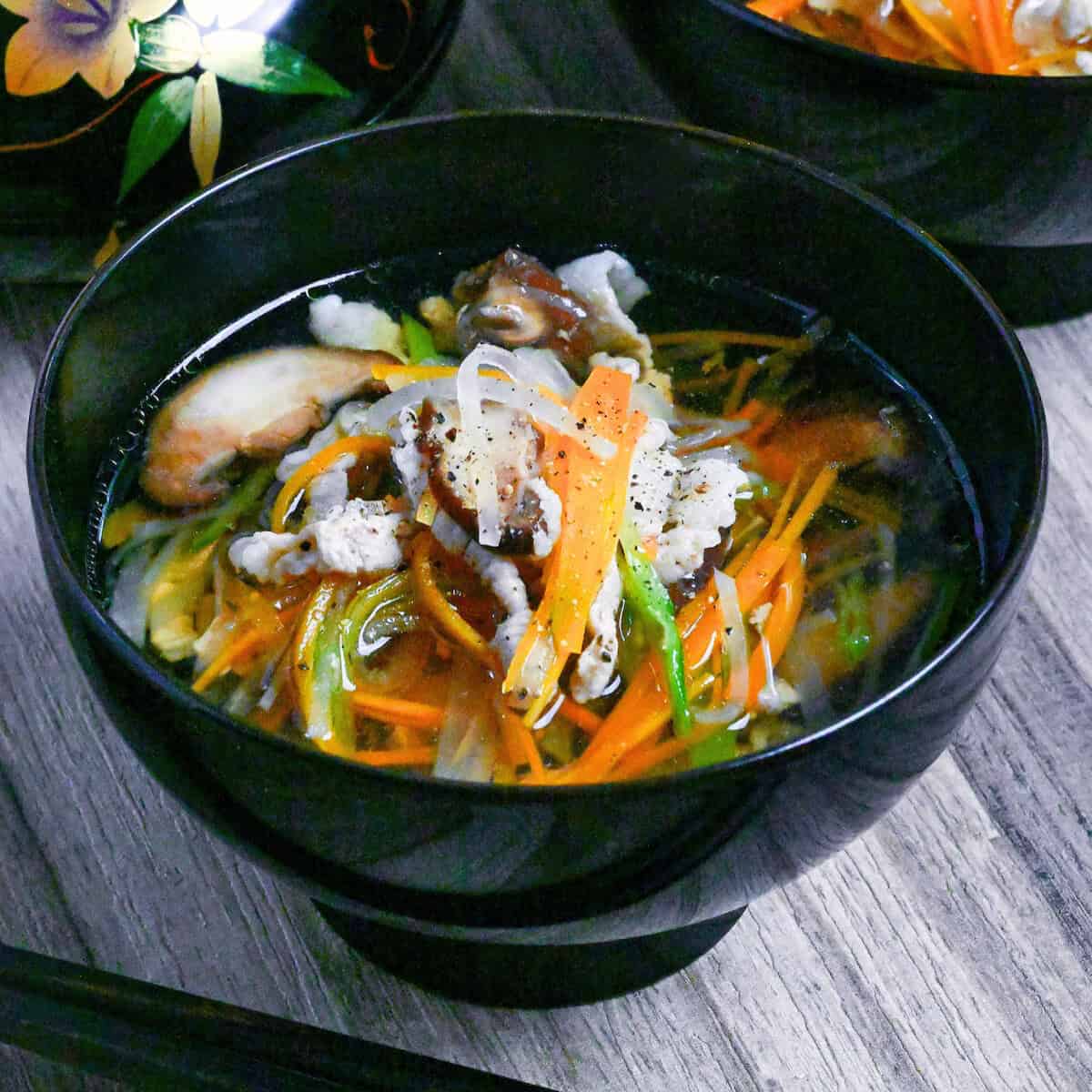
Sawaniwan
Recipe Snapshot
- What is it? Sawaniwan is a Japanese soup loaded with vegetables and pork cut into fine strips, all swimming in clear dashi. No miso goes in, which sets it apart from miso soup.
- Flavor profile: First comes the gentle aroma of pale, clear dashi. Umami from the pork belly fat follows and gives the light broth body. Bite in and the bright vegetable strips crunch.
- Why this recipe works: Everything is cut into matching thin strips, so everything cooks fast and finishes together. A 30-second blanch and cold water keep the vegetables bright and crisp in the broth.
- How to make it: One pot. Blanch the vegetables, then swap the water for dashi. Light soy sauce, mirin, pork and shiitake simmer 1 minute, the vegetables about 3 more, then pepper each bowl.
- What to expect: About 20 minutes, 5 of them at the stove. The catch is knowing when to stop. Bite a strip while still bright, and turn off the heat if it crunches.
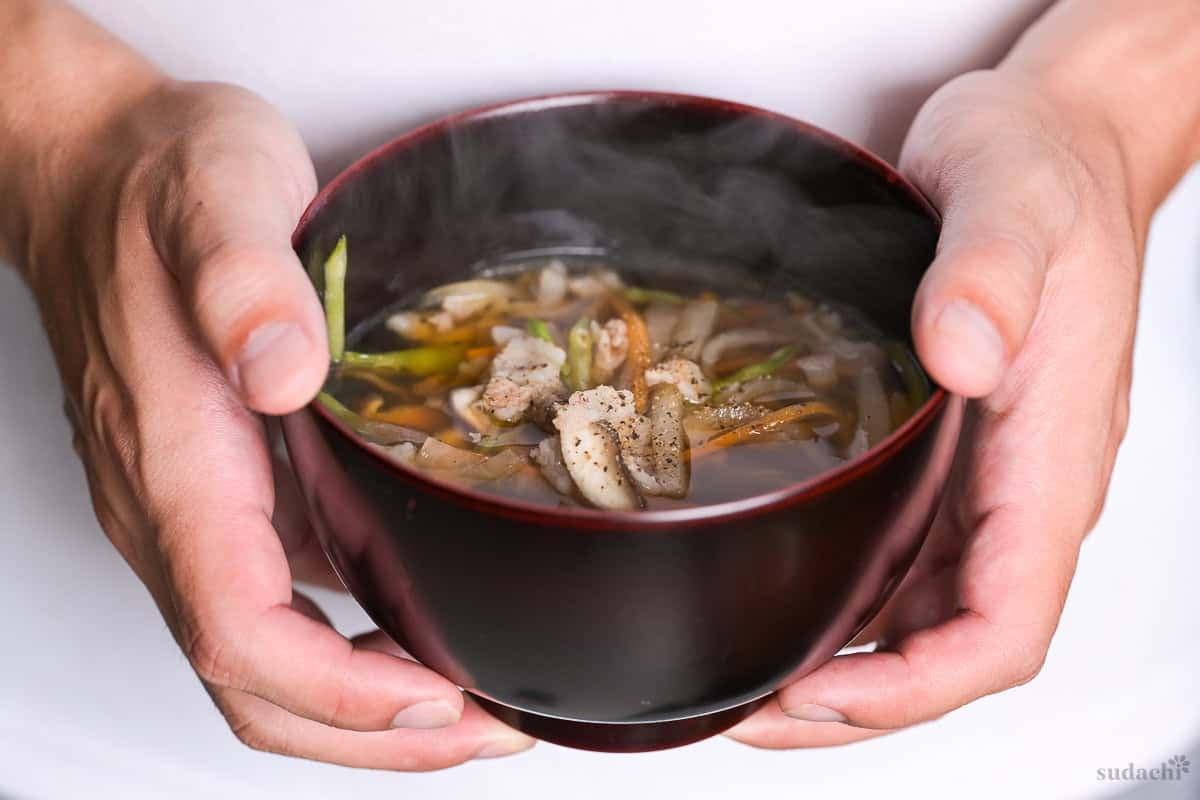
What Is Sawaniwan?
Sawaniwan (沢煮椀) is a Japanese clear soup loaded with ingredients that still drinks light. You cut the vegetables and pork thin and even, give them a quick simmer in dashi, keep the seasoning pale, and scatter black pepper on at the end.
The sawa in the name has nothing to do with a mountain stream. It means plenty here, a bowl packed with ingredients. Say Japanese soup and most people think of miso soup, or osuimono with very little in the bowl. Sawaniwan is different from both.
Sawaniwan is said to come out of Tokyo’s restaurant tradition. There is a theory that Kanda Masayoshi, a cook who had returned from Shanghai, took an idea from Chinese cooking and devised the form we know now in the early Showa years, from the end of the 1920s into the start of the 1930s. Chinese food was in fashion in Japan then, in restaurants and in home cookbooks, so the timing lines up. Folk stories tell it differently. One says hunters carried salt-cured pork or back fat into the mountains and cooked it with mountain vegetables, and that this was the start. The other says fishermen made it with salt-cured meat kept as preserved food on the boat. Neither story is backed by any record.
Pork fat with black pepper is an extremely rare pairing in traditional Japanese cooking. Clear soups that use pepper hardly show up in everyday cooking. About the only others are hamaguri wan, a clam bowl, and senba-jiru. The pepper in sawaniwan is no simmering spice. It is a suikuchi, something you add to the bowl just before eating to lift the aroma. Yuzu peel is a good classic example. Here, the pepper has been used to cut the lingering smell of the fat. That makes sawaniwan a clever dish, a traditional suikuchi idea put to work on untraditional ingredients.
Restaurant sawaniwan uses pork back fat. Salt leads the flavor, and light soy sauce is limited to adding color and aroma. My bowl steps a little away from that. I take the fat from thinly sliced pork belly, let light soy sauce and mirin carry the flavor, and add salt only at the end, and only when a taste shows there is not enough. Rather than stick to one tradition, I set the balance by what tastes best to me.
Japanese Pork and Vegetable Soup Ingredients
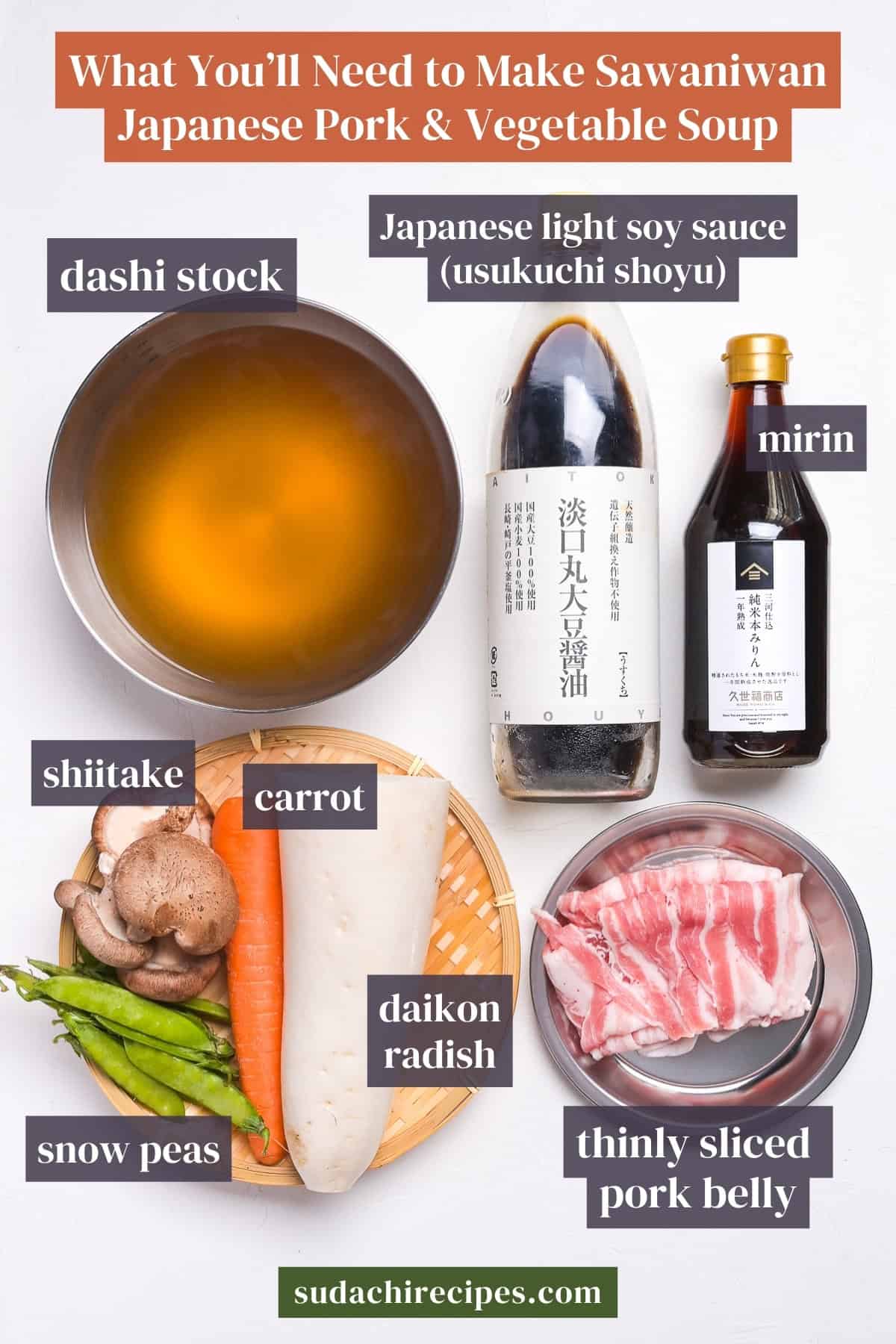
- Thinly sliced pork belly: Its fat carries umami into the dashi and deepens the light broth, so choose a cut with some fat. I think belly tastes great here. Asian grocers sell belly sliced thin for hot pot or shabu-shabu. Cut it into strips. Failing that, half-freeze a slab and slice it thin, or ask the butcher.
- Japanese light soy sauce (usukuchi shoyu): This is the backbone of the flavor, and it is also the soy sauce that keeps the color pale, so the carrot and snow peas keep their orange and green in the broth. The pale color is misleading, though. Light soy sauce runs about 18% salt, saltier than standard Japanese soy sauce. On the Japanese seasoning shelf at an Asian grocer, pick the bottle labeled light or usukuchi, and pass on any bottle marked less sodium or reduced sodium.
- Dashi stock: Dashi from packets, homemade or store-bought, is the easy route. Each packet is coarsely ground kombu and katsuobushi in a tea bag. Pork fat and mirin carry flavor too, so packets are plenty most days. Kuze Fuku is my usual store-bought pick. Save ichiban dashi, made from kombu and katsuobushi, for days you want a clearer, more fragrant bowl.
Substitution Ideas
- Light soy sauce → Standard soy sauce and salt: If you have no usukuchi soy sauce, use the same amount of standard Japanese soy sauce plus a pinch of salt. Light soy sauce is the saltier bottle, so the standard kind alone leaves the soup a little short on salt. Expect a slightly darker color and a slightly heavier soy taste.
- Pork belly → Thinly sliced pork shoulder: The closest swap is thinly sliced pork shoulder (Boston butt). It has a good balance of fat and lean meat, and it tastes a little lighter than belly, but it works just fine here.
- Pork belly → Thinly sliced pork loin: My next pick is thinly sliced pork loin. It carries less fat, so the broth comes out lighter.
Substitutions that I don’t recommend:
- Less-sodium soy sauce instead of light soy sauce: Less-sodium soy sauce is a different product from Japanese light soy sauce. It matches neither the color nor the salt, and the balance of pale color and flavor is thrown off.
- Unblanched lean meat simmered long instead of pork belly: Here the pork is cut into thin strips and simmers only briefly. Put in lean meat without blanching it and let it simmer a long time, and you lose both the clear broth and the gentle richness of the fat.
How to Make My Japanese Vegetable Soup
If you prefer to watch the process in action, check out my YouTube video of this recipe for a complete visual walkthrough!

Before you start (Mise en place):
- Cut the carrot and daikon radish into thin strips of matching length and width. Matched strips all cook through together, and fast.
- Cut the snow peas into strips about as thin as the carrot.
- Thinly slice the shiitake.
- Cut the pork belly into thin strips.

i. Bring plenty of water to a boil in a pot, and set a bowl of cold water next to the stove.
ii. Once the water is at a rolling boil, add the carrot, daikon and snow peas and blanch for 30 seconds.

iii. Drain them in a colander, drop them straight into the cold water, and pour the hot water out of the pot.

The vegetables are not meant to cook through here. They get about 3 more minutes back in the broth later, so these 30 seconds only need to cook the surface. Straight into cold water, the carrot stays orange, the snow peas stay green, and every strip keeps its crisp bite.
i. Pour the dashi into the same pot and bring it to a boil.
ii. Turn the heat to low, add the light soy sauce, mirin, pork and shiitake, and simmer for 1 minute, skimming off the scum if there is a lot.
iii. Drain the vegetables from the cold water, return them to the pot and simmer for about 3 minutes.

Before the carrot and snow peas lose their bright color, taste a strip. If it still has a crisp bite and the pork is cooked through, turn off the heat.
The pork gets that 1 minute before the vegetables go back in all to itself. In that time the savory fat of the belly melts into the dashi, and the light broth gains depth.

i. Taste the soup, and if it needs more salt, add a little at a time.
ii. Divide the broth, vegetables and pork evenly among the bowls.
iii. Sprinkle black pepper over each bowl and serve.

The pepper never boils in the pot, where its aroma would cook off. Sprinkled over each bowl, it keeps its sharp, spicy aroma and gives the gentle broth a clean, crisp finish.

Tips for the Best Sawaniwan
- Match the length of every strip, as well as the thickness. When the cuts vary, the same simmer leaves raw-tasting bits and overly soft bits floating in one bowl. Even strips are all done at once after a short simmer. Cut the snow peas to the carrot’s length too, and each pickup with your chopsticks gets a little of everything.
- Keep the soup at a gentle simmer once the light soy sauce is in. It goes in after you turn the dashi down to low, and from there the pot should only bubble softly. Let it boil hard and the clean taste of the dashi goes dull.
- Decide on salt only after the vegetables are back in the pot. The water still on the vegetables thins the broth a little. Light soy sauce alone is often enough, so add salt only if a taste tells you it needs some.
Cut the strips to match, keep the heat low and leave the salt to the last taste, and this pale soup comes out the same every time.
Storage & Meal Prep
Fridge: Chill fast in a shallow container and eat by tomorrow. Snow peas dull overnight.
Freezer: Freeze single portions flat for 3 to 4 weeks, snow peas removed. Strips soften slightly.
Meal prep: Cut carrot and shiitake a few hours ahead and chill covered. Cut snow peas last.
Reheating: Gently simmer your portion through, salt to taste, pepper the bowl. Repeated whole-pot reheats cloud the broth and kill the crunch.
What to Serve With Japanese Pork and Vegetable Soup
- Salt-Grilled Mackerel (Saba no Shioyaki)
- Perfect Japanese Rice
- Spinach Ohitashi
- Ginger Cucumber Tsukemono
Sawaniwan Troubleshooting
Salt added before tasting piles on top of the salt already in the light soy sauce, and together they come on too strong. Thin it with dashi, a little at a time. Taste a sip after each pour until the balance comes back.
If the salt is right and the finish still falls flat, the pot boiled hard after the vegetables went back in, and the lively aroma of the dashi cooked off. Once the soup is in the bowls, add just a few drops of light soy sauce and a sprinkle of black pepper, and the flavor snaps back into focus.
The 30-second blanch reaches only the outside of each strip. Turn off the heat before the vegetables have had their roughly 3 minutes back in the broth, and the centers stay raw. Simmer about 1 minute more, then bite into a strip again.
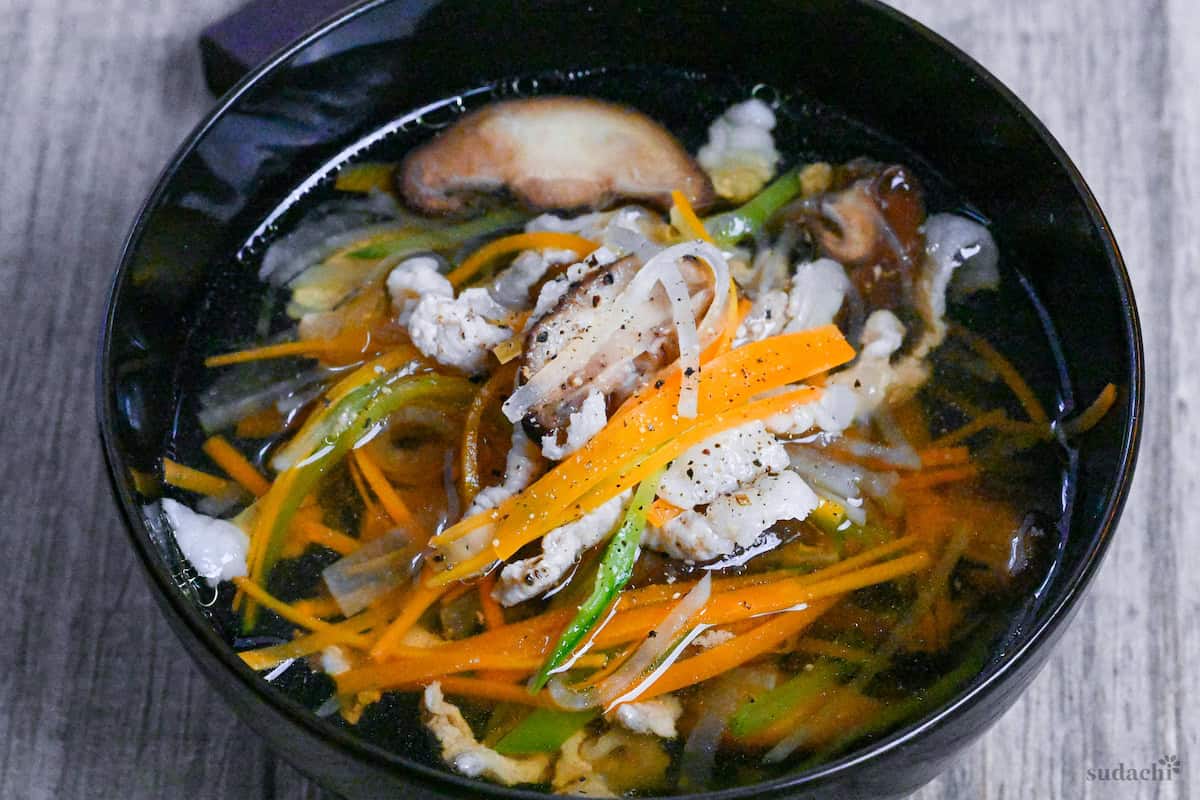
More Thinly Sliced Pork Recipes
- Kasu Jiru Sake Lees Soup
- Mille Feuille Nabe Pork and Napa Cabbage Hot Pot
- Tanmen Vegetable Ramen
- Mizore Nabe Grated Daikon Hot Pot
Whatever is left in that pack of thinly sliced pork can go anywhere from a sake lees soup to a layered napa cabbage hot pot in my Thinly Sliced Pork Recipes.
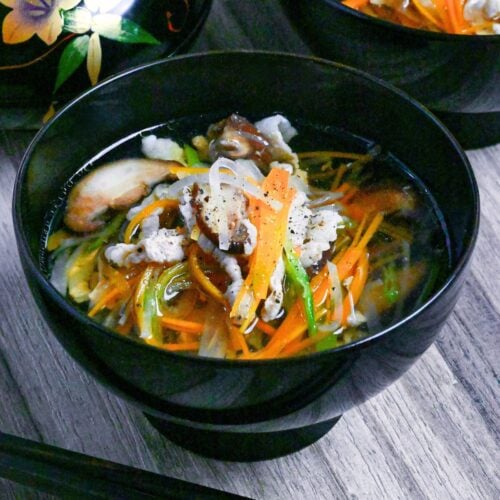
Japanese Vegetable and Pork Soup (Sawaniwan)

Ingredients
- ½ carrot julienned
- ⅛ daikon radish julienned
- 10 snow peas julienned
- 4 fresh shiitake mushroom thinly sliced
- 150 g thinly sliced pork belly cut into thin strips
- 850 ml dashi stock
- 4 tbsp Japanese light soy sauce (usukuchi shoyu)
- 4 tbsp mirin
- salt to taste (if necessary)
- ground black pepper garnish
The ingredient brands and tools I trust are in my Japanese pantry guide and my cooking tools guide.
Can’t find certain Japanese ingredients? See my substitution guide here.
Instructions
- Bring a large pot of water to a rolling boil. While you wait, julienne ½ carrot, ⅛ daikon radish, and 10 snow peas, thinly slice 4 fresh shiitake mushroom and cut 150 g thinly sliced pork belly into strips.

- Prepare a bowl of cold water and set it by the stove. Once the water is boiling, add the carrot, daikon and snow peas to a pot and blanch for 30 seconds.
- Transfer the vegetables to the bowl of cold water and dump the water from the cooking pot.
- Reuse the pot, add 850 ml dashi stock and bring to a boil. Reduce to simmer, add 4 tbsp Japanese light soy sauce (usukuchi shoyu), 4 tbsp mirin, the pork belly, the mushrooms, and cook for 1 minute. Drain the julliened vegetables and add them to the pot. Simmer for about 3 minutes or until the pork is cooked through and the vegetables are softened to your liking.
- Taste the soup and add salt to taste if needed. Divide into serving bowls and sprinkle with ground black pepper. Enjoy!

Leave a rating and a comment