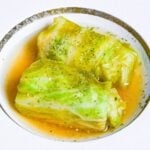
Japanese Cabbage Rolls (Roru Kyabetsu)
Ingredients
- 12 leaves green cabbage large outer leaves, or napa/savoy/cornhead
- 24 slices thinly sliced pork belly shabu-shabu cut, or thin-sliced pork shoulder
- ground black pepper coarse
- 1 tbsp potato starch (katakuriko) for slurry, or cornstarch
- 1 tbsp water for slurry
- dried parsley
Broth
- 500 ml dashi stock or dashi packet
- 2 tbsp sake
- 1 ½ tbsp Japanese light soy sauce (usukuchi shoyu) or regular soy sauce
- 1 tbsp mirin
- ½ tbsp light brown sugar
- 1 tsp salt
- 1 tsp grated ginger or ginger paste
- 1 tsp grated garlic or garlic paste
Instructions
- Bring a large pot of water to a rolling boil and blanch 12 leaves green cabbage for 1 minute. Drain the water and rest until cool enough to touch.

- While the cabbage leaves cool, add the broth ingredients to a saucepan (500 ml dashi stock, 2 tbsp sake, 1 ½ tbsp Japanese light soy sauce (usukuchi shoyu), 1 tbsp mirin, ½ tbsp light brown sugar, 1 tsp salt, 1 tsp grated ginger, and 1 tsp grated garlic) and heat over medium until almost boiling. Turn off the heat and set aside for later.

- Lay the cooled cabbage leaves out on a chopping board and cut out the thickest part of the stem.

- Sprinkle 24 slices thinly sliced pork belly with ground black pepper on both sides and lay two slices on each cabbage leaf.

- Fold two parallel edges of the cabbage leaf over the pork slices.

- Starting from the bottom stem, tightly roll the cabbage and pork upwards to create a neat package, then place them in a large pot with the seam facing down to prevent unraveling.

- Pour the prepared broth over the rolls until evenly covered.

- Place a drop lid (or a light heatproof plate) on top to stop them from moving and bring to a boil over medium heat. Once boiling, reduce the heat to low and simmer for 15 minutes.

- Carefully transfer the cooked cabbage rolls to serving plates but leave the broth in the pot. Mix 1 tbsp potato starch (katakuriko) and 1 tbsp water together in a small bowl to make a slurry, then pour it into the broth and continue to cook until glossy and slightly thickened.

- Pour the thickened sauce over the cabbage rolls and sprinkle with dried parsley. Enjoy!

Notes
I developed this recipe in a 24cm yukihira nabe, but any heavy-bottomed Dutch oven or deep sauté pan works.
A drop lid (otoshibuta) is the easiest "no-fail" insurance against rolls bouncing and opening. A make-shift parchment-paper drop lid or light, heatproof plate works if you don't own one.
The 1-minute blanch is non-negotiable. Blanching softens the cabbage's pectin to make the leaves pliable. Skipping this step leads to brittle leaves that crack and tear during the assembly process.
For richer flavor, sear the rolls in a thin film of oil until golden before simmering.
If the broth feels thin after cooking, reduce it over medium heat for 2-3 minutes to concentrate the savory-sweet balance before adding the starch slurry.
Meal prep: You can blanch and trim the leaves up to 1 day ahead and refrigerate in a sealed bag. For maximum convenience, assemble rolls and freeze them raw, then simmer from frozen and add about 10 extra minutes to the cooking time.
Serving ideas: Spinach Ohitashi, Hiyayakko, Cucumber Tsukemono, Kinpira Gobo
Full Recipe QR Code↑↑